LZ X-Ray, Ia Drang Valley, South Vietnam · 14 November 1965 · 1st Battalion, 7th Cavalry
We Were Soldiers
About 450 cavalrymen dropped by helicopter into a jungle clearing. Some 1,600 North Vietnamese regulars waited on the mountain above. For three days, the Americans held.

The moment · Afternoon · 14 November 1965
Medevac ships will not land on a hot landing zone. Bruce Crandall asks for volunteers, and Ed Freeman steps up. Two unarmed Hueys drop into X-Ray under fire, unload ammunition and water, load the wounded and lift out. Then they turn around and do it again.
In 1965 the Army built a new kind of division around the helicopter. It had never been tested against an enemy army. On 14 November, Lt. Col. Hal Moore flew his 1st Battalion, 7th Cavalry into a small clearing in the Ia Drang Valley called X-Ray. On the mountain above it, unseen, about 1,600 North Vietnamese regulars were waiting for a fight.
First boots on the ground
Artillery from LZ Falcon pounds the clearing for twenty minutes. Then sixteen Hueys of Maj. Bruce Crandall’s Company A, 229th Assault Helicopter Battalion, sweep in at treetop level with their door gunners firing. Hal Moore jumps out with the first troopers of Bravo Company. The elephant grass stands five feet high, and anthills taller than a man dot the clearing. The Hueys turn back to Plei Me for the next load.
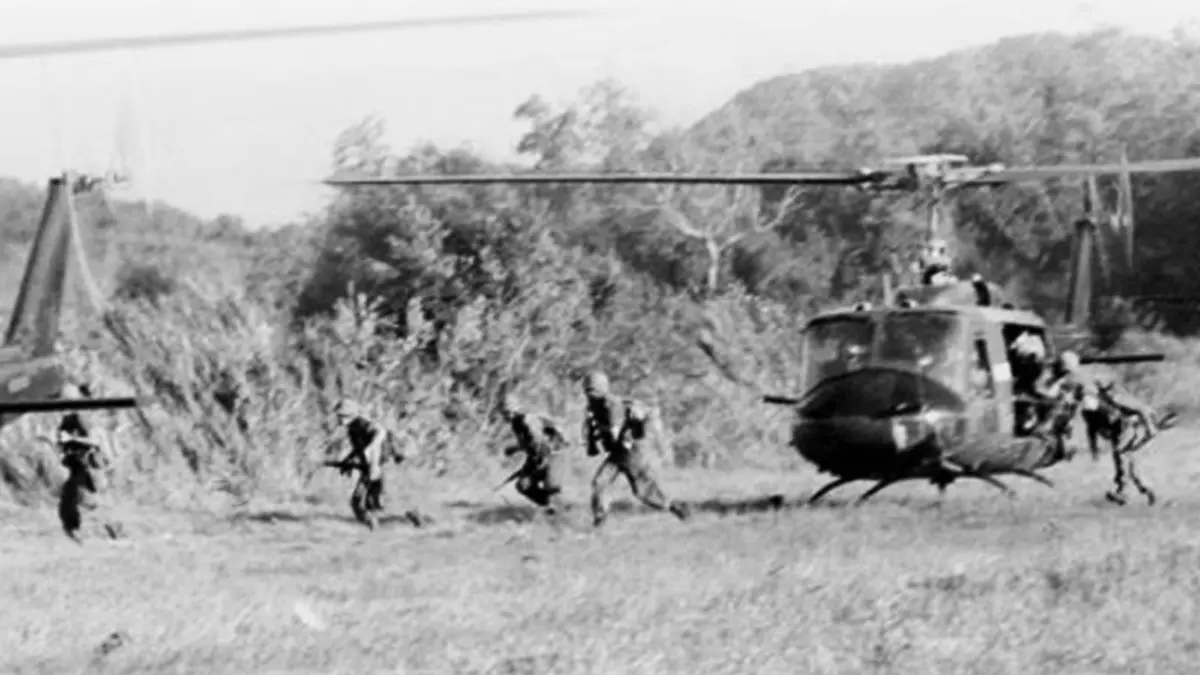
Troopers of the 1st Cavalry Division run from their Hueys into the elephant grass in the Ia Drang Valley, November 1965.. U.S. Army photo / Department of Defense. Three battalions on the mountain
A patrol brings in a North Vietnamese prisoner. Through an interpreter he tells Moore that three battalions are on the mountain above the clearing, and they want to fight. Moore sends Capt. John Herren’s Bravo Company to search the slopes. At about 12:45 the shooting starts. Lt. Henry Herrick’s 2nd Platoon chases a group of enemy soldiers, runs into far more of them, and is cut off.
Wave off
The fifth lift comes in under fire. Eight Hueys get down and unload most of Charlie Company, and Moore waves off the other eight. Minutes later about 200 North Vietnamese charge out of the trees from the southwest. Capt. Robert Edwards’ Charlie Company is ready for them. Rifles, machine guns, artillery and air strikes tear into the attack, and by 16:15 the enemy falls back.
Unarmed, into the fire
Army medevac crews may not land on a landing zone under fire. Crandall decides his own crews will. He moves his base forward to LZ Falcon to cut the flying time and asks for volunteers. His friend of ten years, Capt. Ed Freeman, steps up at once. Their unarmed Hueys land in the middle of the shooting, unload ammunition and water, and carry out the wounded. Crandall makes 22 flights that day, most of them under fire.
Marm’s charge
Moore sends two companies to break through to Herrick’s men. They run into North Vietnamese firing from anthills and trees. A hidden machine gun stops Lt. Joe Marm’s platoon. Marm stands up to draw its fire and hits it with an antitank rocket. It keeps firing, so he sprints 30 meters across open ground, throws grenades and kills the rest of the crew with his rifle. He is shot in the face. At 17:40 Moore calls off the attack.
The lost platoon
Herrick is dead. So is his platoon sergeant, Carl Palmer. Sgt. Ernie Savage, a squad leader, takes the radio and rings the tiny perimeter with artillery, some shells bursting 20 meters out. The medic, Spec. 5 Charles Lose, runs out of bandages and stops the bleeding with C-ration toilet paper. Bugles sound in the dark. Three times the North Vietnamese come at the platoon. Three times Savage’s men throw them back.
Broken Arrow
At first light about a thousand North Vietnamese hit X-Ray from three sides. In Charlie Company’s foxholes the fighting goes hand to hand. At 07:55 Moore orders every unit to throw colored smoke to mark the perimeter. The battalion’s Air Force forward air controller sends the code for an American unit about to be overrun, and fighter-bombers from all over South Vietnam head for X-Ray. By 09:41 the attack is broken.
Code words from the battalion’s forward air controllerBroken Arrow.
The platoon comes home
Lt. Col. Robert Tully’s 2nd Battalion, 5th Cavalry marches in overland, and a three-company force sets out for Savage’s knoll. It gets there without a fight. Savage’s men have held for about 26 hours, and not one more of them has been hit since he took command. Every man still has ammunition. At 16:00, eighteen B-52s bomb the Chu Pong massif above the battlefield.
The last attack
In the dark the North Vietnamese try again, four times, against Capt. Myron Diduryk’s fresh Bravo Company, 2nd Battalion, 7th Cavalry. Artillery and rifle fire stop every assault, and Diduryk has six men wounded. At 06:55 Moore orders every man on the line to fire into the trees, and hidden snipers drop out of them. At 11:55 the battalion starts to fly out. By 15:00 the last of Moore’s men are gone.
The men of X-Ray

West Point, 1945, and a company commander in Korea. At X-Ray he jumped from the lead Huey, ran the fight from the clearing for three days and turned down a summons to brief headquarters in Saigon before it was over. Distinguished Service Cross.

Call sign Ancient Serpent 6. A former Army mapping pilot, he led the sixteen Hueys that carried Moore’s battalion in. When medevac ships would not land, he flew in anyway: 22 flights in an unarmed Huey on 14 November. Medal of Honor, 2007.

Nicknamed “Too Tall” at six foot four. Second in command of Crandall’s sixteen-ship unit, he volunteered to fly with him into the fire. He flew 14 rescue missions into X-Ray and carried out an estimated 30 seriously wounded men. Medal of Honor, 2001.

Led his platoon toward Herrick’s cut-off men until a machine gun pinned them down. He drew its fire, hit it with a rocket, then charged 30 meters alone and wiped out the crew. Shot in the face, he lived. Medal of Honor, 1966.
By the numbers
In pictures


Watch, listen, see
Films, photographs and first-hand accounts from across the web. Each opens in a new tab.

Medal of Honor pilot Bruce Crandall tells how he flew an unarmed Huey into LZ X-Ray again and again.
American Veterans Center
The story of Lt. Joe Marm’s one-man charge on an enemy machine gun at Ia Drang.
The American LegionVideo interview with Clyde “Ernie” Savage, the sergeant who held the cut-off platoon through the night.
Library of Congress Veterans History ProjectVideo interview with Medal of Honor recipient Walter Joseph Marm, recorded for the Medal of Honor Foundation.
Library of Congress Veterans History Project
President Bush’s remarks presenting the Medal of Honor to Ed Freeman in the East Room, 16 July 2001.
George W. Bush White House ArchivesThe full citation: 14 rescue missions into X-Ray and an estimated 30 seriously wounded flown out.
Congressional Medal of Honor SocietyThe Army museum’s biography of Hal Moore, from West Point to Ia Drang and beyond.
National Museum of the United States Army
Seven Firefights in Vietnam (1970) tells the fight at X-Ray hour by hour from Army records and interviews.
U.S. Army Center of Military History“The man at the controls flew through the gunfire not once, not 10 times, but at least 21 times. That single helicopter brought the water, ammunition and supplies that saved many lives on the ground.”
President George W. Bush, presenting the Medal of Honor to Ed Freeman, 16 July 2001
After
Hal Moore received the Distinguished Service Cross, and so did Ernie Savage. Joe Marm received the Medal of Honor at the Pentagon on 19 December 1966. Crandall spent years pressing for Freeman’s, and on 16 July 2001 Freeman received it from President George W. Bush, the first Medal of Honor Bush presented. Crandall’s followed at the White House on 26 February 2007.
Seventy-nine Americans gave their lives at X-Ray. More than 600 North Vietnamese dead were counted on the field. It was the largest single action of the war to that point, and it proved the airmobile division could fight and win against a regular army. On 17 November, the 2nd Battalion, 7th Cavalry was ambushed on the march to nearby LZ Albany, a separate and costly fight.
Moore and Joseph Galloway, the UPI correspondent who was on the ground with the battalion and became the only civilian awarded the Bronze Star for valor in Vietnam, told the story in We Were Soldiers Once... and Young in 1992. Ed Freeman died in 2008, Hal Moore in 2017 and Bruce Crandall in 2026.
Primary sources
- John M. Carland, Stemming the Tide, May 1965 to October 1966. U.S. Army Center of Military History, 2000.
- John A. Cash, “Fight at Ia Drang, 14–16 November 1965,” in Seven Firefights in Vietnam. Office of the Chief of Military History, 1970.
- Harold G. Moore and Joseph L. Galloway, We Were Soldiers Once... and Young. Random House, 1992.