Paris to New Orleans · 30 April 1803 · Jefferson, Livingston, Monroe
What Would You Give for the Whole?
Two American envoys went to Paris to buy one city. They signed for 828,000 square miles and doubled the size of the United States.

The moment · 11 April 1803 · Paris
Robert Livingston has spent more than a year in Paris trying to buy New Orleans. Today Talleyrand asks him whether the United States wants the whole of Louisiana. Livingston says no, only New Orleans and the Floridas. Talleyrand presses him. What would they give for the whole?
M. Talleyrand asked me this day, when pressing the subject, whether we wished to have the whole of Louisiana.Robert R. Livingston to Secretary of State James Madison
In 1803 the United States stopped at the Mississippi, and the West’s farm trade floated down that river past New Orleans to the sea. When Spain shut Americans out of the port’s warehouses, President Jefferson sent James Monroe to Paris to buy the city. Monroe and Robert Livingston signed a deal that doubled the size of the country instead.
All eyes, all hopes
In October 1802 Spain’s intendant at New Orleans ends the American right to store goods there for shipment overseas, and the West is in an uproar. Louisiana, meanwhile, has passed in secret from Spain to Napoleon’s France. Jefferson asks his friend James Monroe, a former governor of Virginia, to join Minister Robert Livingston in Paris. Congress sets aside $2 million. The envoys may offer up to $10 million for New Orleans and the Floridas.
Jefferson to Monroe, 13 January 1803All eyes, all hopes, are now fixed on you … for on the event of this mission depends the future destinies of this republic.
Monroe sails
Monroe boards the Richmond in New York Harbor with his wife and two daughters. The crossing takes a month, and he lands at Le Havre on 8 April. In Paris, Livingston has been pressing the French since December 1801 and getting nowhere. But Napoleon’s army in Saint-Domingue has been destroyed by war and yellow fever, and a new war with Britain is coming. The First Consul decides he cannot hold Louisiana.
The whole of Louisiana
Napoleon has made up his mind to sell all of it. Foreign Minister Talleyrand asks Livingston whether America wants the whole territory. Livingston says no, only New Orleans and the Floridas. Talleyrand says that once France gives up New Orleans, the rest is worth little to her, and asks what they would give for the whole. Livingston names 20 million francs if American claims are paid. Too low, says Talleyrand. Think it over. Monroe reaches Paris the next day.
Eighty million francs
Napoleon hands the sale to his treasury minister, François Barbé-Marbois, who meets Livingston that day. Monroe joins the talks. The Americans have no orders for a deal this size, and Monroe’s own crossing took a month, so asking Washington is out. They decide to buy. They settle on 80 million francs: 60 million to France, and 20 million to pay the debts France owes American citizens.
The treaty
The treaty of cession and two conventions, one for the 60 million francs and one for the claims, are dated 30 April. Translating them takes days, so Livingston, Monroe and Barbé-Marbois sign in the first days of May. When they finish, the three men stand and shake hands. For under three cents an acre, the United States has bought the land from the Mississippi to the Rocky Mountains.
Livingston, after the signingFrom this day the United States take their place among the powers of the first rank.
News for Independence Day
Word of the treaty reaches Jefferson on 3 July, and on the nation’s 27th birthday the news is public. Jefferson had doubted that the Constitution allowed the country to buy land. Treasury Secretary Albert Gallatin had argued in January that the power to make treaties covered it. On 16 July Jefferson calls Congress back early, for 17 October. The treaty allows six months to exchange ratifications, and he will not miss the deadline.
A bargain once missed
Senator James Jackson of Georgia tells the Senate, “We have a bargain now in our power, which, once missed, we never shall have again.” The Senate ratifies the treaty 24 to 7, three days after Congress convenes. Ratifications are exchanged the next day. On 25 October the House votes 90 to 25 to carry the treaty into effect, and on 10 November Jefferson signs the act creating $11.25 million in stock to pay France.
The flag goes up
Twenty days after Spain handed Louisiana to France, the French prefect, Pierre Clément de Laussat, hands it to the United States. In the Sala Capitular of the Cabildo, Governor William C. C. Claiborne and Gen. James Wilkinson sign for America. Outside in the Place d’Armes, the French tricolor comes down as the Stars and Stripes goes up. The two flags pass each other on the way.
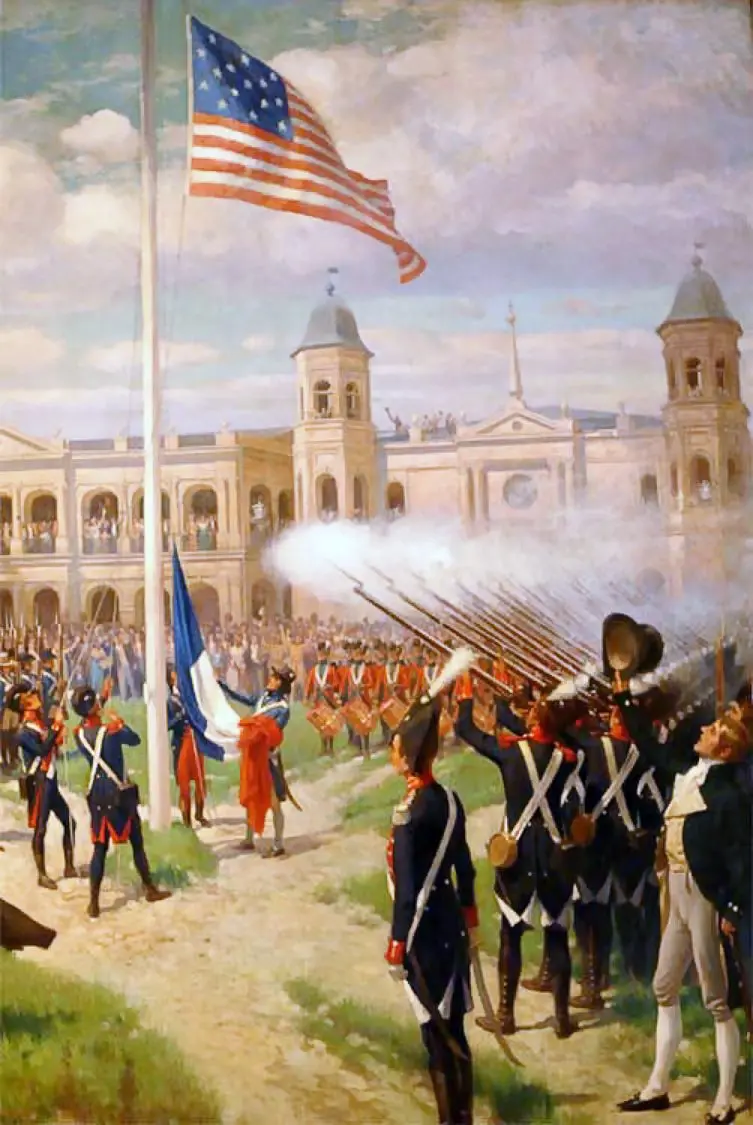
Hoisting American Colors, Louisiana Cession, 1803: Thure de Thulstrup’s 1902 painting of the flag going up in the Place d’Armes, New Orleans, on 20 December 1803.. Thure de Thulstrup / Louisiana State Museum. Three Flags Day
Upper Louisiana changes hands twice in two days. On 9 March the Spanish flag comes down over St. Louis and the French flag goes up. Army Capt. Amos Stoddard, acting for France, lets it fly for one day. On 10 March he raises the Stars and Stripes and claims Upper Louisiana for the United States. Capt. Meriwether Lewis is there to see it. Two months later, he and William Clark start up the Missouri.
The dealmakers

Author of the Declaration of Independence and third president. When Spain closed New Orleans to American goods, he sent Monroe to Paris, saying the republic’s future rode on the mission. Offered the whole territory, he took it and got it ratified fast.

New York’s chancellor and a member of the committee that drafted the Declaration. On 30 April 1789 he swore in George Washington as president. He drew Talleyrand’s offer of the whole territory, and the treaty he negotiated is dated fourteen years later to the day.

Continental Army lieutenant wounded at Trenton in 1776, then senator, minister to France and governor of Virginia. He reached Paris the day after Talleyrand’s offer and, with Livingston, bought far more than his orders allowed. Later the fifth president.

Born in Geneva, he came to America at 19 and served as Treasury secretary longer than anyone. In January 1803 he gave Jefferson the legal case for buying territory by treaty. His Treasury issued the $11.25 million in 6 percent stock that paid France.
By the numbers
In pictures


Watch, listen, see
Films, photographs and first-hand accounts from across the web. Each opens in a new tab.

From the middle of an Arkansas swamp, Charles Kuralt tells the story of the unexpected, astonishingly cheap deal. Aired 1976.
CBS Sunday Morning
The original Louisiana Purchase documents go on display at Louisiana’s Old State Capitol in Baton Rouge, 2026.
Louisiana Public Broadcasting
A virtual tour of the building on Jackson Square where Louisiana became American on 20 December 1803.
Louisiana State MuseumThe Louisiana Purchase Treaty of 30 April 1803, with a full transcript and images of the original.
National Archives
How the Senate ratified the Louisiana Purchase Treaty, 24 to 7, on 20 October 1803.
U.S. Senate
The day-by-day record of how Congress ratified, paid for and took possession of Louisiana.
Library of Congress
Barbé-Marbois’s 1830 history of the cession, which records Livingston’s words at the signing. Free to read.
Internet Archive
Prologue magazine’s account of the offer, the bargaining in Paris, ratification and the transfer at New Orleans.
National Archives“We have lived long, but this is the noblest work of our whole lives.”
Robert R. Livingston, on signing the treaty in Paris, 1803, as recorded by François Barbé-Marbois
After
In October 1803 Jefferson told Congress the new land promised “an ample provision for our posterity, and a wide-spread field for the blessings of freedom and equal laws.” From it came all or part of 15 states. Louisiana itself entered the Union on 30 April 1812, nine years to the day after the date on the treaty.
Two months after the flag went up at St. Louis, Lewis and Clark started up the Missouri to see what the country had bought. They reached the Pacific in November 1805.
The treaty is kept at the National Archives. In St. Louis, the Gateway Arch stands over the Mississippi as the national memorial to Jefferson’s vision of a continental nation.
Primary sources
- Treaty Between the United States of America and the French Republic, 30 April 1803. National Archives.
- Robert R. Livingston to James Madison, 11 April 1803. The Papers of James Madison, Secretary of State Series, vol. 4.
- François Barbé-Marbois, The History of Louisiana, Particularly of the Cession of That Colony to the United States of America. Philadelphia, 1830.