Chalmette, Louisiana · 8 January 1815 · Jackson’s army
The Glorious Eighth of January
A British army that had beaten Napoleon marched on New Orleans. Behind a mile of mud, Andrew Jackson’s riflemen, militia and pirates cut it to pieces in half an hour.

The moment · Dawn · 8 January 1815
Fog hangs over the cane stubble at first light. A British rocket climbs from near the swamp, then a second by the river. An American gun answers at once. Gibbs’s column gives three cheers and marches in close order, straight at the Tennessee and Kentucky rifles.
In December 1814 a British army of Napoleonic veterans landed below New Orleans. Take the city, and Britain would hold the mouth of the Mississippi and the trade of half a continent. Andrew Jackson had two regiments of regulars, frontier riflemen, Louisiana militia, free men of color, Choctaw warriors and a band of pirates. He dug in behind an old millrace and dared them to come.
The pirate says no
British officers land at Barataria, the smugglers’ haven on the Gulf coast south of New Orleans, with an offer for Jean Lafitte: $30,000, land, and a captain’s commission in the Royal Navy if his men will join the invasion. Lafitte asks for time. Then he sends the British papers to Louisiana’s governor, warns him that an attack is coming, and offers his men to the United States in return for a pardon.
Old Hickory takes command
Jackson rides into New Orleans on 2 December, sick but tireless, and sets up headquarters at 106 Royal Street. On the 14th, about 1,200 British sailors and marines in armed barges overwhelm five American gunboats on Lake Borgne. The city panics. Jackson does not. He declares martial law, calls every able man to arms, orders Coffee and Carroll south at top speed, and takes Lafitte’s Baratarians as gunners.
The British are below
Coffee’s Tennesseans ride 135 miles in a little over three days and reach the city on the 20th. Carroll’s men arrive on the 22nd, drilled on flatboats on the way down the river. Early on the afternoon of the 23rd, riders gallop up Royal Street with news: the British have come through Bayou Bienvenue and are camped on the Villeré plantation, nine miles below the city. Nothing stands between them and New Orleans.
Jackson to his aidesGentlemen, the British are below. We must fight them tonight.
The night attack
About 2,000 Americans march down the river road in the winter dark: regulars, Marines, the Orleans battalion, Daquin’s free men of color, Choctaw warriors and Coffee’s riflemen. At 19:30 the schooner Carolina opens fire on the British campfires from the river. Jackson attacks along the levee while Coffee’s Tennesseans sweep through the enemy camp, fighting hand to hand. The British, who expected an easy march into the city, halt and wait for reinforcements.
A wall of mud
At dawn Jackson falls back two miles to an old millrace, the Rodriguez Canal, on the narrowest strip of dry ground between the river and the swamp. His men drive fence rails into the soil and pile mud against them. The wall rises to shoulder height behind a ditch 10 to 20 feet wide. That same day, nearly 5,000 miles away in Ghent, diplomats sign a peace treaty. No one in Louisiana will hear of it for weeks.
The pirates’ guns
New Year’s morning, fog. Behind the line, troops in their best uniforms are dressing for a parade when British batteries open fire. Jackson’s gunners answer, Dominique You and the Baratarians among them. Their aim is better. British guns sheltered behind barrels of sugar are knocked out, and by 13:00 they fall silent. Pakenham decides to wait for reinforcements. On 4 January, 2,250 Kentucky militiamen join Jackson. Only about 550 of them have guns.
Into the fire
Two rockets go up, and Gibbs’s column of veterans marches on the swamp end of the line, short of the ladders and cane bundles it needs to cross the ditch. Batteries 6, 7 and 8 tear gaps in its ranks. At musket range Carroll’s Tennesseans and the Kentuckians open up, three and four deep. Each man fires, steps down to reload, and the next steps up. After 25 minutes the British break. Gibbs is mortally wounded.
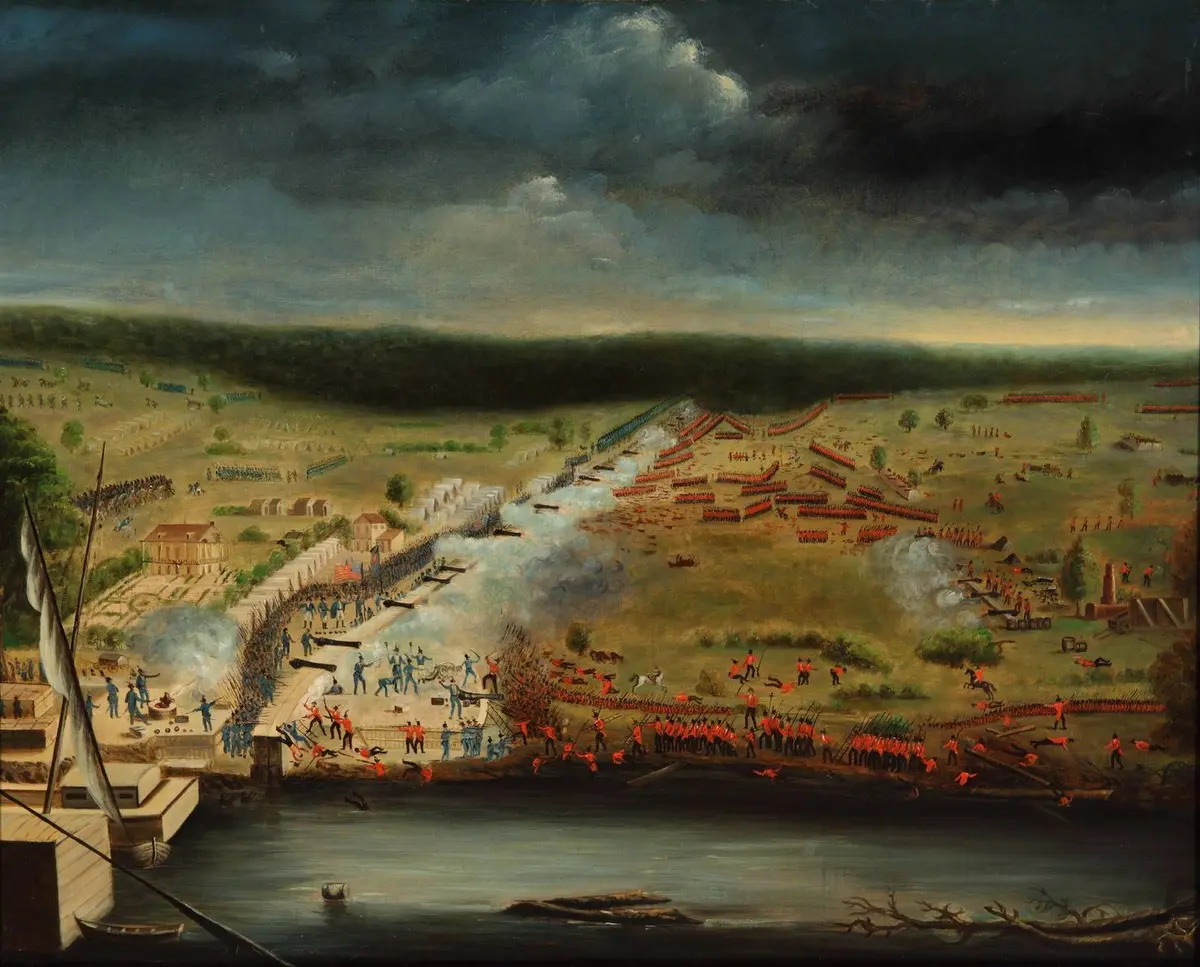
The battle as painted by Jean Hyacinthe de Laclotte, an engineer in Jackson’s army, from his sketches on the field: Line Jackson runs from the river to the swamp as the British columns attack (1815).. Jean Hyacinthe de Laclotte / New Orleans Museum of Art. Jackson’s report to the Secretary of WarFor an hour, the fire of the small arms was as incessant and severe as can be imagined.
Pakenham falls
Gen. John Keane marches the kilted 93rd Highlanders diagonally across the open field to help Gibbs. Raked by cannon and rifle fire, they lose their colonel and Keane goes down wounded. Pakenham rides forward to rally them and is shot down. By the river, Col. Robert Rennie storms the small redoubt in front of the line and climbs the rampart, where a rifle ball kills him. Gen. John Lambert, now in command, orders the army off the field.
The invaders go home
On the night of the 18th the British slip away to their boats. They leave behind 80 men too badly wounded to move, with a letter asking Jackson to care for them. On the 21st Jackson has an address read to every corps on the line. He praises Captains Dominique and Beluche, whose crews served Batteries 3 and 4, and promises that the government will hear of the Lafitte brothers’ courage and fidelity.
The defenders

Carolina frontiersman who carried messages for the Patriots at 13 and lost his mother and both brothers to the Revolution. Broke the Red Stick Creeks at Horseshoe Bend. At New Orleans he attacked the night the British landed and built the line that stopped them.

Master of the smuggling and privateering base at Barataria. He turned down a British offer of $30,000 and a captaincy, warned Louisiana, and gave Jackson his gunners and his knowledge of the bayous. President Madison pardoned the Baratarians in February 1815.

Virginia-born surveyor, married to the niece of Jackson’s wife. Won the Creek War’s first victory at Tallushatchee. Rode 135 miles in just over three days to reach New Orleans, led the flank attack on the British camp on 23 December, and held the line in the swamp.

Nashville merchant, badly wounded at Horseshoe Bend. He drilled his Tennesseans on flatboats all the way down the Mississippi. On 8 January his men held the stretch of line Gibbs’s column struck, and helped throw it back twice. Later governor of Tennessee for 12 years.
By the numbers
In pictures


Watch, listen, see
Films, photographs and first-hand accounts from across the web. Each opens in a new tab.

The park’s own account of 8 January, its key moments and tactics, with replica cannon and muskets fired.
National Park Service
A fast, clear account of Jackson’s victory and how it made him a national hero.
American Battlefield Trust · YouTube
A Chalmette Battlefield park guide explains why the British assault failed so completely.
C-SPAN American History TVJackson’s letter to Secretary of War Monroe, written the day after the battle.
American Battlefield Trust
Tennessee’s state archive tells the battle through period prints, portraits and Laclotte’s eyewitness view.
Tennessee State Library and Archives
The classic NPS account of the campaign, from Lake Borgne to the morning of 8 January.
National Park Service Historical Handbook
The peace treaty, its ratification and the documents of the war’s end, in the Library’s collections.
Library of Congress
Walk Line Jackson, the Rodriguez Canal and the Chalmette Monument, six miles from the French Quarter.
National Park Service“I cannot speak sufficiently in praise of the firmness and deliberation with which my whole line received their approach. More could not have been expected from veterans inured to war.”
Maj. Gen. Andrew Jackson to Secretary of War James Monroe, 9 January 1815
After
The British sailed away with nothing. The Treaty of Ghent had been signed on 24 December, but it took effect only when both governments ratified it, and Britain’s army had orders to fight until then. News of Jackson’s victory reached Washington on 4 February. The treaty arrived about ten days later. The Senate approved it unanimously on 16 February, and on the 17th President Madison exchanged ratifications and the war was over. On 6 February he had pardoned Lafitte’s Baratarians.
On 27 February 1815 Congress thanked Jackson and his army, most of them militia and volunteers “suddenly collected together,” and voted him a gold medal. Americans kept the Eighth of January as a national holiday for decades, alongside the Fourth of July. In 1828 the country elected the hero of New Orleans its seventh president.
Jackson returned to the field for the battle’s 25th anniversary in January 1840, and days later the cornerstone of a monument was laid there. Finished in 1908, the Chalmette Monument stands just over 100 feet tall. Today the battlefield, with Line Jackson rebuilt along the Rodriguez Canal, is part of Jean Lafitte National Historical Park and Preserve.
Primary sources
- Chalmette National Historical Park, Louisiana. National Park Service Historical Handbook Series No. 29.
- Maj. Gen. Andrew Jackson to Secretary of War James Monroe, Camp 4 miles below New Orleans, 9 January 1815.
- Chalmette Battlefield, Jean Lafitte National Historical Park and Preserve. National Park Service brochure, 2004.