Cape Cod Harbor · 11 November 1620 · The Mayflower passengers
A Civil Body Politic
Sixty-six days across the Atlantic, with no charter for the shore ahead. Before anyone landed, 41 men signed an agreement to govern themselves.

The moment · 11 November 1620 · Off Cape Cod
Sixty-six days out of Plymouth, the Mayflower stands into Cape Cod harbor. There is no charter for this coast, and some aboard say no one can command them ashore. The men gather and sign, one by one. Forty-one names. Then they confirm John Carver as governor.
Covenant and combine ourselves together into a civil body politic.The Mayflower Compact
A congregation of English Separatists had lived for more than a decade in exile in Holland. In 1620 they set out to build a life of their own in America, under a patent to settle in Virginia. The Atlantic delivered them to Cape Cod instead, outside the bounds of their patent. Before anyone went ashore, they made a law of their own.
One ship, 102 souls
The Pilgrims left Southampton in August with two ships. Twice the leaky Speedwell forced them back, first into Dartmouth, then into Plymouth from 100 leagues out at sea. They dismissed her, left part of the company behind and crowded the rest aboard the Mayflower, a ship of about 180 tons under master Christopher Jones. She sails alone with 102 passengers. All dates here are Old Style, as Bradford kept them.
The great iron screw
Fierce storms shake the ship and leave her upper decks leaking. Then one of the main beams amidships bows and cracks. The sailors mutter about turning back. Instead the passengers bring out a great iron screw they carried from Holland. It forces the beam back into place, the carpenter sets a post under it, and Jones declares the hull strong and firm under water. They sail on.
Howland holds on
Some gales blow so hard the ship cannot carry a scrap of sail and drifts for days. In one, a young man named John Howland is thrown into the sea. He catches the topsail halyards trailing overboard and holds on, several fathoms under, until the crew hauls him up and hooks him aboard. He lives to serve the colony for decades. At sea, a baby boy is born. His parents name him Oceanus.
Land
After long beating at sea they sight Cape Cod, and Bradford writes that they were not a little joyful. Their patent is for Virginia, so they turn south toward the Hudson River. Within half a day the ship is caught among dangerous shoals and roaring breakers. With the wind failing, they bear up for the Cape again and get clear before nightfall.
A civil body politic
Some of the strangers, passengers who are not of the Leiden church, are saying that ashore they will use their own liberty, since no one has power to command them outside Virginia. The leaders answer with a written agreement. Before the ship comes to anchor, 41 men sign it. They bind themselves to frame just and equal laws for the general good and promise to obey them. Then they confirm John Carver as governor.
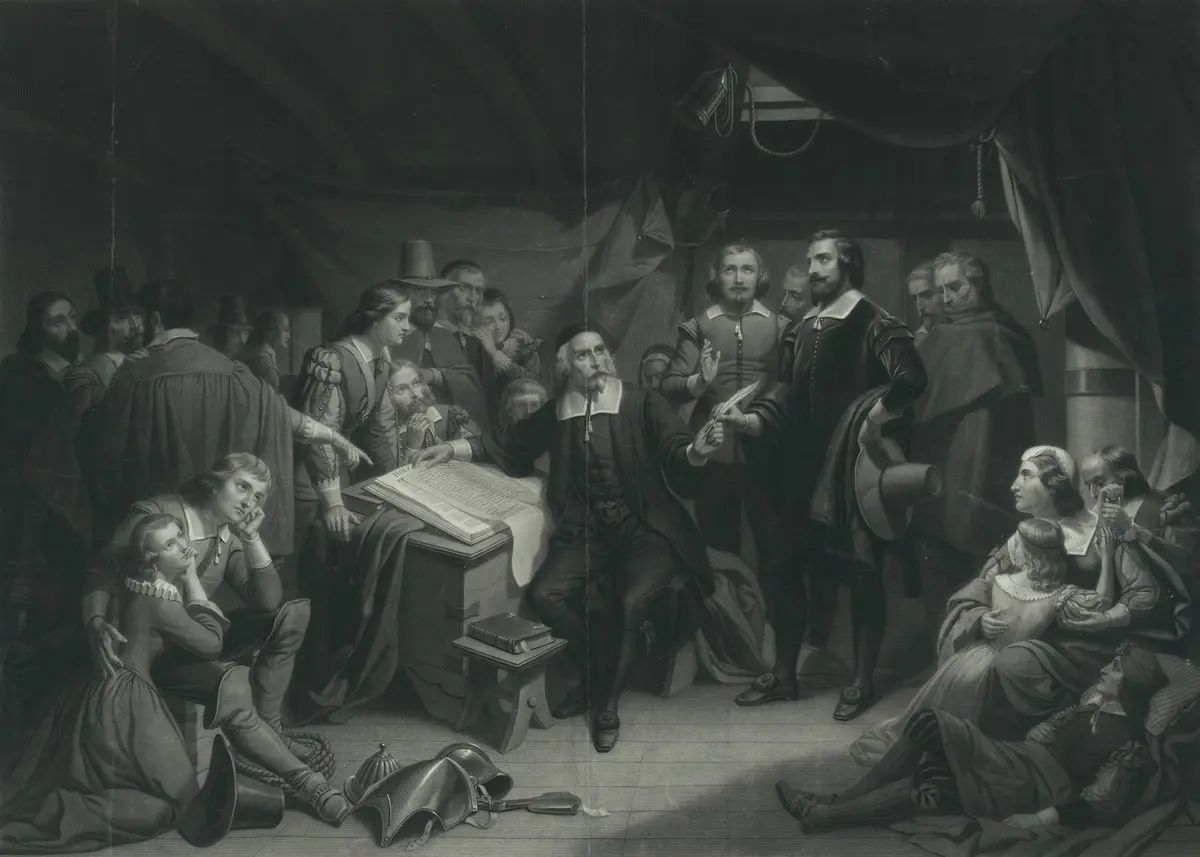
The Pilgrims signing the Compact on board the Mayflower, 11 November 1620, engraved by Gauthier in 1859 after a painting by T. H. Matteson.. Tompkins Harrison Matteson (painter), Gauthier (engraver) / Library of Congress. The Mayflower CompactWe … do by these presents solemnly and mutually in the presence of God, and one of another, covenant and combine ourselves together into a civil body politic.
Searching for a home
While the ship rides at anchor, Captain Myles Standish leads armed parties ashore to scout the Cape. A second baby, Peregrine White, is born aboard. In December an exploring party in the shallop finds a sheltered harbor with cornfields and running brooks. On 16 December the Mayflower sails in, and on 25 December the men begin building the first house at Plymouth.
Six or seven sound persons
Scurvy and sickness sweep the colony in the depth of winter. At times two or three die in a day, and by spring about half of the company is gone. At the worst, only six or seven are on their feet. They fetch wood, make fires, cook, wash and nurse everyone else, night and day. Two of them are Elder William Brewster and Captain Standish. Bradford calls it a rare example, worthy to be remembered.
Peace and a new governor
In March a Native man named Samoset walks into the settlement and greets them in broken English. Days later the great sachem Massasoit arrives with Squanto, who speaks English better still. Carver and Massasoit make a peace of mutual defense that still holds when Bradford writes of it 24 years later. Squanto stays and teaches them to plant corn. In April Carver dies, and the colony chooses William Bradford governor.
The harvest
Every family has its portion of cod and bass, and wild turkeys are in great store. With the harvest in, Governor Bradford sends four men out fowling so the colony can rejoice together. Massasoit comes with some ninety men, and for three days the colonists and the Wampanoag feast side by side. Massasoit’s hunters bring in five deer as gifts for the governor, the captain and others.
The leaders

Orphaned in Yorkshire, he joined the Separatist church as a teenager and followed it into exile in Holland. Chosen governor when Carver died in April 1621, he led Plymouth for about 30 of the next 36 years and wrote its history in his own hand.

A deacon of the Leiden church who worked from 1617 to arrange the voyage. Confirmed governor the day the Compact was signed, he carried the colony through its first winter and made the peace with Massasoit before he died in April 1621.

A Cambridge man who once served Queen Elizabeth’s secretary of state, then the Separatists’ ruling elder from 1609. In Leiden his press printed books smuggled into England, and he escaped arrest. The first winter, he was one of the few nursing the sick.

A soldier who had fought in the Low Countries, hired to defend the colony. He led the first armed scouting parties on Cape Cod, nursed the sick through the first winter, and was elected militia captain in February 1621, a post he held for life.
By the numbers
In pictures


Watch, listen, see
Films, photographs and first-hand accounts from across the web. Each opens in a new tab.

Plimoth Patuxet on the Compact and the Plymouth Colony records that document the founding of self-government at Plymouth.
Plimoth Patuxet Museums
The full-size Mayflower reproduction back under sail after a three-year restoration.
Plimoth Patuxet Museums
Newsreel of the reproduction sailing up to Plymouth Rock, escorted by small boats and greeted by crowds.
British Pathé
A lecture tracing the Compact and Plymouth’s 1636 General Fundamentals back to Magna Carta.
General Society of Mayflower DescendantsThe complete digitized Of Plimoth Plantation, with the Compact in Bradford’s own hand.
State Library of Massachusetts
The Law Library of Congress on why 41 men signed an agreement before they landed.
Library of Congress
The full text of the Compact and the names of all 41 men who signed it.
Pilgrim Hall Museum
Adams’s 1802 oration hailing the Compact as a true social compact, the only legitimate source of government.
Project Gutenberg“Thus out of small beginnings greater things have been produced by His hand that made all things of nothing, and gives being to all things that are; and as one small candle may light a thousand, so the light here kindled hath shone to many, yea in some sort to our whole nation.”
William Bradford, Of Plimoth Plantation
After
The Compact held. The colony made its own laws and chose its governor by election every year. By 1650 Bradford counted more than 160 people living who had sprung from the few who survived the first winter. Today their descendants number in the millions.
At Plymouth in 1802, John Quincy Adams called the Compact “perhaps, the only instance in human history of that positive, original social compact, which speculative philosophers have imagined as the only legitimate source of government.” In 1776 the Declaration of Independence rested all just government on that same ground: the consent of the governed.
Bradford’s manuscript vanished from Boston’s Old South Church when the British evacuated the city in 1776. It turned up in the Bishop of London’s library at Fulham in 1855 and came home to Massachusetts in 1897, where the State Library keeps it. In 1957 a full-size Mayflower II crossed from Plymouth, England, in 54 days. She still rides at Plymouth.
Primary sources
- William Bradford, Of Plimoth Plantation, manuscript, 1630–1650. State Library of Massachusetts.
- Mourt’s Relation: A Relation or Journal of the Beginning and Proceedings of the English Plantation Settled at Plimoth in New England. London, 1622.
- John Quincy Adams, Oration at Plymouth, 22 December 1802, in Commemoration of the Landing of the Pilgrims.