Salem Harbor · 12 June 1630 · The Winthrop Fleet
A City upon a Hill
Before they built a single house, John Winthrop told the settlers of Massachusetts Bay what they were building. A city on a hill, with the eyes of all people upon it.

The moment · 1630 · The Winthrop company
The company is bound for a coast few of them have ever seen. Their governor stands to speak. Be knit together as one man, he tells them. Rejoice together, mourn together, labour and suffer together. Then he tells them who will be watching.
For we must consider that we shall be as a city upon a hill. The eyes of all people are upon us.John Winthrop, A Model of Christian Charity, 1630
In 1630 about 700 English Puritans set out to build a new commonwealth on Massachusetts Bay. They carried their company’s royal charter with them, so the colony would govern itself from New England. Their governor, John Winthrop, gave them a charge for the work ahead. Live as one people, he said, and remember that the whole world will be watching.
Twelve men and a charter
Twelve gentlemen of the Massachusetts Bay Company sign an agreement at Cambridge. They will cross the ocean with their families by the first of March, on one condition: the company’s royal charter and its government must go with them. The company agrees. In October it elects John Winthrop, a 41-year-old Suffolk lawyer and lord of Groton manor, as its governor. The colony will rule itself from America.
The admiral of the fleet
Winthrop opens his journal aboard the Arbella, a ship of 350 tons under Captain Peter Milborne, with 52 seamen and 28 guns. The fleet’s first four ships agree to sail in company: the Arbella as admiral, the Talbot as vice-admiral, the Ambrose as rear-admiral, and the Jewel. Seven more, the Charles, Mayflower, William and Francis, Hopewell, Whale, Success and Trial, will follow from Southampton. All dates here are Old Style, as Winthrop kept them.
A Model of Christian Charity
Winthrop gives the company a lay sermon on how they must live in the new land. Tradition places it aboard the Arbella at sea. Some historians think he spoke it at Southampton before the fleet sailed. His charge is plain. Be knit together as one man. Abridge your own comforts to supply your neighbor’s needs. Do justly, love mercy, walk humbly with God. Then he takes a line from Matthew 5:14, the city on a hill that cannot be hid.
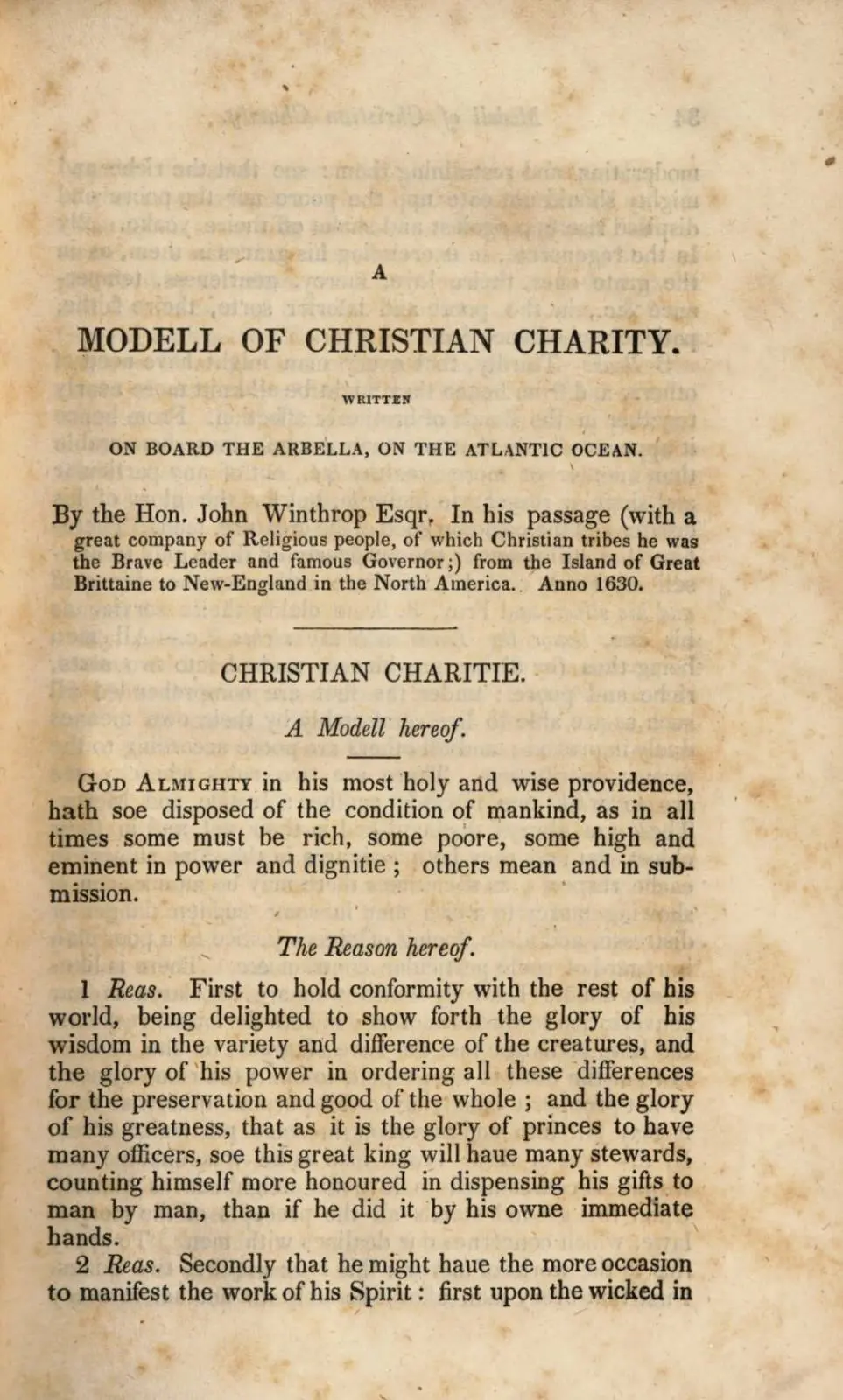
The opening page of A Modell of Christian Charity, "written on board the Arbella, on the Atlantic Ocean," as first printed by the Massachusetts Historical Society in 1838.. John Winthrop / Massachusetts Historical Society. John Winthrop, A Model of Christian CharityFor we must consider that we shall be as a city upon a hill. The eyes of all people are upon us.
Not a woman or child showed fear
About six in the morning the Arbella weighs anchor and passes the Needles into the Channel. Next day eight sail close in from astern. Word at Yarmouth was that Dunkirk privateers lay in wait. Milborne clears the gun deck, loads the guns and arms 25 landsmen with muskets. The women and children go below and the company prays on deck. Winthrop writes that not a woman or child showed fear. The ships prove friendly, and they trade salutes.
Sixty-seven cod
Gales split the Arbella’s foresail and break the Ambrose’s main yard. Through one storm the minister, George Phillips, still preaches twice on the Sabbath. Winthrop notes that few are sick and none dismayed. On 7 June, with the salt fish gone, they sound bottom at 30 fathoms and put out a few hooks. In under two hours they haul up 67 cod, some a yard and a half long. Later they take 26 more, and all feast.
Strawberries at Cape Ann
At about four in the morning the Arbella nears port and fires two guns. She threads the narrow strait by Baker’s Island and anchors inside the islands. John Endecott, leader of the settlement at Naumkeag, now Salem, comes aboard that afternoon. Winthrop and the assistants sup ashore on venison pasty and good beer. Meanwhile most of the passengers go ashore on Cape Ann and gather fine strawberries.
Trimountaine shall be called Boston
Through the summer the other ships come in, and the settlers spread around the bay. Across the river lies the Shawmut peninsula, with its three hills and fresh springs. On 7 September the Court of Assistants meets at Charlestown and names three new towns. Trimountaine shall be called Boston, after the town in Lincolnshire. Mattapan becomes Dorchester, and the town on the Charles, Watertown.
The eyes of all people
Eleven days before his inauguration, President-elect John F. Kennedy addresses a joint convention of the Massachusetts legislature. He says he has built his administration by the standard Winthrop set before his shipmates on the Arbella 331 years before. He quotes the line, then asks four questions history will put to every public servant. Were we men of courage, of judgment, of integrity, of dedication?
President-elect John F. KennedyToday the eyes of all people are truly upon us.
The shining city
Ronald Reagan took up Winthrop’s city at the first CPAC in 1974. As the shining city, it ran through the 1980 and 1984 campaigns and his eight years in office. At 9:02 p.m. he gives his Farewell Address, his 34th speech to the nation from the Oval Office and his last. He closes with Winthrop’s city: a tall, proud city, built on rocks stronger than oceans, with doors open to anyone with the will and the heart to get here.
President Ronald Reagan, Farewell AddressAfter 200 years, two centuries, she still stands strong and true on the granite ridge, and her glow has held steady no matter what storm.

The voices

A Suffolk lawyer and lord of Groton manor, elected governor of the Massachusetts Bay Company in October 1629. He led the 1630 fleet, kept the journal of the voyage and governed the colony for 12 of its first 20 years.

A former soldier and steward to the Earl of Lincoln, chosen deputy governor before the fleet sailed. He crossed in the Arbella, served four terms as governor, and in 1650 signed the charter of Harvard College.

A Navy veteran of the South Pacific who served Massachusetts for 14 years in the House and Senate. Eleven days before taking office he stood in the State House and held his new administration to Winthrop’s standard.

He took up Winthrop’s words at the first CPAC in 1974 and made them his own as the shining city. He carried it through two winning campaigns and eight years in the White House, and closed his Farewell Address with it.
By the numbers
In pictures


Watch, listen, see
Films, photographs and first-hand accounts from across the web. Each opens in a new tab.

Reagan’s Oval Office farewell, 11 January 1989, closing on his vision of the shining city upon a hill.
Ronald Reagan Presidential Foundation
President-elect Kennedy quotes Winthrop to the Massachusetts legislature, 9 January 1961, eleven days before taking office.
John F. Kennedy Library FoundationReagan’s 1980 election-eve address retells Winthrop aboard the Arbella and the shining city on a hill.
Ronald Reagan Presidential FoundationTwelve digitized pages, including Kennedy’s reading copy of his City upon a Hill address.
John F. Kennedy Presidential Library
Winthrop’s handwritten journal from the Arbella’s 1630 sailing through 1636, all 194 page images online.
Massachusetts Historical SocietyThe 17th-century oil portrait of John Winthrop, kept by his descendants and bequeathed to the Society in 1830.
American Antiquarian Society
Zoomable copy of Captain John Bonner’s map of Boston, the town Winthrop’s settlers founded in 1630.
Library of Congress
Carwitham’s hand-colored engraving of Boston’s harbor and steeples, high-resolution and zoomable.
Library of CongressRead it
A Model of Christian Charity: the close366 words · Full text
Now the onely way to avoyde this shipwracke, and to provide for our posterity, is to followe the counsell of Micah, to doe justly, to love mercy, to walk humbly with our God. For this end, wee must be knitt together, in this worke, as one man. Wee must entertaine each other in brotherly affection. Wee must be willing to abridge ourselves of our superfluities, for the supply of other’s necessities. Wee must uphold a familiar commerce together in all meekeness, gentlenes, patience and liberality. Wee must delight in eache other; make other’s conditions our oune; rejoice together, mourne together, labour and suffer together, allwayes haueving before our eyes our commission and community in the worke, as members of the same body. Soe shall wee keepe the unitie of the spirit in the bond of peace.
The Lord will be our God, and delight to dwell among us, as his oune people, and will command a blessing upon us in all our wayes. Soe that wee shall see much more of his wisdome, power, goodness and truthe, than formerly wee haue been acquainted with. Wee shall finde that the God of Israell is among us, when ten of us shall be able to resist a thousand of our enemies; when hee shall make us a prayse and glory that men shall say of succeeding plantations, “the Lord make it likely that of New England.” For wee must consider that wee shall be as a citty upon a hill. The eies of all people are uppon us.
… Beloued there is now sett before us life and good, Death and evill, in that wee are commanded this day to loue the Lord our God, and to loue one another, to walke in his wayes and to keepe his Commandements and his Ordinance and his lawes, and the articles of our Covenant with him, that wee may liue and be multiplied, and that the Lord our God may blesse us in the land whither wee goe to possesse it. … Therefore lett us choose life that wee, and our seede may liue, by obeyeing His voyce and cleaveing to Him, for Hee is our life and our prosperity.
John Winthrop, 1630, in the spelling of the Massachusetts Historical Society edition of 1838 · Source
“And she’s still a beacon, still a magnet for all who must have freedom, for all the pilgrims from all the lost places who are hurtling through the darkness, toward home.”
President Ronald Reagan, Farewell Address, 11 January 1989
After
The fleet built a commonwealth. Boston grew from a cluster of houses on the Shawmut peninsula into the capital of Massachusetts Bay. In 1635 the town voted to start its Latin school, and in 1636 the General Court founded the college that became Harvard. By about 1640, some 20,000 English men, women and children had followed the Arbella to New England.
Winthrop’s sermon waited two centuries for a printer. The Massachusetts Historical Society first published it in 1838, from a manuscript copy held by the New-York Historical Society. Its most famous line has been quoted by American leaders ever since.
Kennedy carried the line to Washington in 1961. Reagan made it his own and gave it a glow: a shining city, a beacon to the world. Winthrop’s charge still describes how Americans see their country. A free people, building in the open, with the eyes of all people upon them.
Primary sources
- John Winthrop, A Modell of Christian Charity, 1630. Collections of the Massachusetts Historical Society, 3rd series, vol. 7 (Boston, 1838).
- John Winthrop, Winthrop’s Journal, “History of New England,” 1630–1649, ed. James Kendall Hosmer, vol. 1 (New York: Scribner, 1908).
- John F. Kennedy, Address to a Joint Convention of the General Court of the Commonwealth of Massachusetts, 9 January 1961. John F. Kennedy Presidential Library.
Keep exploring
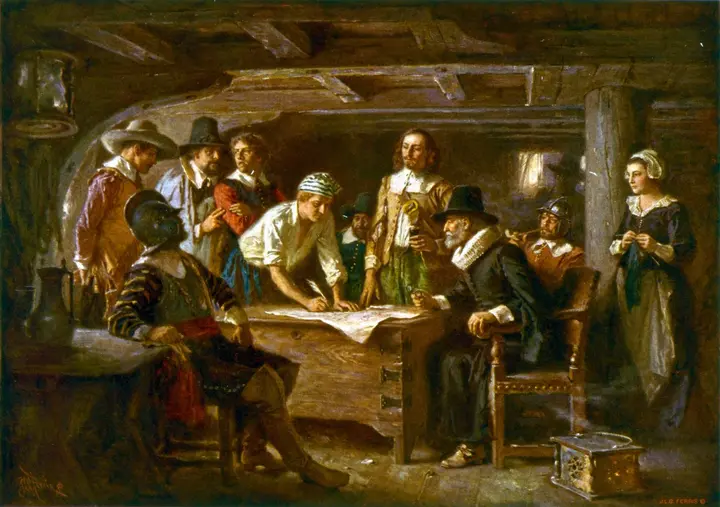
- The Mayflower CompactBefore they set foot ashore, the Pilgrims agreed to govern themselves by laws they would make together.41signers
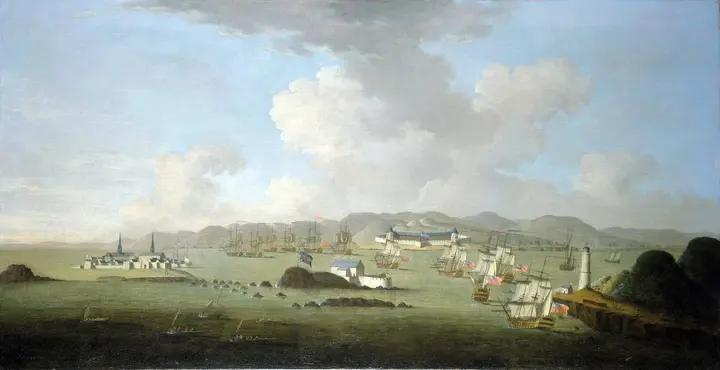
- The Gibraltar of the New World FallsAbout 4,000 New England militia under a Maine merchant, backed by the Royal Navy, dragged their guns through the bog and took France’s greatest fortress in North America.47days to take Louisbourg
- The Zenger TrialA New York jury acquitted printer John Peter Zenger of seditious libel in 1735, and the case became the seed of a free American press.8 monthsin jail, then a jury said no
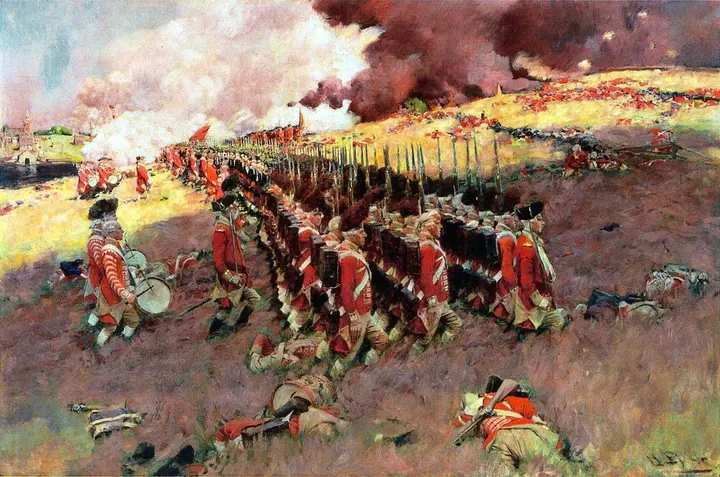
- Bunker HillFarmers and militia on Breed’s Hill held their fire until the last moment and threw back the British regulars twice.2assaults thrown back


Free, with no ads. Support the museum →