Under the Arctic ice cap · 3 August 1958 · USS Nautilus (SSN-571)
Nautilus 90 North
The world’s first nuclear-powered ship dove under the ice off Alaska, crossed the top of the world without surfacing, and came up off Greenland.

The moment · 23:15 EDT · 3 August 1958
Nautilus runs deep under the polar ice, where no ship has ever been. About 1,000 yards from 90 degrees north, Cmdr. William Anderson takes the microphone and speaks to all hands. Then he counts it down. Ten. Eight. Six. Four. Three. Two. One. Mark.
For the world, our country, and the Navy—the North Pole.Cmdr. William R. Anderson, to his crew
In the summer of 1958 no ship had ever reached the North Pole. The Arctic Ocean lay under a drifting roof of ice, and no submarine could stay down long enough to cross it. Nautilus could. Her reactor freed her from the surface, limited only by the supplies she carried. President Eisenhower wanted it tried, in secret. Cmdr. William Anderson took her north.
Steaming to Ireland in the desert
Before Nautilus could sail, her reactor had to prove itself on land. The Mark I prototype at the reactor test station in Idaho went critical on 30 March 1953 and made its first power on 31 May. In June, Hyman Rickover ordered a 100-hour run at full power. The crew plotted the miles on a chart of the North Atlantic and shut down only when the “ship” reached Ireland.
Into the Thames
President Truman laid her keel at Electric Boat in Groton, Connecticut, on 14 June 1952. Nineteen months later, First Lady Mamie Eisenhower breaks a bottle of champagne across the bow and Nautilus slides into the Thames River before a cheering crowd. She is commissioned on 30 September 1954 under Cmdr. Eugene Wilkinson, the first nuclear-powered ship in the United States Navy.
Underway on nuclear power
With Rickover beside him on the bridge, Wilkinson orders the lines cast off. A loud noise in the starboard reduction gear forces a shift to electric drive, but the engineers find a loose locking pin, fix it in minutes, and put her back on steam. As Nautilus clears the breakwater into Long Island Sound, a signalman blinks a message to the escort tug Skylark.
Nautilus to the tug SkylarkUnderway on nuclear power.
The records fall
Headed south for shakedown, Nautilus stays submerged all the way to Puerto Rico: 1,381 miles in 89.8 hours. No submarine has ever stayed down so far, or held such a speed underwater for more than an hour. In exercises she virtually wipes out the anti-submarine tactics that beat the U-boats. On 4 February 1957 she logs her 60,000th nautical mile, the 20,000 leagues of Jules Verne’s Nautilus.
The squeeze
Ten days out of Seattle under secret orders, Nautilus enters the Chukchi Sea. The water averages no more than 120 feet deep, and the ice is jammed against Alaska and Siberia. She meets a mile-long floe hanging more than 60 feet down and creeps under it with 5 feet to spare above her sail. Anderson turns back to Pearl Harbor to wait for the ice to open.
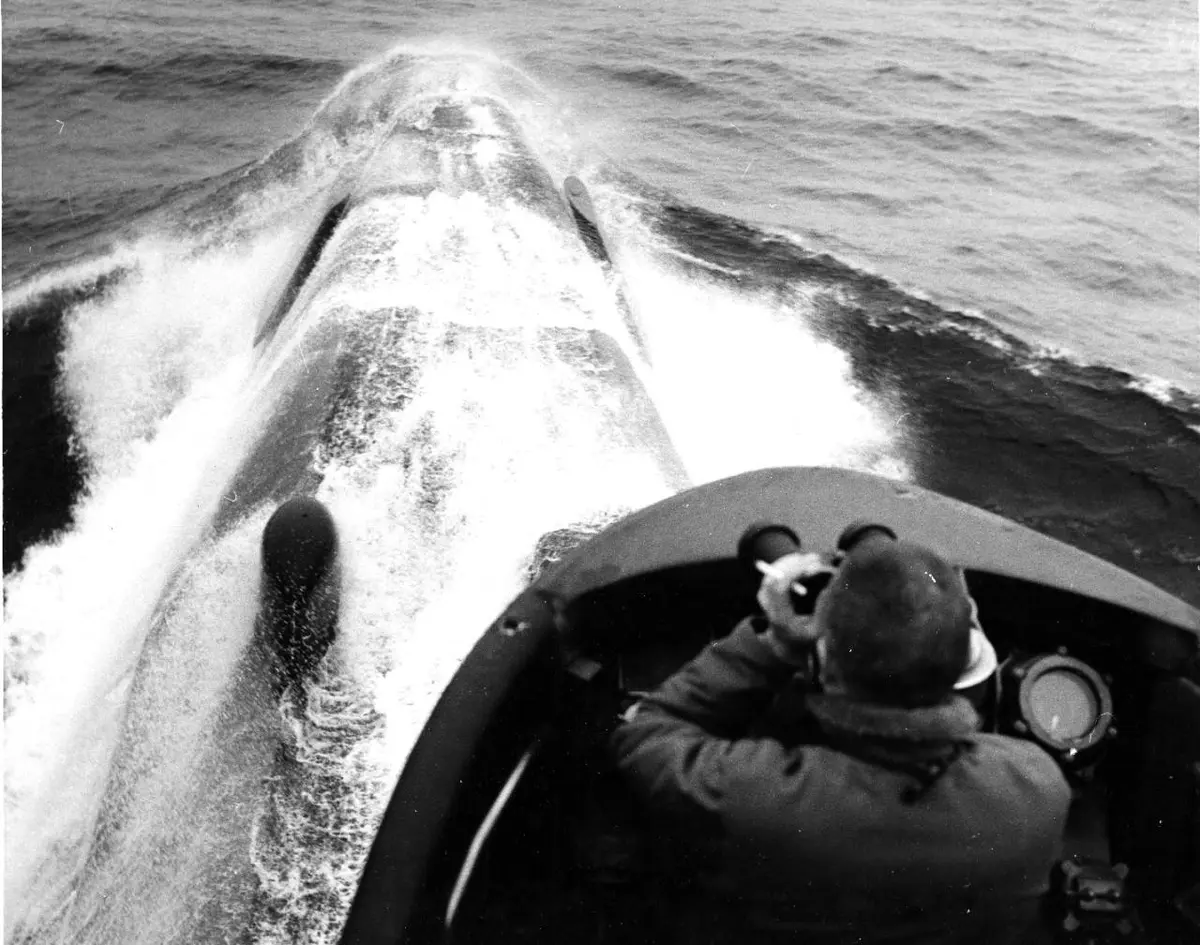
Nautilus plunges through the Chukchi Sea as the officer of the deck studies the edge of the polar ice she must pass under.. U.S. Navy photo USN 1036980 / Naval History and Heritage Command. Under the ice
Nautilus slipped out of Pearl Harbor on 23 July and threaded the Bering Strait. Off Point Barrow, Alaska, she dives into the Barrow Sea Valley and turns due north. Dr. Waldo Lyon’s upward-looking sonar traces the underside of the ice overhead. A new inertial navigator, first built for the Navaho missile, holds her course where magnetic compasses are useless.
Ninety north
About 1,000 yards from the Pole, Anderson takes the microphone: “All hands, this is the Captain speaking.” He counts down ten, eight, six, four, three, two, one. Mark. Nautilus is the first ship in history at the North Pole. There is no break in the ice to surface through, so she holds course, now heading due south. In the crew’s mess, Anderson signs a letter to President Eisenhower.
Anderson to his crew, at the PoleFor the world, our country, and the Navy—the North Pole.
Nautilus 90 North
After 96 hours and 1,830 miles under the ice, Nautilus surfaces northeast of Greenland and radios three words to Washington: “Nautilus 90 North.” She has crossed from the Pacific to the Atlantic over the top of the world. A message comes back from the White House, addressed to the officers and men: “Congratulations on a magnificent achievement. Well done!”
The first in peacetime
A helicopter lifts Anderson off near Iceland and he flies to Washington. In the White House, President Eisenhower pins the Legion of Merit on him and presents the Presidential Unit Citation to his crew, the first ever awarded in peacetime. Every man who made the voyage may wear it with a gold N clasp. Then Anderson flies back to rejoin his ship before she reaches England.

The pioneers

Came to America at six, a tailor’s son raised in Chicago. Naval Academy, Class of 1922. In less than seven years he built the industry, the prototype reactor and the training program, and put Nautilus to sea. Led naval nuclear propulsion for 33 years.

World War II submariner who earned the Silver Star in USS Darter. Joined Rickover’s team at Oak Ridge and worked the reactor physics. Took Nautilus to sea in 1955 and signaled “Underway on nuclear power.” Later the first captain of the nuclear cruiser Long Beach.

Tennessean and Naval Academy graduate who made eleven combat patrols in World War II and won the Bronze Star. Rickover picked him to command Nautilus in 1957. He told the White House the crossing could be done, then took her under the ice to the Pole.

Physicist at the Navy Electronics Laboratory in San Diego who spent a decade learning how sea ice behaves. He built the upward-looking sonar that let Nautilus see the ice above her and rode along as ice pilot. His ashes were scattered at the North Pole.
By the numbers
In pictures


Watch, listen, see
Films, photographs and first-hand accounts from across the web. Each opens in a new tab.

Eisenhower decorates Anderson at the White House, then Nautilus at sea and her crew at work below.
Universal Newsreel (Internet Archive)
The Navy’s map-based story of Operation Sunshine, from Seattle and Pearl Harbor to the Pole and Greenland.
Naval History and Heritage Command
All 69 scanned pages of Nautilus’s official deck log for the month she crossed the Pole.
National Archives
Full text of Anderson’s Legion of Merit and the first peacetime Presidential Unit Citation for his crew.
The American Presidency ProjectThe Navy’s own history of Nautilus’s polar voyages, with the crew’s memories of the ice and the Pole.
Undersea Warfare, U.S. Navy
The christening, sea trials, the Arctic voyage and the New York homecoming in official Navy photographs.
Naval History and Heritage Command
The official history of Rickover’s program, from Oak Ridge to Nautilus and the polar voyages, free to read.
U.S. Department of Energy
Naval Reactors’ 2025 report: 177 million miles steamed on nuclear power and never a reactor accident.
Naval Reactors, U.S. Department of Energy“The skill, professional competency and courage of the officers and crew of Nautilus were in keeping with the highest traditions of the Armed Forces of the United States and the pioneering spirit which has always characterized our country.”
Presidential Unit Citation, presented by President Dwight D. Eisenhower, 8 August 1958
After
Nautilus crossed the Atlantic to a crowd on the pier at Portland, England, then came home. On 25 August 1958 fireboats threw up plumes of water as she steamed into New York Harbor, and an estimated 250,000 people lined Broadway for her crew’s ticker-tape parade.
The voyage proved that American submarines could go anywhere under the polar ice. Rickover’s program went on to power the fleet: today it runs 97 reactors, and every American submarine and aircraft carrier sails on nuclear power. Across more than 7,600 reactor-years and 177 million miles, there has never been a reactor accident.
Nautilus steamed 510,000 miles before she was decommissioned on 3 March 1980. She was named a National Historic Landmark in 1982, and since 11 April 1986 she has been open to the public at the Submarine Force Museum in Groton, Connecticut, the town where she was built.
Primary sources
- Nautilus IV (SSN-571). Dictionary of American Naval Fighting Ships, Naval History and Heritage Command.
- Awards Presented to Commander Anderson and to the Other Officers and the Crew of the U.S.S. Nautilus. President Dwight D. Eisenhower, 8 August 1958.
- The United States Naval Nuclear Propulsion Program, 2025. Naval Reactors, U.S. Department of Energy.