Off Cape Canaveral · 20 July 1960 · USS George Washington (SSBN-598)
From Out of the Deep
The Navy built a new missile, a new kind of submarine and a way to fire one from the other under the sea. Then it did it twice in one afternoon.

The moment · 12:39 · 20 July 1960
George Washington runs submerged 30 miles off Cape Canaveral with Admiral Raborn aboard. A Polaris missile leaves its tube, breaks the surface, lights its motor and climbs out over the Atlantic toward a target no one aboard can see. It hits. Cmdr. Osborn writes the message.
Polaris. From out of the deep to target. Perfect.Cmdr. James B. Osborn, to President Eisenhower
In 1955 no nation could fire a ballistic missile from under the sea. Adm. Arleigh Burke, the Chief of Naval Operations, wanted exactly that: a missile hidden in a submarine, safe from a surprise attack and always ready to answer one. He gave the job to Rear Adm. William “Red” Raborn, a carrier aviator. Four and a half years later, it was done.
An aviator takes the job
The Secretary of the Navy creates the Special Projects Office on 17 November. Burke picks Raborn to run it, and he takes charge on 5 December. The first assignment is to take the Army’s Jupiter to sea. Jupiter is a huge liquid-fueled rocket, and liquid fuel is a dangerous thing to carry in a ship. Raborn and his engineers start looking for something smaller and safer.
Solid fuel, small warhead
At a Navy study at Woods Hole that summer, physicist Edward Teller argues that a much lighter warhead can be ready within five years. Raborn’s technical director, Capt. Levering Smith, is sure a solid-fuel rocket can be made to work in a submarine. On 8 December the Secretary of Defense lets the Navy leave Jupiter and build its own missile. They call it Polaris, after the North Star.
Sputnik moves the deadline
In February 1957 Burke asks for a submerged-launch missile by 1963. Then on 4 October the Soviets put Sputnik in orbit, and the deadline moves up to the end of 1960. On the last day of the year the Navy orders missile submarines. At Electric Boat the attack submarine Scorpion has been on the building ways for two months. She is redesigned around a new 130-foot section holding 16 missile tubes and becomes George Washington.
Learning to fly
The early test missiles off the pads at the Cape fail one after another. Raborn’s team keeps fixing and firing, and on 20 April test vehicle AX-6 flies clean. At Groton, engineers fire a one-ton dummy cylinder out of one of George Washington’s missile tubes to prove the launcher. On 27 August the test ship Observation Island fires the first Polaris ever launched at sea.
Two crews, one boat
George Washington slides into the Thames River on 9 June 1959. She is commissioned on the 30th of December with two full crews, so she can go back to sea while one crew rests: the Blue crew under Cmdr. James B. Osborn and the Gold crew under Cmdr. John L. From Jr. On 28 June 1960 she sails south for Cape Canaveral and loads two Polaris missiles.
From out of the deep
With Raborn aboard as an observer, George Washington runs submerged on the Atlantic Missile Range about 30 miles off Cape Canaveral. The first Polaris leaves its tube, breaks the surface, ignites and flies its programmed course to the target area. Osborn’s message goes out to the President, the Secretary of Defense, the Chief of Naval Operations and Raborn’s own Special Projects Office.
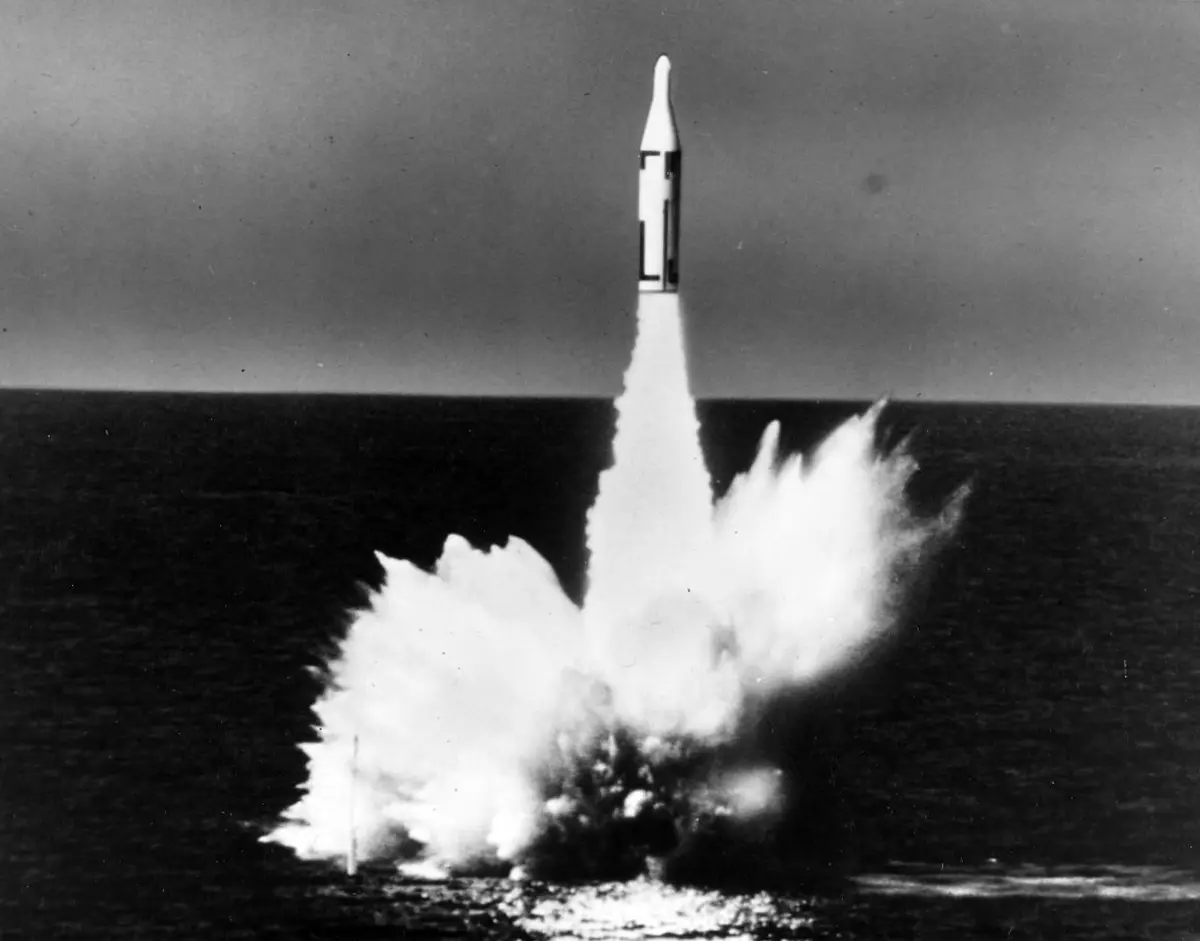
The first Polaris fired from George Washington breaks the surface and ignites, July 1960 (K-25571).. U.S. Navy / National Archives, via Naval History and Heritage Command. George Washington to President EisenhowerPolaris. From out of the deep to target. Perfect.
Twice in one day
Less than two hours later, a second missile leaves the submerged boat and comes down in the impact area 1,100 miles downrange. Both flights meet every test objective. George Washington returns to the Cape for her Gold crew, and on 30 July they fire two more from under the sea. Four launches, four successes.
On patrol
At Charleston she loads all 16 missiles and receives the Navy Unit Commendation. Then the Blue crew takes her to sea on the first Polaris deterrent patrol. Osborn keeps her submerged for 66 days. She surfaces at New London on 21 January 1961, and the Gold crew takes her out again on 14 February. The deadline set after Sputnik is met.

The men

Texas-born naval aviator, Annapolis 1928. Won the Silver Star in 1945 for getting the kamikaze-struck carrier Hancock’s flight deck working again in four hours. Ran Polaris from the start, rode George Washington for the first shot and won the Collier Trophy.

Missouri-born ordnance officer, Annapolis 1932. Served in the carrier Hornet and the cruiser Northampton when both were sunk in 1942. A solid-fuel rocket man from China Lake, he engineered Polaris and later led the work on Poseidon and Trident.

He graduated from Annapolis twelve days after Pearl Harbor. Commanded Tunny when she fired the Navy’s first Regulus missile. Fired the first Polaris from under the sea and took her on the first patrol.
By the numbers
In pictures


Watch, listen, see
Films, photographs and first-hand accounts from across the web. Each opens in a new tab.

The 21 July 1960 newsreel: loading at Cape Canaveral, the hatches opening, and both launches from under the sea.
Universal Newsreel (Wikimedia Commons)
The Navy’s own film on PERT, the scheduling system Raborn’s office built to drive Polaris ahead of schedule.
U.S. Navy Special Projects Office (Internet Archive)
The Navy’s history of SSBN-598 with photos of the first launch, the missile room and Raborn.
Naval History and Heritage Command
The Navy’s record of George Washington, from her keel to the first launch, the first patrol and decommissioning.
NHHC, Dictionary of American Naval Fighting Ships
How the Navy went from surfaced missile boats to 41 Polaris submarines in seven and a half years.
Naval History and Heritage CommandPresident Kennedy’s Rose Garden remarks honoring Raborn and the men who built Polaris, 15 June 1961.
The American Presidency Project
How Teller’s 1956 bet on a light warhead became the weapon Polaris carried to sea.
Lawrence Livermore National LaboratoryThe two officers who ran the Special Projects Office and delivered Polaris to the fleet.
Naval Submarine League“These 29 submarines, each with a full complement of missiles, will be a formidable deterrent force. The sooner they are on station, the safer we will be.”
President John F. Kennedy, Special Message to the Congress on the Defense Budget, 28 March 1961
After
President Kennedy presented Raborn the Collier Trophy for 1960 in the Rose Garden on 15 June 1961, and through him to the men in the Navy and industry who built Polaris. Kennedy noted that a trophy made to honor aviation had gone to the man who did so much for the nation’s defense through submarines.
The Navy went on to build 41 ballistic missile submarines in seven and a half years, the “41 for Freedom,” carrying 656 missiles. Levering Smith stayed with the program through Poseidon and into Trident, and helped Britain put Polaris to sea as well.
George Washington served for 25 years and was decommissioned on 24 January 1985. Her sail stands outside the Submarine Force Museum in Groton, Connecticut. Her motto, Primus in Pace, means “First in Peace.”
Primary sources
- George Washington III (SSBN-598). Dictionary of American Naval Fighting Ships, Naval History and Heritage Command.
- Naval message, USS George Washington to the President and others, date-time group 201739Z July 1960, released by Cmdr. J. B. Osborn.
- Raborn and Smith Led the Way at Strategic Systems Programs: SSPO at 50. The Submarine Review, Naval Submarine League, 2006.
Keep exploring
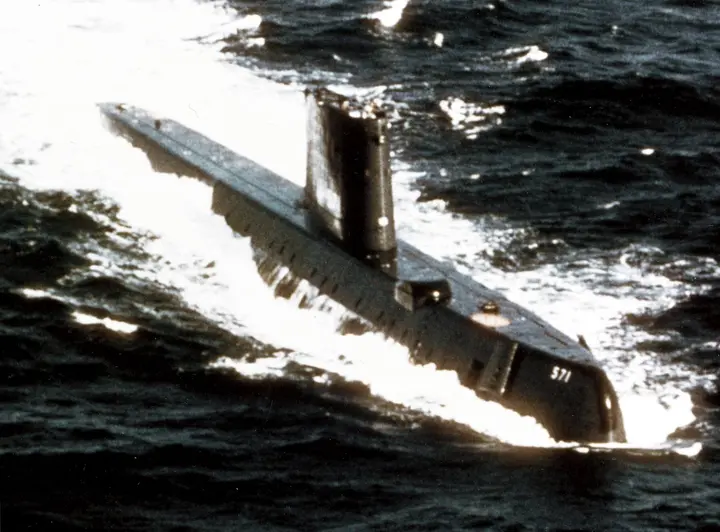
- Nautilus 90 NorthThe world’s first nuclear-powered ship sailed 1,830 miles beneath the Arctic ice and became the first ship ever to reach the North Pole.90°Nunder the ice
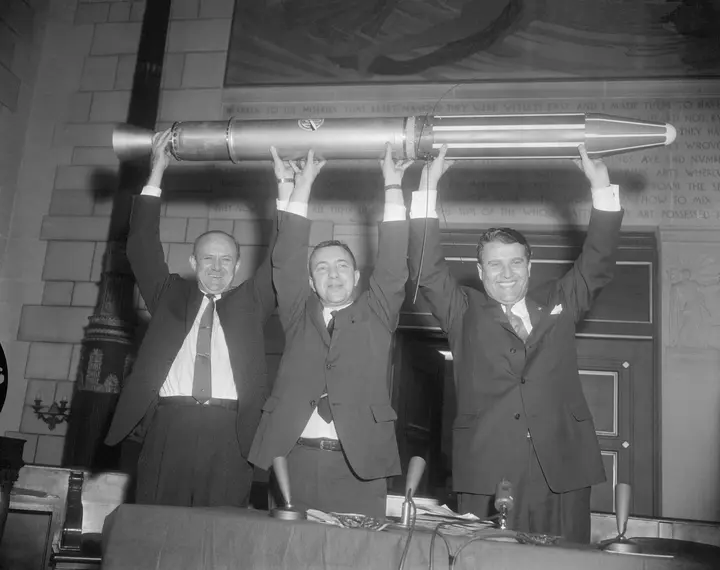
- Explorer 1America’s first satellite went up on a Jupiter-C and found the Van Allen radiation belts.84days from go to launch
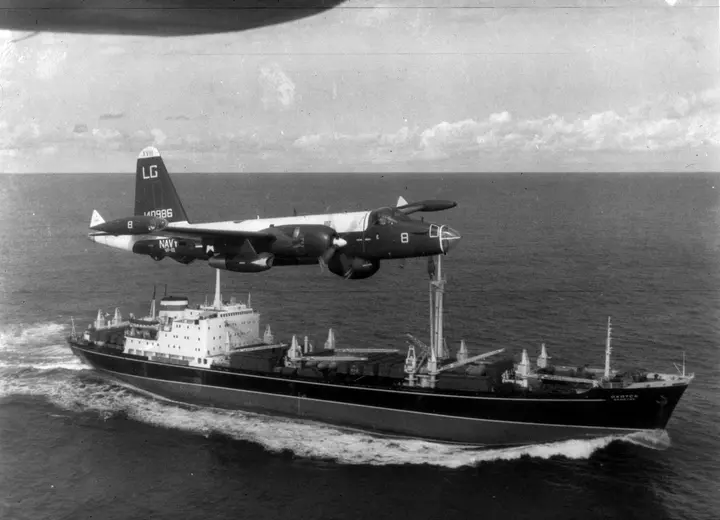
- Thirteen DaysU-2 photographs found Soviet missiles in Cuba. A naval quarantine and a steady President sent them home without a war.13days
- Thirty Seconds Over TokyoFour months after Pearl Harbor, 80 volunteers flew Army bombers off a Navy carrier and struck Japan.16B-25 bombers


Free, with no ads. Support the museum →