Independence, Missouri, to the Willamette Valley · 22 May 1843 · The Great Migration
Travel, Travel, Travel
In 1843 nearly a thousand Americans loaded their lives into covered wagons and walked 2,000 miles to Oregon. Men who knew the country said wagons could never get through. They took them anyway.

The moment · 27–30 August 1843 · Fort Hall
Fort Hall, on the Snake River. Ahead lie 475 miles of rock, sage and mountains. The Hudson’s Bay man in charge says he cannot see how wagons will get through. Dr. Marcus Whitman says they will. On 30 August the wagons roll west.
Travel, travel, travel; nothing else will take you to the end of your journey.Dr. Marcus Whitman’s constant advice, as Jesse Applegate remembered it
In the spring of 1843 the Oregon Country was held jointly by Britain and the United States, and Britain’s Hudson’s Bay Company ran it from Fort Vancouver. Men who had seen the Snake River country said no wagon train could cross it. Nearly a thousand Americans set out from Missouri to prove them wrong, with their wagons, their cattle and their children.
Sunshine and song
For days the emigrants have gathered on the prairie a dozen miles west of Independence, Missouri. They have adopted rules, inspected wagons and hired Captain John Gantt, a former Army officer and mountain man, to pilot them to Fort Hall. On Monday morning, 22 May, the whole company rolls out. By three in the afternoon it reaches Elm Grove. That night there is music in the tents. Burnett will remember a journey begun “in sunshine and song.”
Two columns
On 1 June the company elects Peter Burnett captain, with James Nesmith as orderly sergeant and nine men as a council. A train this size, with thousands of loose cattle, is hard to hold together. Burnett resigns on 8 June and William Martin takes his place. At the Big Blue the emigrants divide: a light column for those with few cattle, and a cow column for families with big herds, under Jesse Applegate.
A day with the cow column
At four in the morning the sentinels fire their rifles and the camp wakes. Sixty men ride out and bring in some 5,000 horses and cattle. At seven a trumpet sounds, and 60 wagons in 15 platoons of four move out in order. Dr. Whitman, who caught up with the train on the Platte, rides along as its doctor. At sundown the pilot leads the wagons into a circle, and in ten minutes the corral is closed.
Jesse Applegate, A Day with the Cow Column in 1843It has been a prosperous day; more than twenty miles have been accomplished of the great journey.
A cold-water Fourth
Independence Rock is still 300 miles ahead. The South Fork of the Platte, 460 miles out, is half a mile wide and full of quicksand. The men stretch green buffalo hides over wagon beds, tack them down, dry them in the sun and float their goods across in the skin boats. From 1 to 5 July they work the river. The Fourth is spent wading and swimming cattle and wagons over.
James Nesmith’s diary, 4 July 1843The glorious Fourth has once more rolled around.
Castles on the plains
Past Courthouse Rock the trail reaches Chimney Rock, a clay spire Nesmith judged could be seen thirty miles across the plains. On 10 July he and eight or ten others climb the mound at its base. On 14 July the train reaches Fort Laramie, a fur traders’ post, and stops two days to repair wagons. Coffee costs $1.50 a pint. The traders at nearby Fort Platte throw the young men a ball.
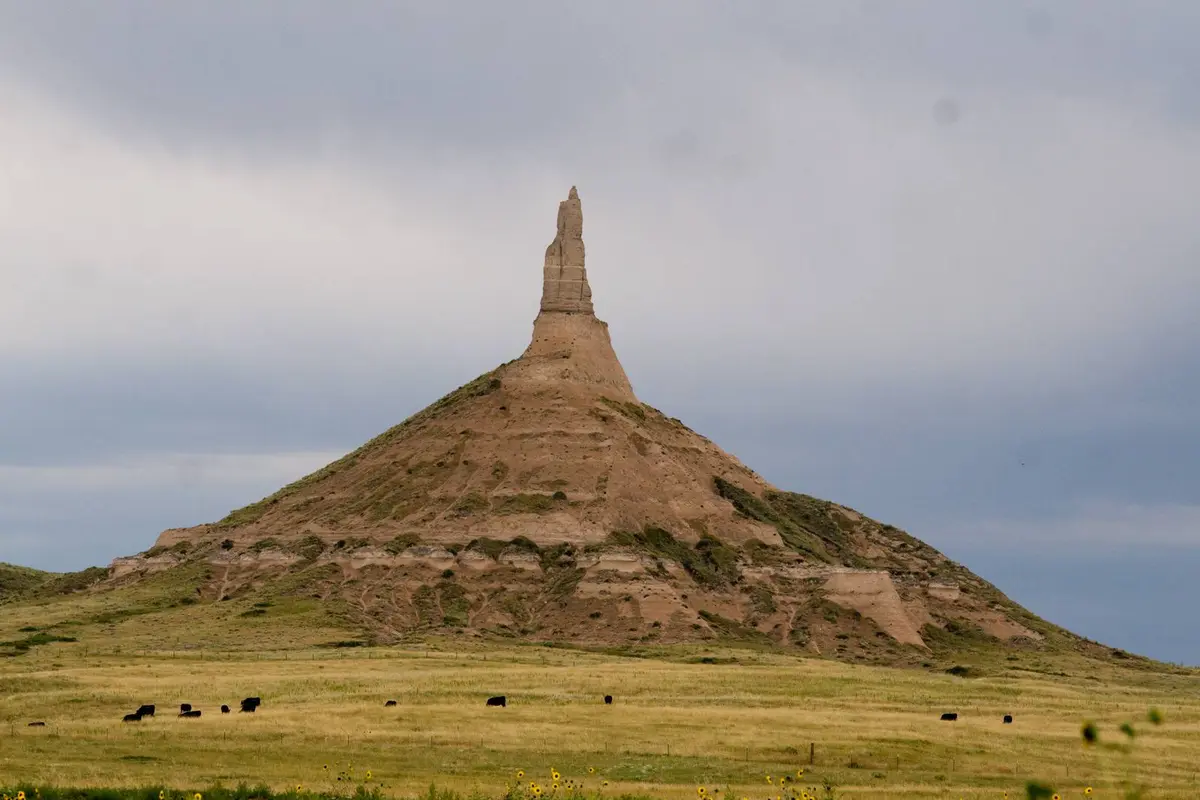
Chimney Rock, Nebraska, the landmark mentioned in more emigrant diaries than any other on the trail.. Mike Tigas. Over the Divide
The train reaches Independence Rock on the Sweetwater in the last days of July. Nesmith paints his name on it in gunpowder, tar and buffalo grease, beside trappers’ names ten years old. On 3 August the emigrants see the snows of the Wind River Mountains, the first eternal snow they have ever seen. On 7 August they cross South Pass, 7,412 feet up, and drink from the first spring that flows to the Pacific.
Travel, travel, travel
Captain Gantt’s contract ends at Fort Hall, a Hudson’s Bay post on the Snake. Some of the young men leave their wagons and go on with pack animals. The trader in charge, Richard Grant, tells Burnett he will not say Americans cannot take wagons through, but he cannot see how. Whitman has no such doubt. He takes over as pilot, and on 30 August the wagons roll on down the Snake.
Axes in the timber
Past Fort Boise and up Burnt River, the road is the roughest yet. On 1 October Burnett’s wagons cross the Grande Ronde, and Whitman hands the lead to Stickus, a Cayuse guide who proves faithful and able. Then come the Blue Mountains and their pine forests. Men go ahead with axes and cut a road through the timber. Snow falls on 5 October. At the foot of the mountains they buy corn and potatoes from the Indians.
The end of the road
On 16 October Burnett reaches Fort Walla Walla, 1,691 miles and 147 days from the rendezvous. Wagons have rolled from Missouri to the Columbia. Most families drive on to The Dalles, then take to the river on rafts and boats. Three emigrants drown in the rapids, among them a son each of Jesse and Lindsay Applegate. Nesmith reaches Oregon City on 27 October. Burnett reaches Fort Vancouver about 7 November.
The leaders

New York-born doctor who crossed to Oregon in 1836 and built a mission near Walla Walla. He rode east in the winter of 1842–43, joined the train on the Platte, kept it healthy and moving, and piloted the wagons on from Fort Hall.

Kentucky-born surveyor and farmer from Missouri’s Osage River who went west with his brothers Charles and Lindsay. He led the slow, heavy column that drove the herds to Oregon, then wrote its classic account, A Day with the Cow Column in 1843.

Tennessee-born lawyer from Weston, Missouri, who rallied his neighbors to go and was elected the train’s first captain. He kept a journal of each day’s miles. In Oregon he served in the provisional legislature and on its supreme court. In 1849 California elected him its first governor.
By the numbers
In pictures


Watch, listen, see
Films, photographs and first-hand accounts from across the web. Each opens in a new tab.

OPB’s Oregon Experience follows Oregon from the fur trade and the wagon trains to statehood in 1859.
Oregon Public Broadcasting
Aerial footage picks out the remains of the Oregon Trail, barely visible from the ground.
Smithsonian Channel
The 300-foot spire mentioned in more emigrant diaries than any other landmark on the trail.
National Park Service
The broad, gentle gap in the Rockies that let wagons cross the Continental Divide.
Oregon-California Trails AssociationJesse Applegate’s classic account of one day with the 1843 train, from 4 a.m. to the night watch.
Oregon Historical Quarterly, via WikisourcePeter Burnett’s 1880 memoir, built on the journal he kept from Missouri to the Columbia.
Internet Archive
The orderly sergeant’s daily diary, from the Fourth of July in the Platte to Oregon City.
Oregon Historical Quarterly, via Wikisource
Charles Preuss’s zoomable map of the road to Oregon, from Frémont’s surveys. This section covers South Pass.
David Rumsey Map Collection“Our title to the country of the Oregon is “clear and unquestionable,” and already are our people preparing to perfect that title by occupying it with their wives and children.”
President James K. Polk, Inaugural Address, 4 March 1845
After
The wagons kept coming, more every year. On 15 June 1846 the United States and Britain signed the Oregon Treaty and drew the border at the 49th parallel. Congress organized Oregon Territory on 14 August 1848, and on 14 February 1859 Oregon entered the Union as the 33rd state.
Jesse and Lindsay Applegate, who lost their boys on the Columbia, resolved to find a safer way for those who came after. In 1846 they opened the Applegate Trail into southern Oregon. Jesse helped write the laws of Oregon’s provisional government. Peter Burnett served as one of its judges, went on to California in 1848 and was elected its first governor. Marcus Whitman stayed at his mission and died there in 1847.
Between 1841 and 1884, an estimated 300,000 to 500,000 people crossed overland to the West. In 1978 Congress made the route the Oregon National Historic Trail. At Guernsey, Wyoming, the wagon wheels of those years wore ruts deep into the sandstone, and they are still there.
Primary sources
- Applegate, Jesse. “A Day with the Cow Column in 1843.” Quarterly of the Oregon Historical Society 1, no. 4 (December 1900).
- Burnett, Peter H. Recollections and Opinions of an Old Pioneer. D. Appleton & Co., 1880.
- Nesmith, James W. “Diary of the Emigration of 1843.” Quarterly of the Oregon Historical Society 7, no. 4 (December 1906).
Keep exploring
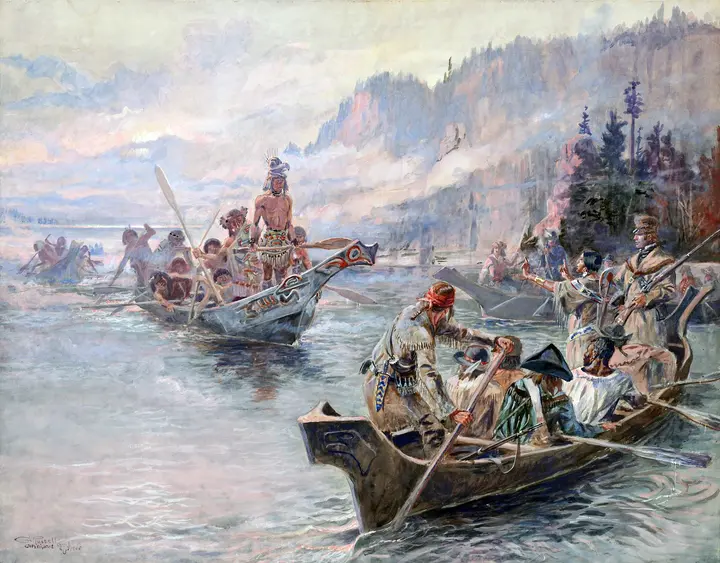
- Lewis & ClarkAcross a continent no American had crossed, to the Pacific, and back again.8,000miles
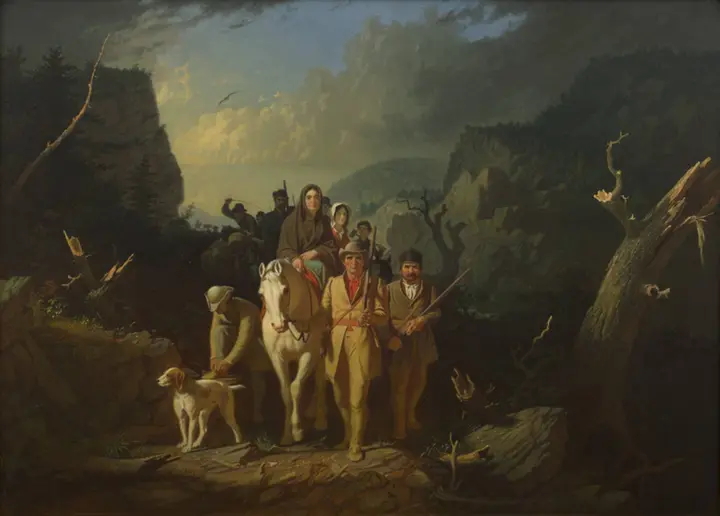
- The Wilderness RoadIn March 1775 Daniel Boone and about thirty axmen cut a road through Cumberland Gap to the Kentucky River. By 1810 some 200,000 pioneers had used it.200 miof road, cut by axmen
- The Pony ExpressYoung riders galloped mail from Missouri to California in ten days, through blizzards, deserts and hostile country.1,966miles in 10 days
- The Gold RushGold in the American River drew 300,000 people west and made California a state in under three years.300,000forty-niners


Free, with no ads. Support the museum →