San Antonio de Béxar, Texas · 6 March 1836 · The Alamo garrison
Victory or Death
About 200 men held an old mission for 13 days against an army of thousands. Not one of them surrendered. Six weeks later their battle cry won Texas in 18 minutes.

The moment · About 05:00 · 6 March 1836
After nearly two weeks of bombardment, the Mexican guns have gone quiet and the worn-out garrison sleeps. Then the shouting starts. Four columns are running at the walls with ladders. Travis seizes his rifle and sword, sprints for the north wall and fires down into them.
Come on boys, the Mexicans are upon us, and we’ll give them Hell!William B. Travis on the wall, as his slave Joe remembered it
In February 1836 General Antonio López de Santa Anna, who had torn up Mexico’s 1824 constitution, marched north with thousands of soldiers to crush the revolt in Texas. In his path at San Antonio de Béxar stood an old Spanish mission called the Alamo. Its garrison could have pulled out. About 200 men stayed instead, held it for 13 days, and bought Texas the time to win.
The enemy in sight
Santa Anna’s army marches into Béxar. The garrison, about 150 men under Lt. Col. William B. Travis and Col. James Bowie, pulls back into the Alamo. From the bell tower of San Fernando church, 700 yards away, the Mexicans raise a blood-red flag: no quarter. Santa Anna demands surrender at discretion. Travis answers with a shot from the 18-pounder, the heaviest gun on the walls.
To the People of Texas
Bowie collapses with a fever and Travis takes sole command. Under 24 hours of bombardment, he writes a letter addressed to the People of Texas and all Americans in the world. Capt. Albert Martin carries it out through the Mexican lines to Gonzales. Within days it is printed in Texas newspapers, and it is reprinted across the United States.
Travis, from the Commandancy of the AlamoI shall never surrender or retreat. … Victory or Death.
The Immortal 32
Thirty-two men from Gonzales, 70 miles to the east, answer the letter. Led by Lt. George C. Kimbell, they slip through the Mexican siege lines in the dark and make it inside the walls. They are the only help that ever reaches the Alamo. Every one of them knows what the red flag means. With them, the garrison numbers close to 200.
Bonham rides back
The day before, at Washington-on-the-Brazos, delegates declared Texas independent. It was Sam Houston’s 43rd birthday. The men in the Alamo will never hear of it. On 3 March James Butler Bonham, a South Carolina lawyer Travis had sent out to find help, gallops back through the Mexican lines with a white bandana in his hat and rides in through the gate. He could have stayed away.
The assault
In the dark, four Mexican columns rush the walls from four directions with scaling ladders. The defenders’ cannon and rifles stop the first charges cold. Travis is at the north wall battery, firing down into the attackers, when a bullet strikes him in the head. He is among the first to die. The columns regroup, mass against the north wall, and pour over it into the plaza.
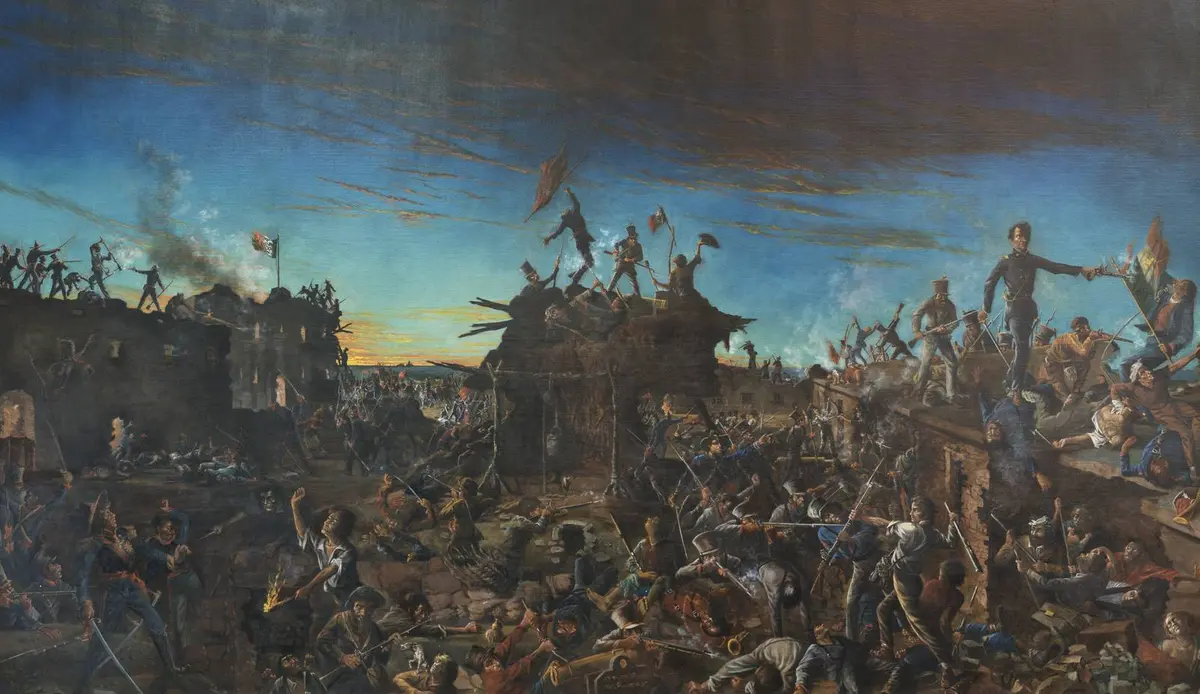
Dawn at the Alamo: Travis stands on the north wall battery as the columns come over (Henry Arthur McArdle, 1905, Texas Senate Chamber).. Henry Arthur McArdle; photograph by Carol M. Highsmith / Library of Congress. To the last man
The defenders fall back into the long barrack and the church and fight room to room. Bowie dies in his sickbed. Crockett dies with his men. Within about 90 minutes every defender is dead, and as many as 600 Mexican soldiers are killed or wounded. Santa Anna has the bodies burned. He spares Susanna Dickinson, her baby daughter Angelina and Travis’s slave Joe, and sends them east with the news.
Houston falls back
Sam Houston, now commanding the army, reaches Gonzales on 11 March. Word of the Alamo arrives, and Susanna Dickinson brings it in person. Outnumbered, he burns the town and falls back east, drilling his men as he goes. On Palm Sunday, 27 March, the Mexican army shoots 342 of Col. James Fannin’s captured men at Goliad. Houston keeps retreating and waits for his moment.
Remember the Alamo
At San Jacinto, Deaf Smith burns Vince’s Bridge behind the armies. In the afternoon lull, about 900 Texans form up in silence and cross the open prairie toward a camp of more than 1,200. The Twin Sisters cannon fire, a fifer plays, and the line breaks into a run. The fight lasts 18 minutes. Houston’s horse is shot from under him and a musket ball shatters his ankle.
The Texan battle cryRemember the Alamo! Remember Goliad!
Santa Anna in the grass
The count is 630 Mexican soldiers dead and 730 captured. Nine Texans are killed or mortally wounded. The next day a search party finds a man hiding in the grass in a common soldier’s clothes. They do not know who he is until other prisoners call him el presidente. Santa Anna is brought to Houston, lying wounded under an oak, and orders his armies out of Texas.

The men

South Carolina-born lawyer who led the 1835 move on Anahuac. Commissioned lieutenant colonel of Texas cavalry, he reached the Alamo on 3 February with about 30 men. He wrote the letter that called Texas to arms and died on the north wall.

Kentucky-born frontiersman whose name rides on the Bowie knife. He fought at Concepción and the Grass Fight in 1835. He came to the Alamo on 19 January, vowed to die in its ditches rather than give it up, and kept that vow from his sickbed.

Creek War scout and three-term congressman from Tennessee. Beaten for reelection in 1835, he told the voters they could go to hell and he would go to Texas. He swore to defend the new republic, rode into the Alamo in early February and died there.

Wounded three times at Horseshoe Bend in 1814, later governor of Tennessee. Texas declared independence on his 43rd birthday. He took the army that was left, fell back, picked his ground and won San Jacinto in 18 minutes with a shattered ankle.
By the numbers
In pictures


Watch, listen, see
Films, photographs and first-hand accounts from across the web. Each opens in a new tab.

Historians walk the empty Alamo church and grounds, from the siege to the final assault and its legacy.
American Battlefield Trust · YouTube
The original letter from the Alamo, page by page, with its story and full transcript.
Texas State Library and Archives
A walk along the lost walls, batteries and gates the garrison held for 13 days.
American Battlefield Trust · YouTube
Slide between today’s Alamo Plaza and the 1836 compound to see where the walls stood.
The AlamoThe assault as told by Travis’s slave Joe, a survivor, two weeks after the battle.
The Alamo
A tour of the field where Houston’s army won Texas in 18 minutes.
American Battlefield Trust · YouTubeThe campaign and battle in a timed sequence, from the retreat to Santa Anna’s capture.
San Jacinto Museum of History
Houston’s official report, eyewitness accounts and casualty lists from the decisive battle.
Texas State Library and Archives“I call on you in the name of Liberty, of patriotism & every thing dear to the American character, to come to our aid, with all dispatch.”
Lt. Col. William Barret Travis, the Alamo, 24 February 1836
After
San Jacinto made Texas a free republic. Sam Houston was elected its first president and took office in October 1836. On 29 December 1845 Texas joined the Union as the 28th state.
Texas bought the Alamo church in 1883 and the long barrack in 1905, and gave both to the Daughters of the Republic of Texas to keep. Travis’s letter is in the Texas State Library and Archives in Austin. The state bought it from his great-grandson in 1893 for $85.
On the San Jacinto battlefield stands a 567-foot column topped by a Lone Star, dedicated on 21 April 1939. “Remember the Alamo” has been the American byword for courage against impossible odds ever since.
Primary sources
- William Barret Travis, “To the People of Texas & all Americans in the world,” the Alamo, 24 February 1836. Texas State Library and Archives Commission.
- Sam Houston, official report of the Battle of San Jacinto to President David G. Burnet, 25 April 1836.
- “Alamo, Battle of the.” Handbook of Texas Online, Texas State Historical Association.