Willow Run, Michigan · Spring 1944 · Ford Motor Company
A Bomber an Hour
Ford promised the Army a four-engine heavy bomber off a moving line every hour. The aircraft industry called it impossible. By 1944 the farm field outside Detroit was doing it.

The moment · About 4 a.m. · January 1941 · Coronado
Consolidated builds its bomber by hand, outdoors, about one a day. Charles Sorensen locks himself in his hotel room and draws all night. By about four in the morning it’s on paper: the B-24 broken into sections, a moving line, a finished bomber every hour.
On 16 May 1940 President Roosevelt told Congress he wanted the nation able to build at least 50,000 planes a year. That December he called on Americans to become the great arsenal of democracy. Ford Motor Company answered with the boldest promise of the war: a four-engine heavy bomber rolling off a moving assembly line every hour.
Fifty thousand planes
German armies have overrun the Netherlands and are driving through Belgium into France. President Roosevelt goes before a joint session of Congress and asks for a number no country has ever reached. He wants American industry geared up to build at least 50,000 military and naval planes a year, and he asks Congress for the money to start.
Roosevelt to CongressI should like to see this nation geared up to the ability to turn out at least 50,000 planes a year.
The arsenal of democracy
Britain is fighting on against Nazi Germany and needs planes, tanks, guns and freighters to stay in the fight. In a fireside chat heard across the country, Roosevelt tells Americans their factories will have to supply them. He asks for a mightier production effort than the nation has ever made, and an end to business as usual.
Roosevelt, fireside chatWe must have more ships, more guns, more planes — more of everything.
One a day, or one an hour
The government wants Ford to make parts for the B-24 Liberator. Edsel Ford and production chief Charles Sorensen go to Consolidated Aircraft to see the bomber built. Sorensen finds parts fitted by hand and final assembly done outdoors in the hot sun. Consolidated is aiming for about one plane a day. That night Sorensen locks himself in his hotel room in Coronado and starts to draw.
The whole plane
By about four in the morning Sorensen has it on paper: one huge plant laid out like a Ford car factory, the bomber broken into sections that flow down a moving line, and a finished B-24 every hour. He figures it will take a $200 million plant. Ford goes back to the government with a counteroffer. It will not just make parts. It will build complete bombers.
Ground broken
Ford breaks ground on Henry Ford’s own farmland beside a creek called Willow Run, 35 miles west of Detroit. Albert Kahn designs a main building more than 3,200 feet long. Sorensen’s team plans every station on a scale model and splits the B-24 into 11 major assemblies and 69 subassemblies. The line turns 90 degrees near its end, on turntables, so the plant stays in Washtenaw County.
The first Liberator
The first B-24 rolls off the Willow Run line seventeen months after ground was broken. Eight days later President Roosevelt and the First Lady tour the plant with Henry Ford, Edsel Ford and Sorensen. Charles Lindbergh, hired by Henry Ford that April as a consultant, works on the bomber’s nose and gun mounts. The plant finishes only 56 airplanes in all of 1942.
Turning the corner
The Army keeps changing the bomber’s design, and every change means retooling a line built for a fixed one. Critics call the place Will It Run. Ford’s people solve the problems one by one, swapping hand-built parts for castings and hard steel dies. Edsel Ford dies of cancer on 26 May, at 49. On 3 November the 1,000th finished B-24 rolls out.
Rosie at Willow Run
More than 15,000 women work at Willow Run, about a third of the assembly line. Each Liberator takes more than 300,000 rivets in more than 500 sizes. One of the riveters is Rose Will Monroe, a young widow from Kentucky. When actor Walter Pidgeon comes to film a war bond short, he finds a real riveter named Rose and puts her on screen.
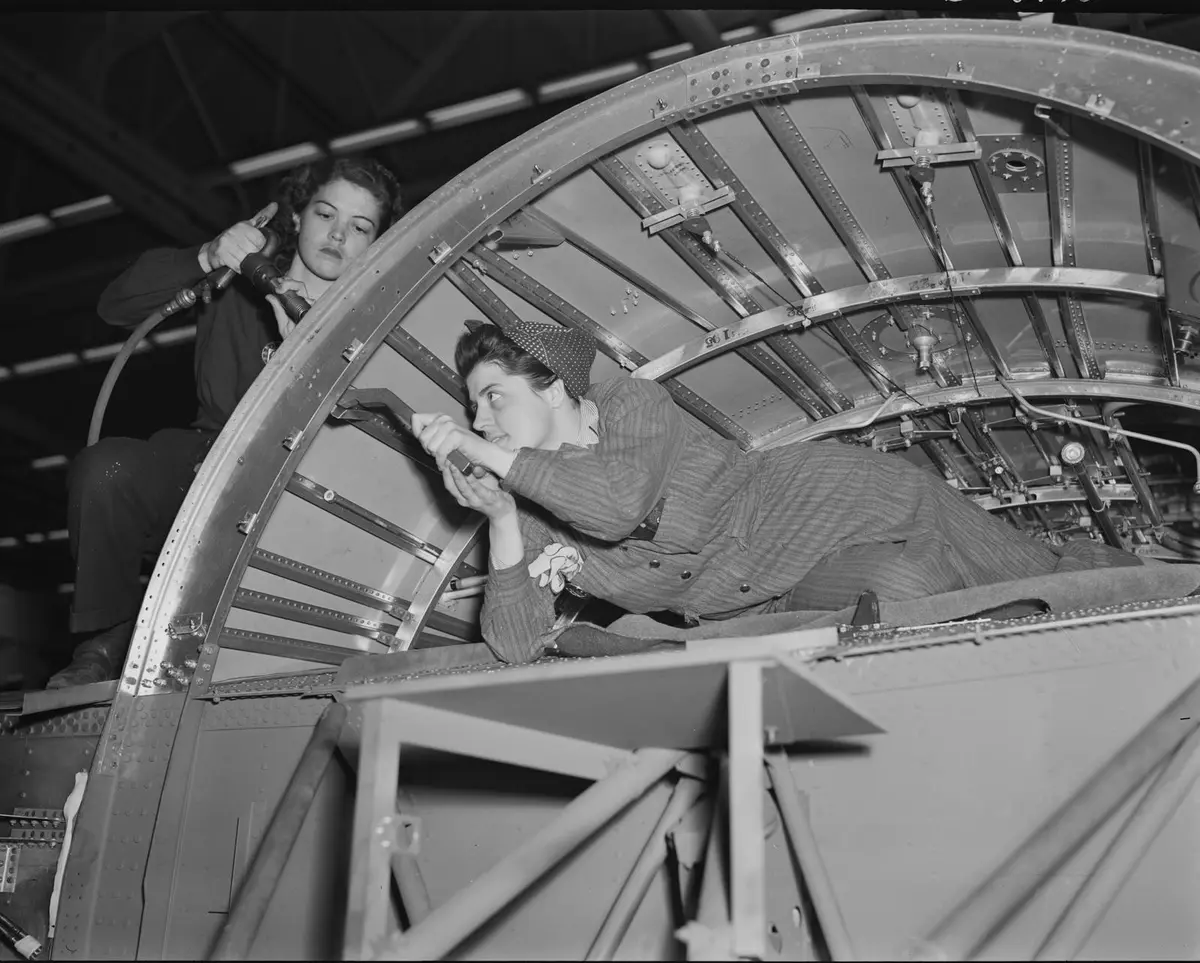
A team of women working inside a center wing section of a B-24E Liberator at Willow Run, 1942–43. Howard R. Hollem, Office of War Information / Library of Congress. One an hour
Working two nine-hour shifts, six days a week, Willow Run turns out 453 bombers in 468 working hours. That is a finished B-24 Liberator every 63 minutes. Sorensen’s hotel-room promise is now the plant’s routine. Ferry crews sleep on cots at the plant, waiting for their bombers to come off the line, and in September the 6,000th Liberator flies over Detroit.

The builders

Born in Copenhagen in 1881, he came to America at four and joined Ford as a patternmaker in 1905. He helped build the moving assembly line, sketched Willow Run overnight in a Coronado hotel room, and promised a bomber an hour.

Henry Ford’s only son and the company’s president from 1919. He went to San Diego with Sorensen, backed the plan to build whole bombers, and answered for the plant when Senator Truman came to inspect it. He died in May 1943, at 49.

Born in Pulaski County, Kentucky, in 1920 and widowed with two small daughters, she came to Michigan to rivet bombers. Walter Pidgeon put her in a war bond film, and she became a real-life Rosie the Riveter. She later ran her own construction company.

The Michigan farm boy whose Model T and moving assembly line put America on wheels. Willow Run rose on his own farmland. When Edsel died in 1943, Henry took the presidency back at 79 and saw the bomber line through the war.
By the numbers
In pictures


Watch, listen, see
Films, photographs and first-hand accounts from across the web. Each opens in a new tab.

Ford’s own wartime film on how the company mass-produced the B-24 Liberator at Willow Run.
Ford Motor Company · Internet Archive
Mo Rocca and curator Matt Anderson on how Ford turned car methods into a bomber line.
The Henry Ford · YouTube
The plant that built a bomber an hour, and the work to save its last section as a museum.
Detroit PBS
Photos and artifacts from Ford’s archives, from the construction site to the 6,000th bomber.
The Henry Ford
Ford’s 1944 flow chart of B-24 production, from fuselage sections to the single final line.
The Henry Ford
Full text and audio of Roosevelt’s 29 December 1940 fireside chat.
Miller Center, University of Virginia
Local history of the plant, from Henry Ford’s farm to 453 bombers in 468 working hours.
Ann Arbor Observer · Ann Arbor District LibraryThe Encyclopedia of Detroit on the bomber plant, its airfield and their life after the war.
Detroit Historical Society“We must be the great arsenal of democracy. For us this is an emergency as serious as war itself.”
President Franklin D. Roosevelt, fireside chat, 29 December 1940
After
In late 1944 the Army cut its B-24 orders as the air war turned to the B-29. Willow Run finished its last bomber on 28 June 1945: 6,792 complete Liberators flown off its own airfield and 1,893 kits for other plants. Liberators served with every branch of the American armed forces.
Kaiser-Frazer built some 739,000 cars in the plant after the war. General Motors followed and built transmissions and cars there until 2010. When most of the building came down in 2014, the Yankee Air Museum saved a section of the bomber plant as its future home.
Willow Run proved what Sorensen saw in a San Diego hotel room. The methods that built the Model T could build anything, even a four-engine bomber, and build it by the thousand.
Primary sources
- Willow Run Bomber Plant. The Henry Ford, Dearborn, Michigan.
- Message to Congress on Appropriations for National Defense, President Franklin D. Roosevelt, 16 May 1940. The American Presidency Project.
- Fireside Chat on National Security (the Arsenal of Democracy), President Franklin D. Roosevelt, 29 December 1940.