Ann Arbor, Michigan · 12 April 1955 · Jonas Salk, Thomas Francis and the Polio Pioneers
Could You Patent the Sun?
Americans mailed in their dimes, a Pittsburgh lab built the vaccine, and 1.8 million schoolchildren lined up to test it. Then Jonas Salk gave it away.

The moment · 10:20 EST · 12 April 1955
Rackham Auditorium, Ann Arbor. More than 500 scientists and physicians fill the seats. Cameras crowd a long platform at the back. Thomas Francis steps to the lectern with the verdict on 1.8 million children. It is ten years to the day since Roosevelt died.
The vaccine works. It is safe, effective, and potent.University of Michigan announcement of the Francis Report
Every summer, polio came for America’s children. Towns shut their movie theaters, parents kept their children home, and still the wards filled with iron lungs. In 1952 it struck nearly 58,000 Americans. A nation that had sent its dimes to the White House for fourteen years wanted a vaccine. A young doctor in Pittsburgh built one. Then the country tested it on its own children, all at once.
The president who could not walk
Franklin Roosevelt, 39, falls ill on vacation at Campobello Island, New Brunswick. On 25 August a specialist diagnoses infantile paralysis. His legs never recover. For the rest of his life he walks only with steel braces and a strong arm to lean on. He finds relief in the warm pools of Warm Springs, Georgia, and builds a treatment center there for other polio patients.
The March of Dimes
President Roosevelt founds the National Foundation for Infantile Paralysis and puts his old law partner, Basil O’Connor, in charge. Radio star Eddie Cantor asks every American to mail a dime to the White House and calls it the March of Dimes. Two days in, $17.50 has come. Then the flood. By 29 January the mailroom is buried under 2,680,000 dimes, and the President’s own mail is lost in it.
President Roosevelt, radio address, 29 January 1938In all the envelopes are dimes and quarters and even dollar bills, gifts from grownups and children, mostly from children who want to help other children to get well.
A lab in the contagious hospital
Jonas Salk comes to the University of Pittsburgh to build a Virus Research Laboratory in the city’s Municipal Hospital for Contagious Diseases. The National Foundation pays for it and asks him to sort polio viruses by type. His team includes microbiologist Julius Youngner, whose quick color test can measure virus in a test tube. By 1951 the work is done. There are three types of polio, and a vaccine must stop all three.
The worst year
Polio sweeps the country as never before. Nearly 58,000 Americans catch it. More than 21,000 are left with some paralysis, and more than 3,000 die, most of them children. Hospitals line up iron lungs in rows to breathe for patients whose chest muscles have stopped. In Pittsburgh, Salk is growing all three types of poliovirus in monkey kidney cells and killing them with formaldehyde. In monkeys, it works.
The first shots
At the D. T. Watson Home for Crippled Children, Salk starts testing his killed-virus vaccine on children who have already had polio. He gives every injection himself. Their antibody levels climb. He moves on to more volunteers, then to his lab staff and himself. In 1953 he boils needles on his kitchen stove and vaccinates his wife and their three sons. On 26 March 1953 he reports his results to the nation on radio.
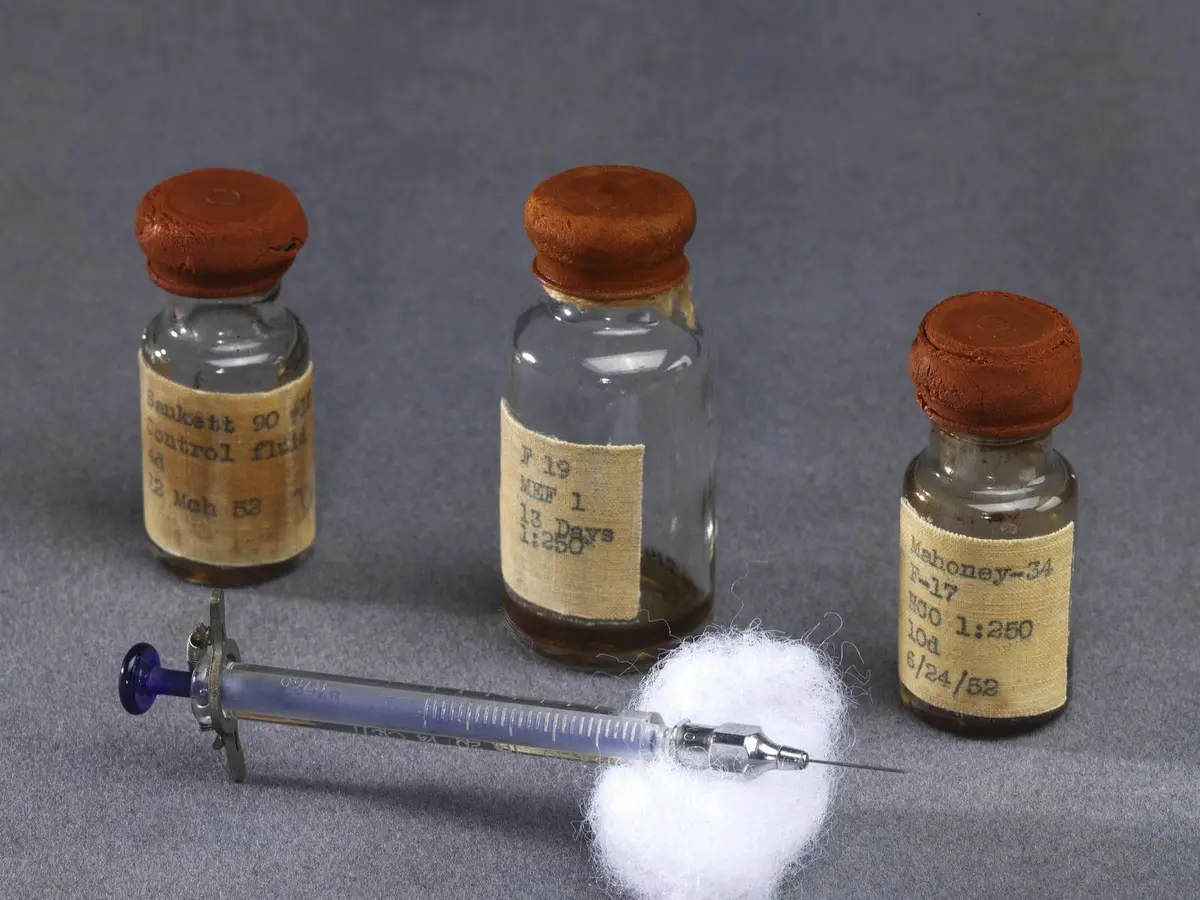
Jonas Salk’s own syringe and vials from his first vaccine tests near Pittsburgh in 1952.. Smithsonian National Museum of American History. Polio Pioneer No. 1
At Franklin Sherman Elementary School, six-year-old Randy Kerr rolls up his sleeve and gets the first shot of the national field trial. Thomas Francis of the University of Michigan runs it, and he demands a true test: in many areas, half the children get vaccine and half get a look-alike placebo, and nobody knows which. About 444,000 children get vaccine and about 210,000 get placebo. Each Polio Pioneer gets three shots, a card and a pin.
The greatest test in history
It is the largest medical trial ever run. In all, 1,829,916 children in 44 states, plus Canada and Finland, take part. More than 300,000 Americans make it happen, among them 20,000 physicians and health officers, 40,000 nurses, 14,000 principals and 50,000 teachers. In Ann Arbor, Francis’s staff loads 144 million pieces of information onto 1.8 million IBM punch cards. Francis guards the results so closely that not even Salk knows the details.
The vaccine works
Francis reads his report in Rackham Auditorium. In the areas where shots were given blind, 33 fully vaccinated children were paralyzed by polio, against 115 who got placebo. The vaccine is 80 to 90 percent effective against paralytic polio, and it is safe. Reporters sprint for the phones. Church bells ring across the country. That same day the federal government licenses the vaccine for use.
University of Michigan, release for 10:20 ESTThe vaccine works. It is safe, effective, and potent.
The people’s vaccine
Salk sits down with Edward R. Murrow for CBS Television’s See It Now. Millions of parents are about to line up for a vaccine the whole country paid for with its dimes. Murrow asks the question on everyone’s mind: who owns the patent? Salk does not hesitate. He never patents the vaccine and never takes a royalty from it.
Jonas Salk to Edward R. MurrowWell, the people, I would say. There is no patent. Could you patent the sun?
The conquerors

New York-born physician who learned killed-virus vaccines from Thomas Francis on the wartime flu vaccine. In Pittsburgh he led the team that built the polio vaccine, tested it on himself and his own sons, and refused to patent it.

Yale-trained virologist and the first American to isolate the human flu virus. Ran the Army’s influenza commission in World War II. He designed the 1954 field trial, insisted on a blind placebo test, and delivered the verdict.

Newsboy at ten who paid for college playing the fiddle, then became Roosevelt’s law partner. He ran the March of Dimes from its first day, chaired the American Red Cross, and bet the Foundation’s money on Salk’s trial.

Struck by polio at 39, he built Warm Springs into a treatment center and in 1938 founded the National Foundation that paid for Salk’s lab and the field trial. He died on 12 April 1945, ten years to the day before the announcement.
By the numbers
In pictures


Watch, listen, see
Films, photographs and first-hand accounts from across the web. Each opens in a new tab.

Archival film of the day America learned the Salk vaccine worked, from the foundation that paid for it.
March of Dimes
How Thomas Francis and his Ann Arbor team proved Salk’s vaccine safe and effective.
University of Michigan School of Public Health
The opening chapter of PBS’s film on the epidemic summers and the nation that beat them.
American Experience, PBS
How President Roosevelt founded the March of Dimes in 1938 to beat the disease that struck him.
Smithsonian Channel
The Roosevelt Library’s short history of the Birthday Balls and the dimes that flooded the White House.
FDR Presidential LibraryThe full text of the 12 April 1955 release: the vaccine works, with the trial’s numbers.
University of Michigan
Salk’s vaccine vials, a Polio Pioneer pin, an iron lung and March of Dimes artifacts.
Smithsonian National Museum of American HistoryPresident Eisenhower’s citation to Jonas Salk and his remarks in the Rose Garden, 22 April 1955.
The American Presidency Project“When I think of the countless thousands of American parents and grandparents who are hereafter to be spared the agonizing fears of the annual epidemic of poliomyelitis … I have no words in which adequately to express the thanks of myself and all the people I know.”
President Dwight D. Eisenhower to Jonas Salk, Rose Garden, 22 April 1955
After
Ten days after Ann Arbor, President Eisenhower welcomed Salk to the Rose Garden and handed him a citation naming him a benefactor of mankind. Salk later received the Congressional Gold Medal in 1975 and the Presidential Medal of Freedom in 1977. Pittsburgh renamed the old Municipal Hospital, where the vaccine was made, Salk Hall.
The disease collapsed. From more than 21,000 paralytic cases in 1952, the United States reported 2,525 cases of polio in 1960 and 61 in 1965. Albert Sabin’s oral vaccine, licensed in 1961, helped finish the job. The last case of polio caught inside the United States came in 1979, and in 1994 the whole Western Hemisphere was certified free of wild polio.
Salk never patented the vaccine. In 1963 he opened the Salk Institute for Biological Studies in La Jolla, California. The March of Dimes, its first mission won, turned to fighting birth defects. Every American child who has never seen an iron lung owes a debt to the dimes, the doctors and the Polio Pioneers of 1954.
Primary sources
- Polio Vaccine Evaluation Results, University of Michigan News Service release, 12 April 1955.
- Citation Presented to Dr. Jonas E. Salk and Accompanying Remarks, President Dwight D. Eisenhower, 22 April 1955. The American Presidency Project.
- Poliomyelitis. Epidemiology and Prevention of Vaccine-Preventable Diseases (Pink Book), Centers for Disease Control and Prevention.