Massachusetts General Hospital, Boston · 16 October 1846 · Morton, Warren and Gilbert Abbott
This Is No Humbug
A Boston dentist held a glass globe of ether to a young man’s face, and the city’s senior surgeon picked up his knife. Within weeks the world knew surgery no longer had to hurt.

The moment · Friday morning · 16 October 1846
Gilbert Abbott, 21, sits in the operating chair under the dome. Morton holds the glass globe to his mouth. After four or five minutes Abbott seems asleep. Warren cuts beneath his jaw. Abbott does not shrink or cry out. The first public trial of ether in surgery is under way.
Gentlemen, this is no humbug.John Collins Warren, as first reported in 1859
Before 1846, surgery meant lying awake while the knife did its work. Patients put it off until they had no choice, and surgeons were prized for speed. In the fall of that year a 27-year-old Boston dentist offered a vapor he said would stop the pain. The hospital’s senior surgeon agreed to try it, in public, in front of his colleagues.
A tooth pulled in his sleep
Dentist William Morton has learned from the chemist Charles T. Jackson that sulfuric ether can deaden feeling. Toward evening a Boston man named Eben Frost comes in with an aching tooth and wants it out. Morton soaks his handkerchief in ether and has Frost breathe it. He pulls a firmly rooted bicuspid. Frost comes around within a minute and knows nothing of what was done.
An invitation
Morton asks John Collins Warren, the hospital’s first surgeon, for a chance to prove his method. Warren satisfies himself the vapor is harmless and agrees. House surgeon Charles Heywood writes to Morton at Warren’s request and asks him to come on Friday. The patient is Gilbert Abbott, 21, admitted on 25 September with a mass under his left jaw that he has carried since birth.
The glass globe
A handkerchief works for a tooth. Surgery needs more. With advice from the physician Augustus Gould, in whose home he boards, Morton orders an inhaler from a glassmaker: a glass globe holding sponges soaked in ether, with a valved mouthpiece so the patient breathes in vapor and breathes out into the room. It is not ready on time. In the theater the doctors wait, and some think he will not come. Then Morton walks in with it.
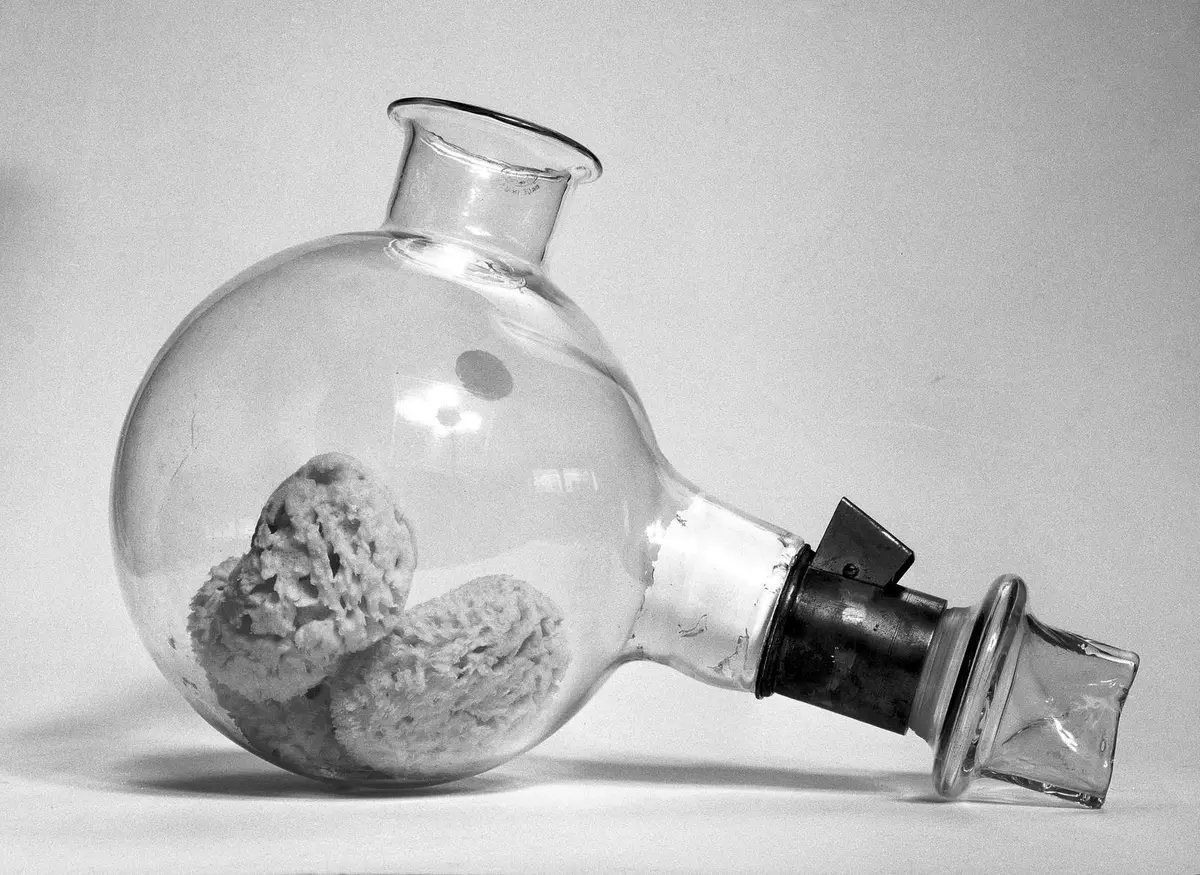
A replica of Morton’s ether inhaler: a glass globe holding sponges soaked in ether, breathed through the mouthpiece.. Wellcome Collection. Under the dome
Abbott breathes from the globe for four or five minutes and seems to fall asleep. Warren makes an incision of about three inches beneath the jaw, finds a tangle of veins and ties it off with a ligature. Abbott does not shrink or cry out at the cut. Near the end he stirs and mutters. Afterward he tells Warren he felt no pain, only something like a blunt instrument scraping his neck.
Warren to the gallery, as first reported in 1859Gentlemen, this is no humbug.
Complete success
The next day the vapor is given again, and this time surgeon George Hayward wields the knife. He removes a large fatty tumor from a woman’s upper arm in four or five minutes. When she wakes she says she felt no pain and knew nothing of the operation. Her only worry was for a child she had left at home. Bigelow writes that no one who saw it doubted the unconsciousness was real.
The leg
Now the real test. Alice Mohan, a young woman with a diseased knee, needs her right leg taken off above the knee. She protests that the vapor is too sharp to breathe, then goes under in about five minutes. Hayward amputates. She remembers nothing of the incision, and when Bigelow asks her afterward, she cannot say whether the leg is gone. It is the first major operation done under ether.
Henry Jacob Bigelow, 18 November 1846Two recent cases serve to confirm, and one I think to decide, the great utility of this process.
The news goes out
Henry Jacob Bigelow, a 28-year-old surgeon who watched the first operations, reads a paper on them to the Boston Society for Medical Improvement on 9 November. On the 18th the Boston Medical and Surgical Journal prints it. It is the world’s first formal report of surgical anesthesia. Three days later Dr. Oliver Wendell Holmes writes to Morton and suggests a name for the new state: anaesthesia.
Gone round the world
On 3 December the steamer Acadia leaves Boston carrying letters about the discovery. Bigelow’s father, Dr. Jacob Bigelow, has written to Dr. Francis Boott in London. On 19 December a London dentist, James Robinson, pulls a woman’s molar under ether. On 21 December surgeon Robert Liston amputates the leg of Frederick Churchill at University College Hospital. Churchill feels nothing. Within a year, surgeons in many countries are using ether.
The men in the theater

Born in Charlton, Massachusetts, he studied at the Baltimore College of Dental Surgery and opened a practice in Boston. He built the inhaler and put Gilbert Abbott under. In the Civil War he gave ether to the wounded at Fredericksburg, Chancellorsville and Spotsylvania.

Boston surgeon trained at Edinburgh, co-founder and first surgeon of Massachusetts General Hospital, first dean of Harvard Medical School and co-founder in 1812 of the journal now called the New England Journal of Medicine. He staked his name on an untried vapor and operated.

Young Boston surgeon who watched the first operations, pressed for more and wrote them up. His 1846 paper was voted the most important article in two centuries of the New England Journal of Medicine. He later became Harvard’s professor of surgery.

Harvard’s first professor of clinical surgery. He performed the second operation under ether the day after Ether Day, then on 7 November the first major one, amputating Alice Mohan’s leg while she slept. It settled the question for good.
By the numbers
In pictures


Watch, listen, see
Films, photographs and first-hand accounts from across the web. Each opens in a new tab.

A silent film reenactment of Ether Day, made and acted by the hospital’s own staff.
Massachusetts General Hospital
From the first public demonstration of ether in 1846 to anesthesia research at the same hospital today.
Massachusetts General Hospital
The artists behind the Ether Dome’s 2001 painting explain how they recreated the moment.
Massachusetts General Hospital
Harvard’s online exhibit on the first operations under ether, with letters, records and early photographs.
Countway Library, Harvard Medical SchoolThe original journal article that announced surgical anesthesia to the world, 18 November 1846.
Internet ArchiveJohn Collins Warren’s 1848 book on his first operations under ether, with his surgical remarks.
Internet Archive
Morton’s 1847 pamphlet on the proper way to give ether by inhalation, from the National Library of Medicine.
Internet Archive
Southworth and Hawes’s 1847 daguerreotype of Warren teaching beside a patient under ether in the Ether Dome.
J. Paul Getty Museum“It has long been an important problem in medical science to devise some method of mitigating the pain of surgical operations. An efficient agent for this purpose has at length been discovered.”
Henry Jacob Bigelow, Boston Medical and Surgical Journal, 18 November 1846
After
Within a year ether was in use across Europe and beyond. In the spring of 1847 Warren brought the Boston daguerreotypists Southworth and Hawes into the theater, and they made the first photographs of live operations. By the end of the Civil War, Union surgeons had done at least 80,000 operations under anesthesia. Morton went to the front himself and gave ether to the wounded in the field hospitals.
In Jefferson, Georgia, Dr. Crawford Long had removed a tumor from a patient’s neck under ether on 30 March 1842, though he did not publish it until 1849. Boston’s public demonstration is the one that reached the world. Both men were Americans.
In 1868 Boston raised the Ether Monument in the Public Garden. Morton died that same year, at 48, and lies at Mount Auburn Cemetery under an epitaph saying that before him, surgery had always been agony. The old operating theater, now the Ether Dome, became a National Historic Landmark in 1965 and is still a lecture hall. Every 16 October, Boston keeps Ether Day.
Primary sources
- Henry Jacob Bigelow, “Insensibility during Surgical Operations Produced by Inhalation.” Boston Medical and Surgical Journal 35, no. 16, 18 November 1846.
- John Collins Warren, Etherization; with Surgical Remarks. Boston: W. D. Ticknor, 1848.
- Surgical Records, vol. 30, 1846: case of Edward Gilbert Abbott. Massachusetts General Hospital Archives, transcribed in P. G. Firth, “Ether Day Revisited,” Annals of Surgery Open, 2022.
Keep exploring
- Smallpox InoculationDr. Zabdiel Boylston inoculated Boston against smallpox in 1721, and his careful count of every patient showed the method saved lives.1 in 40died after inoculation, vs. 1 in 7 naturally
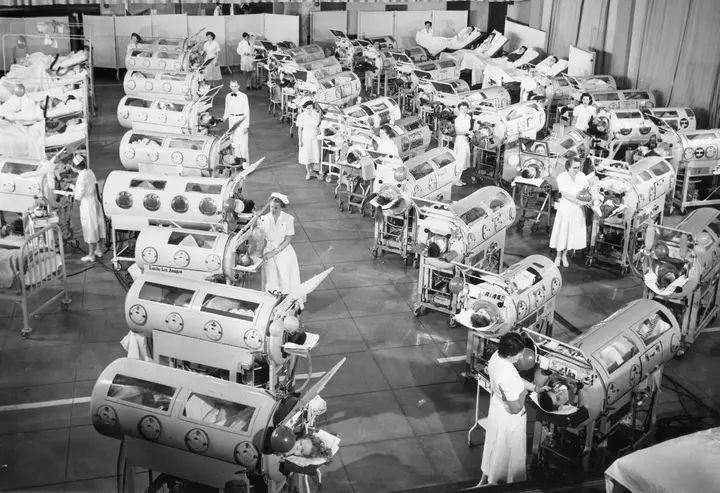
- The Polio VaccineJonas Salk’s vaccine was tested on nearly two million schoolchildren, declared safe and effective, and never patented.1.8Mchildren in the trial
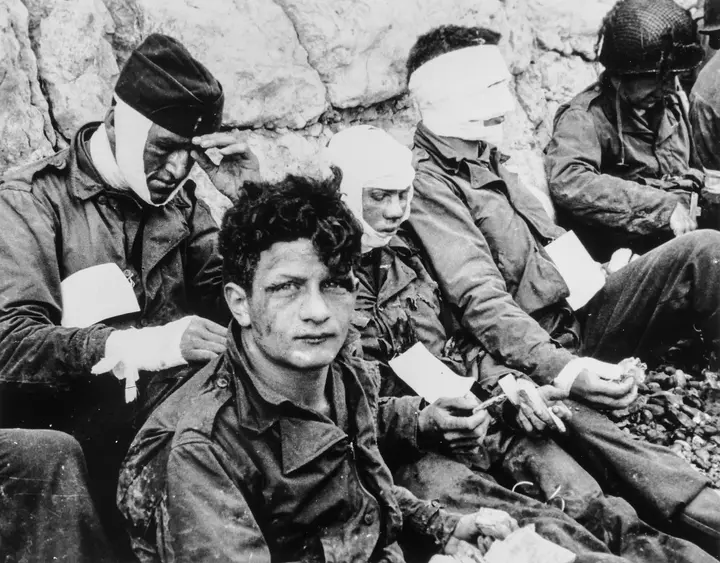
- Penicillin for D-DayBritain discovered penicillin but made it by the spoonful. Peoria scientists and 21 American companies had 2.3 million doses ready for D-Day.2.3Mdoses by D-Day
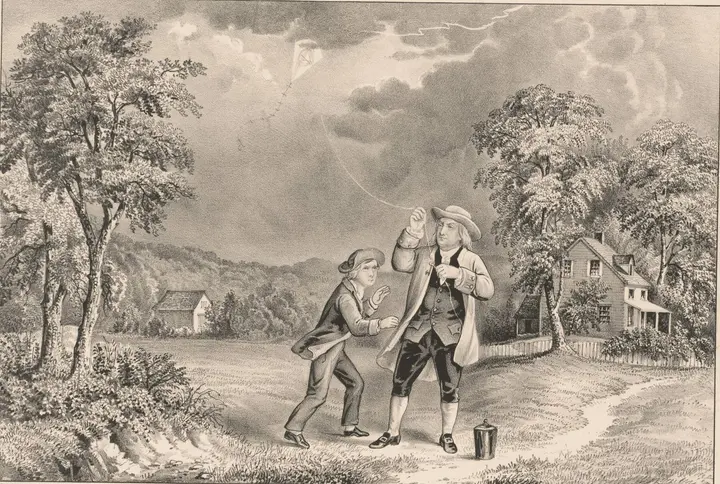
- Franklin and the Lightning RodFranklin proposed the test, a kite repeated it in a Philadelphia storm, and a few feet of iron rod gave every house a way to survive lightning.6–8 ftof iron rod to save a house


Free, with no ads. Support the museum →