Mount Everest, Nepal · 1 May 1963 · American Mount Everest Expedition
Let’s Go Together
An American team climbed Everest by two routes in one spring. Six men stood on top, and two of them went up a ridge nobody had climbed and came down the other side.

The moment · 18:15 · 22 May 1963
Eleven hours out of their last camp, Tom Hornbein and Willi Unsoeld come off the West Ridge snow and see Whittaker’s flag forty feet away. They throw their arms around each other’s shoulders and walk to it together. The sun is low. There is no way back.
I have promises to keep, and miles to go before I sleep.Willi Unsoeld by radio as they left the summit, quoting Robert Frost
Ten years after Hillary and Tenzing, no American had stood on the summit of Everest. Norman Dyhrenfurth won a permit from Nepal in 1961, then spent two years raising money and building a team. The plan was bold: put Americans on top by the South Col, and send a second team up the unclimbed West Ridge to cross the summit and come down the other side.
The march in
Nineteen Americans, a British transport officer, a Nepalese liaison officer and 32 hand-picked Sherpas leave the Kathmandu valley with 909 porter loads averaging 62 pounds each. They walk for a month. On 21 March they set Base Camp at 17,800 feet, closer to the Khumbu Icefall and earlier in the year than any expedition before them.
Jake Breitenbach
On the second day in the Icefall, a thirty-foot wall of ice collapses on Jake Breitenbach of the West Ridge team. He is killed instantly. The team gathers at Base Camp and decides together to go on. Five days later Unsoeld, Whittaker, Lute Jerstad and Nawang Gombu climb a 70-foot vertical ice wall at the top of the Icefall and look into the Western Cwm.
Two routes at once
Jerstad, Dick Pownall and the Sherpas Nima Tenzing and Chotari reach the South Col at 26,200 feet, the earliest in the year anyone had stood there. Meanwhile the West Ridge team scouts a line nobody has tried. With every Sherpa needed on the Col, they string cable, rig motor winches and haul sleds of oxygen up the slope themselves.
Into the gale
Jim Whittaker and Nawang Gombu leave Camp VI at 27,450 feet under a huge plume of blowing snow. Their tracks fill in behind them. Each drops a partly used oxygen bottle at about 28,400 feet to save weight. At 11:30 they reach the South Summit, where the storm hits with full force. Whittaker looks at the final ridge, weighs it, and keeps going.
First American on top
Below the last dome Whittaker stops and waits for Gombu. He tells him to go first. Gombu tells him to go first. They walk the last five feet side by side and hold each other upright on the summit in the wind. Whittaker drives a four-foot aluminum stake with an American flag into the snow. On the way down their oxygen runs out. They reach Camp VI about 17:30.
Whittaker to Gombu, at the summitLet’s go together.
Past the point of no return
Tom Hornbein and Willi Unsoeld leave Camp V-W, a tent on a snow ledge no more than eight feet long at 27,200 feet. They climb a steep gully on the North Face, one at a time, cutting steps. At 10:30 they radio Base that the route below is too dangerous to descend. The only way off the mountain now is over the top.
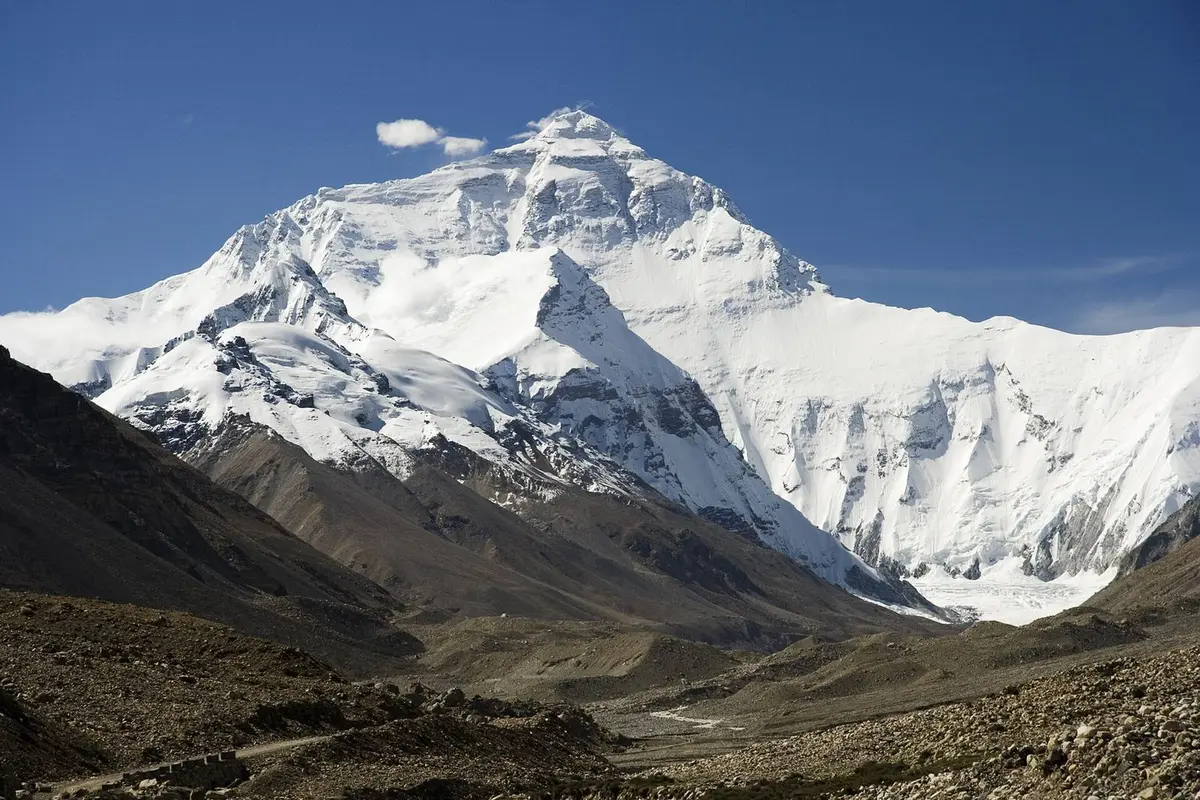
Everest’s North Face from the Rongbuk Valley in Tibet. Hornbein and Unsoeld climbed the steep couloir high on this face, now named for Hornbein.. Luca Galuzzi / Wikimedia Commons. The South Col team
On the other side of the mountain, Lute Jerstad and Barry Bishop climb the Southeast Ridge. Bishop is close to exhaustion. Shortly before 15:30 they see Whittaker’s flag, still standing, and step onto the summit together. Jerstad shoots the highest motion pictures ever made. They spend 45 minutes on top, watching and shouting down the West Ridge for their friends, then start down.
Over the top
Hornbein and Unsoeld trade crampons for bare rock on the ridge crest, then cross the last snow to the flag. Unsoeld tucks a crucifix and two prayer flags into Gombu’s scarf at the foot of the pole. After twenty minutes they start down the Southeast Ridge as the sun sets. No one has ever gone up one side of Everest and down the other.
Unsoeld by radio, leaving the summitI have promises to keep, and miles to go before I sleep.
A night at 28,000 feet
In the dark the two pairs find each other at about 21:30 and rope up together. At 00:30 they cannot see the route and stop where they are, at about 28,000 feet, with no tent, no sleeping bags and almost no oxygen. Unsoeld warms Hornbein’s feet against his own body. At dawn all four stand up and walk down. All four live.
The climbers

Mount Rainier guide from Seattle who taught mountaineering and skiing in the Army, then became the first full-time employee of REI in 1955. At 6 feet 5, he broke trail through the storm with Nawang Gombu and planted the flag on top.

Navy anesthesiologist from St. Louis, released early from duty at San Diego Naval Hospital to make the climb. He redesigned the team’s oxygen mask, pushed hard for the West Ridge, and climbed the couloir that now bears his name.

Physics graduate of Oregon State, Teton guide and teacher of philosophy and religion, serving with the Peace Corps in Nepal. He made the first ascent of Masherbrum in 1960. On Everest he ran the West Ridge effort and climbed it to the top with Hornbein.

Filmmaker who came to America in 1937 and served in the U.S. Army. After Everest in 1952 and Lhotse in 1955, he won the permit, raised the money and picked the team. On 1 May he hauled a movie camera high above Camp VI.
By the numbers
In pictures


Watch, listen, see
Films, photographs and first-hand accounts from across the web. Each opens in a new tab.

Rare footage of Hornbein and Unsoeld’s 1963 West Ridge climb, alongside a 2012 team retracing their route.
Eddie Bauer / First Ascent
Eleven White House photographs of the Hubbard Medal ceremony on 8 July 1963, every climber named.
JFK Library
The White House sound recording of President Kennedy’s remarks as he presented the Hubbard Medal.
JFK Library
Dyhrenfurth and Unsoeld’s own account from the 1964 American Alpine Journal, from the march in to the night out.
Himalayan Journal
The American Alpine Club on the West Ridge climb, the first traverse of Everest and the night above 28,000 feet.
American Alpine Club
196 photographs and records of the 1963 expedition, from the trek through Nepal to life in camp.
American Alpine Club LibraryHornbein recounts a life in the mountains, from a Colorado summer camp at 13 to the West Ridge of Everest.
Estes Park MuseumThe American Alpine Club’s tribute to the first American on Everest, who died in April 2026 at 97.
American Alpine Club“So we are glad to welcome all of you gentlemen here and tell you that we followed your actions with the greatest pride.”
President John F. Kennedy, Rose Garden, 8 July 1963
After
On 8 July 1963 President Kennedy welcomed the team to the Rose Garden and presented the National Geographic Society’s Hubbard Medal to Dyhrenfurth for the whole expedition. Nawang Gombu presented the President with a white Buddhist scarf, the same kind he had tied to the flagpole on the summit.
Unsoeld and Bishop were flown from Namche Bazar to a Kathmandu hospital and lost toes to frostbite. Hornbein and Jerstad came through without lasting injury. Two years later Gombu climbed Everest again, the first man to reach the top twice.
Whittaker went on to lead the 1978 expedition that put the first Americans on top of K2, and ran REI as its chief executive. Hornbein taught anesthesiology for decades at the University of Washington. The steep gully that took him and Unsoeld through the North Face is still called the Hornbein Couloir.
Primary sources
- Norman G. Dyhrenfurth and William F. Unsoeld, “Mount Everest, 1963.” American Alpine Journal, 1964; reprinted in the Himalayan Journal, vol. 25.
- Remarks Upon Presenting the Hubbard Medal to the Leader of the American Everest Expedition, President John F. Kennedy, 8 July 1963.
- Presentation of the Hubbard Medal to members of the American Mount Everest Expedition, White House Photographs, 8 July 1963. John F. Kennedy Presidential Library.