Santiago de Cuba · 1 July 1898 · Rough Riders and the regulars
The Crowded Hour
Theodore Roosevelt rode up Kettle Hill under fire with the regulars beside him. Eight and a half minutes of Gatling fire later, the San Juan Heights were American.

The moment · About 13:00 · 1 July 1898
The order comes at last. Roosevelt swings onto Little Texas and rides through the lines, waving his hat, as Mauser fire sweeps the grass. The regulars jump up and go with him. Forty yards from the crest a wire fence stops the horse. He jumps down and runs on.
Then I am the ranking officer here and I give the order to charge.Lt. Col. Theodore Roosevelt, to a captain of the regulars
Spain’s army held the heights outside Santiago de Cuba, and Admiral Cervera’s squadron lay bottled up in the harbor below. Take the heights and the city would fall. On 1 July 1898 about 6,600 American soldiers, regulars and volunteers, went at the San Juan Heights across open ground under Mauser fire. The Rough Riders were among them.
Ashore in Cuba
The Fifth Army Corps lands through heavy surf at Daiquirí, east of Santiago, with too few boats. The Rough Riders left their troop horses in Tampa; only eight troops of 70 men each made the voyage. The officers’ horses are pushed overboard to swim for it. One of Roosevelt’s drowns. The other, Little Texas, makes it ashore. Two days later the regiment fights its first battle, at Las Guásimas.
The guns open
The army moves on Santiago. Lawton’s division attacks the village of El Caney to the north. At El Pozo, about two miles from the heights, American field guns open fire, and Lt. John Parker’s four Gatling guns go into battery behind them. Spanish artillery answers, its smokeless powder hiding the guns. The cavalry division and Kent’s infantry start down a single jungle trail toward the San Juan River.
Bloody Ford
The trail is narrow and choked with men. An Army observation balloon, towed above the column, comes down near the ford over the San Juan River and shows the Spanish gunners exactly where the troops are crossing. Fire pours onto the ford. Across the river the regiments spread out in the tall grass and wait for orders, pinned under Mauser fire from heights they cannot yet answer.
Waiting under fire
The Rough Riders lie in a sunken lane below Kettle Hill while bullets cut the grass. Capt. William “Bucky” O’Neill, mayor of Prescott, Arizona, walks up and down in front of his troop, smoking. A sergeant begs him to lie down. O’Neill laughs and says the Spanish bullet isn’t made that will kill him. Moments later a bullet strikes him in the mouth. He is dead before he falls.
Up Kettle Hill
Lt. Col. Dorst rides in through the bullets with the order to advance. Roosevelt mounts Little Texas and pushes through the lines to the front. When a captain of the regulars says he cannot charge without orders, Roosevelt gives the order himself. The 9th Cavalry, the 1st Cavalry and the Rough Riders go up Kettle Hill together. Sgt. George Berry of the 10th carries two regiments’ colors up the slope.
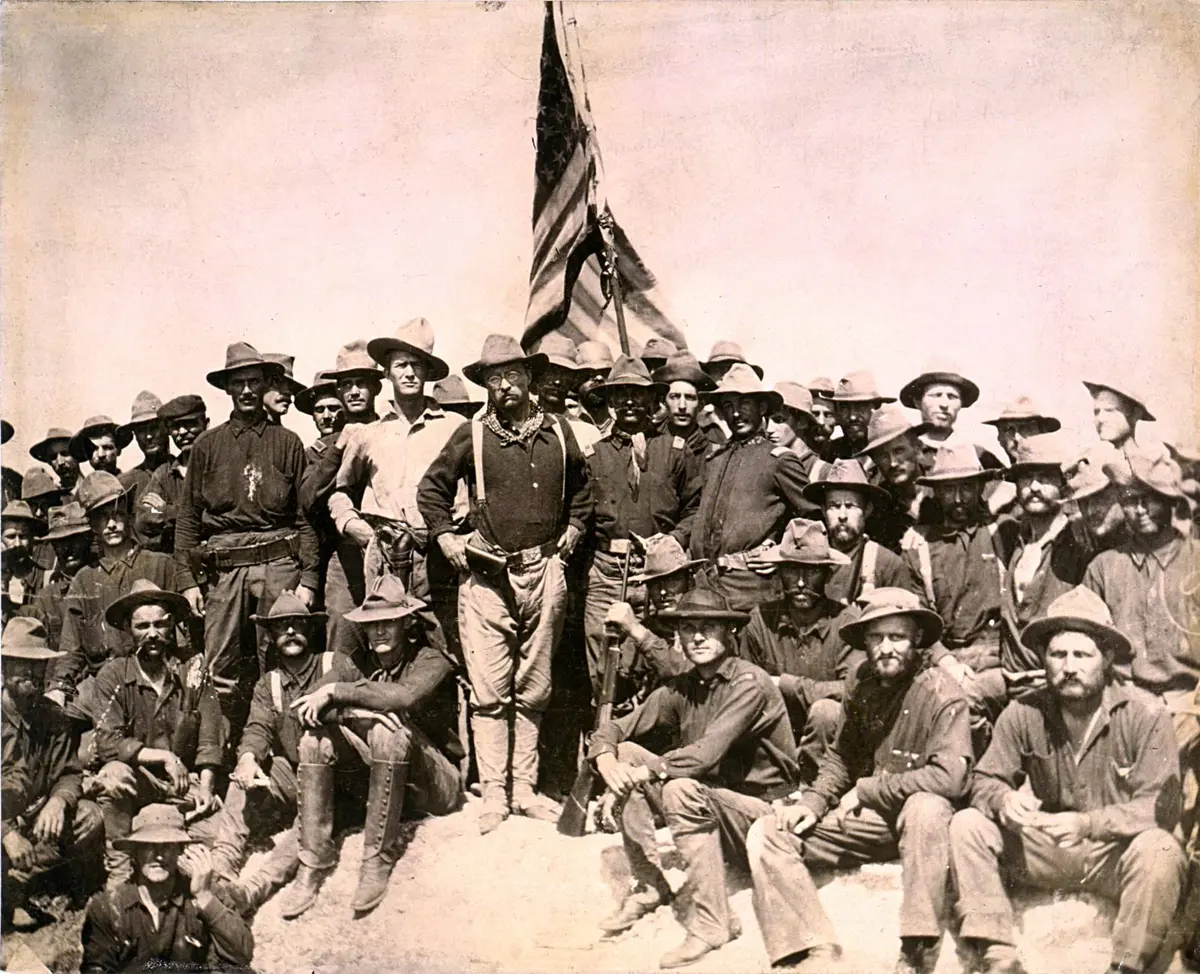
Colonel Roosevelt and his Rough Riders at the top of the hill they captured, Battle of San Juan, July 1898. William Dinwiddie / Library of Congress (LC-USZ62-7626). Lt. Col. Dorst, with the orderMove forward and support the regulars in the assault on the hills in front.
Our Gatlings
Below San Juan Hill, Parker runs three Gatlings forward past the ford and opens fire at 600 to 800 yards. Each gun grinds out 500 shots a minute. The Spanish fire slackens, then the defenders climb out of their trenches and run. Kent’s infantry, led by Brig. Gen. Hamilton Hawkins, goes up the slope under the hail. At 13:23 Parker orders cease fire. A moment later the crest is American.
Roosevelt, on Kettle HillIt’s the Gatlings, men, our Gatlings!
On the heights
Roosevelt leads the next rush off Kettle Hill, across the valley to the Spanish trenches on the heights beyond. Two Spaniards rise and fire at him from ten yards. He kills one with a revolver from the sunken battleship Maine. By evening he commands the fragments of six cavalry regiments on the crest, looking down on Santiago. When about 400 Spanish troops come at the line, Parker turns a Gatling on them and breaks it up.
The fleet comes out
With the heights lost, Admiral Cervera takes his four cruisers and two destroyers out of Santiago harbor in a run for the open sea. The blockading squadron opens fire at once. Commodore Winfield Scott Schley’s Brooklyn and the battleships Iowa, Indiana, Texas and Oregon chase them down the coast. By early afternoon all six Spanish ships are sunk or burning on the beach. One American is killed, Chief Yeoman George Ellis of Brooklyn.
The flag over Santiago
Gen. José Toral surrenders the city and every Spanish soldier in the district, nearly 24,000 men by General Shafter’s count. At noon the 9th Infantry and a battalion of the 13th, the regiments given first honors for the assault, escort the flag into the city. A field gun fires, a band plays The Star-Spangled Banner, and the American lines around Santiago break into six miles of cheering.
The leaders

Quit as Assistant Secretary of the Navy to help raise the 1st U.S. Volunteer Cavalry. Took command of the regiment days before the battle, led the charge up Kettle Hill on horseback and the rush on to the San Juan Heights.

Army surgeon who won the Medal of Honor in the 1886 campaign against Geronimo. Raised and trained the Rough Riders with Roosevelt, then led their brigade, with the 1st and 10th Cavalry, onto the heights on 1 July.

West Point, 1892. Argued before the war that machine guns could attack, then proved it. His three Gatlings covered the final rush up San Juan Hill, and the heights fell eight and a half minutes after they opened fire.

Civil War veteran and former commandant of cadets at West Point. At 63 he led Kent’s infantry up the open slope of San Juan Hill behind Parker’s covering fire and was wounded near the crest.
By the numbers
In pictures


Watch, listen, see
Films, photographs and first-hand accounts from across the web. Each opens in a new tab.

Biograph film of a Rough Rider troop charging on horseback at Tampa before the regiment sailed for Cuba.
Library of Congress
The Army’s own short tribute to the Battle of San Juan Hill, 1 July 1898.
U.S. Army
Roosevelt’s own 1899 account of raising the regiment and leading it up Kettle Hill. Free to read.
Project Gutenberg
Lt. John Parker’s 1898 history of his Gatling detachment, with his official report and photographs.
Project Gutenberg
William Dinwiddie’s 1898 photograph of Roosevelt and his Rough Riders on the hill they took.
Theodore Roosevelt CenterPresident Clinton’s remarks presenting Roosevelt’s Medal of Honor in the Roosevelt Room, 16 January 2001.
Clinton White House Archives
The Navy’s account of the 3 July battle that destroyed Admiral Cervera’s entire squadron.
Naval History and Heritage Command
The American memorial in Santiago marking where Spain surrendered the city on 17 July 1898.
American Battle Monuments Commission“The instant I received the order I sprang on my horse and then my “crowded hour” began.”
Theodore Roosevelt, The Rough Riders, 1899
After
Roosevelt came home a national hero. That November New York elected him governor. In September 1901 he became president at 42, the youngest in the nation’s history. On 16 January 2001, in the White House room named for him, President Clinton presented his Medal of Honor to his great-grandson Tweed Roosevelt. He is the only president to receive it.
Wood became military governor of Cuba and later Army Chief of Staff. Parker kept pressing the case for machine guns, and in France in 1918, commanding the 102nd Infantry, he won the Distinguished Service Cross four times.
General Shafter’s order of 19 July summed up the campaign: seventeen days of battle and siege, and eastern Cuba cleared of Spanish troops. The war ended with the Treaty of Paris that December. A memorial kept by the American Battle Monuments Commission still marks the tree outside Santiago where the surrender was arranged.
Primary sources
- Theodore Roosevelt, The Rough Riders. Charles Scribner’s Sons, 1899.
- John H. Parker, History of the Gatling Gun Detachment, Fifth Army Corps, at Santiago, 1898. Includes his official report and General Shafter’s General Orders No. 26 of 19 July 1898.
- Samuel J. Cox, “Victory at Santiago, 3 July 1898,” H-Gram 020, Naval History and Heritage Command.