Earth orbit · 2–13 December 1993 · Space Shuttle Endeavour, STS-61
The Trouble with Hubble Is Over
Hubble went up with a flaw in its mirror one-fiftieth the width of a human hair. Seven astronauts flew up, caught it and fixed it in five spacewalks.

The moment · 13 January 1994
Five weeks after the last spacewalk, NASA puts two pictures of galaxy M100 side by side. On the left, the old blur. On the right, the view through the camera Hoffman and Musgrave installed: crisp spiral arms, sharp points of light. Senator Barbara Mikulski holds them up.
The trouble with Hubble is over.Senator Barbara Mikulski, NASA press conference
In April 1990 the United States put a telescope the size of a school bus into orbit, and its first pictures came back blurry. Its 7.9-foot mirror had been ground a sliver too flat. But Hubble was the first telescope built to be repaired in space. NASA sent seven astronauts to catch it, open it up and give it new eyes.
A flaw in the glass
Discovery carries Hubble into orbit, and the next day the crew lifts it out of the payload bay and lets it go. Then the first pictures come down. Stars that should be sharp points are fuzzy smears. On 27 June NASA announces the cause: the outer edge of the 7.9-foot primary mirror was ground 2.2 microns too flat, because a test instrument had a lens set 1.3 millimeters out of place.
Glasses for a telescope
In a hotel in Garching, Germany, engineer James Crocker of the Space Telescope Science Institute adjusts a European shower head mounted on movable rods and sees the answer: small corrective mirrors on arms that reach into the light path by remote control. That becomes COSTAR, a box the size of a large refrigerator holding five pairs of corrective mirrors. At NASA’s Jet Propulsion Laboratory, a team builds a new camera, WFPC2, with the correction ground into its own optics.
Night launch
Endeavour lifts off from Pad 39B in the dark with seven astronauts and more than 200 special tools. Richard Covey commands and Ken Bowersox flies as pilot. Swiss astronaut Claude Nicollier of the European Space Agency will run the robot arm. Two pairs will do the spacewalking: Story Musgrave with Jeff Hoffman, and Kathryn Thornton with Tom Akers.
A firm handshake
After two days of chasing, Covey flies Endeavour up close to the 43-foot telescope. Nicollier reaches out with the robot arm, grabs a fixture on Hubble’s side and lowers it into the payload bay, where it stands upright for the work ahead. Nothing on the mission can happen without this catch.
Covey to Mission ControlEndeavour has a firm handshake with Mr. Hubble’s telescope.
Gyros and wings
Musgrave and Hoffman spend 7 hours 54 minutes outside replacing the gyroscopes that point the telescope. Next, Thornton and Akers take on the solar arrays. One old array will not roll up. Thornton, riding the end of the robot arm, holds it over her head and lets it go. Bowersox fires the thrusters to back away, and it drifts off flapping like a giant bird. Two new arrays go on.
New eyes
The big one. Hoffman, anchored to the robot arm, and Musgrave slide the old camera out of Hubble like a drawer. In goes WFPC2, more than 600 pounds and the size of a baby grand piano, with a delicate pickoff mirror that has to go in without a bump. The swap takes about 40 minutes. They finish the day by installing two new magnetometers. Time outside: 6 hours 47 minutes.
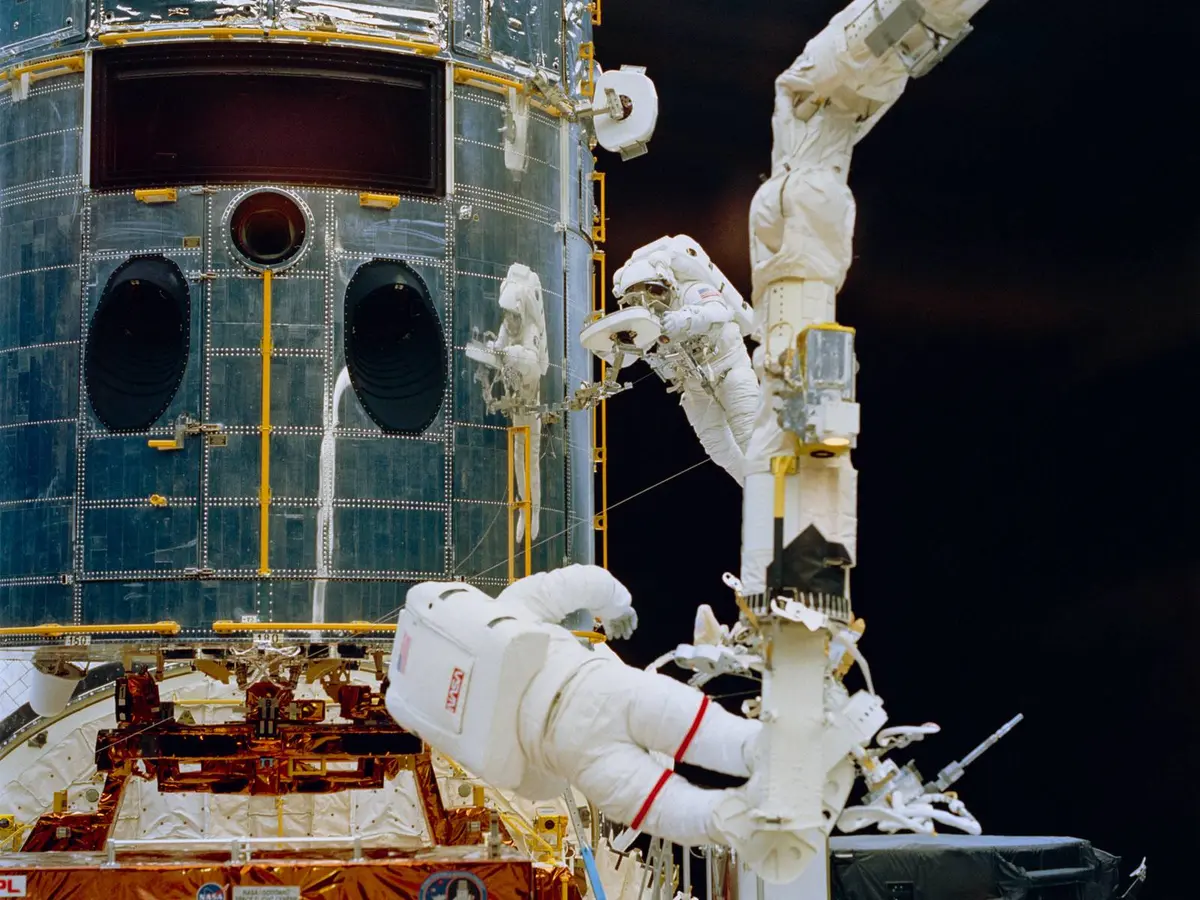
Jeffrey Hoffman, anchored to the end of Endeavour’s robot arm, prepares to install the new Wide Field and Planetary Camera 2 as Story Musgrave works at the open bay, 7 December 1993 (STS061-74-046).. NASA / Johnson Space Center. The corrective optics
Thornton and Akers pull out the High Speed Photometer and install COSTAR in its place, plus a new computer coprocessor. Akers finishes with 29 hours 40 minutes of career spacewalking, a new American record. On the fifth spacewalk Musgrave and Hoffman replace the solar array drive electronics and cover the magnetometers. It is Hanukkah, and Hoffman has a menorah and a dreidel aboard.
Back to work
Nicollier lifts Hubble out of the bay on the arm and releases it, new arrays spread wide. Three hours later President Clinton calls the crew from the Oval Office. Endeavour lands at Kennedy Space Center at night on 13 December after 163 orbits and 4,433,772 miles. Five spacewalks, 35 hours 28 minutes outside, every task done.
The pictures
WFPC2 sends its first test data on 18 December and photographs galaxy M100 on New Year’s Eve. NASA releases the results in January: the same galaxy before and after, the blur gone. Astronomers who see the new pictures give the camera team a standing ovation. Hubble can now pick out details 30 light-years across in a galaxy tens of millions of light-years away.
Senator Barbara Mikulski, NASA press conferenceThe trouble with Hubble is over.
The repair crew

Marine Corps aircraft crew chief in Korea and Japan, then a surgeon with six degrees. Made the space shuttle’s first spacewalk in 1983. Flew three of the five Hubble spacewalks and, with Hoffman, put in the camera that fixed its vision.

Harvard-trained astrophysicist who built gamma-ray and X-ray telescopes before NASA picked him in 1978. Made the shuttle’s first unplanned spacewalk in 1985. Riding the robot arm, he pulled Hubble’s old camera and slid WFPC2 into place.

Physicist from Montgomery, Alabama, with a doctorate from the University of Virginia. Spacewalked on Endeavour’s first flight in 1992. On Hubble she released the damaged solar array by hand and installed COSTAR with Tom Akers.

Air Force fighter pilot who flew 339 combat missions in Southeast Asia, then a test pilot. Piloted the first shuttle flight after Challenger. Commanded Endeavour, flew the rendezvous with Hubble and landed the crew at night in Florida.
By the numbers
In pictures


Watch, listen, see
Films, photographs and first-hand accounts from across the web. Each opens in a new tab.

Kathy Thornton tells how the crew caught Hubble, threw away a solar array and gave it new eyes.
NASA Goddard
Payload commander Story Musgrave recounts the training and spacewalks that fixed Hubble.
NASA Goddard
NASA’s film of STS-61: crew training, spacewalk highlights, COSTAR going in and Hubble’s release.
NASA Scientific Visualization Studio
The astronomer-astronaut recalls the pressure on NASA and his crew to fix Hubble.
NASA JSC Oral History Project
Transcript of President Clinton’s 10 December 1993 call congratulating the crew in orbit.
The American Presidency Project
NASA’s photo album of the first Hubble repair: the catch, the spacewalks and the release.
NASA Hubble (Flickr)
NASA’s day-by-day history of the first Hubble servicing mission, from crew selection to landing.
NASA History
The January 1994 picture that proved the fix: galaxy M100 through Hubble’s old and new optics.
NASA / STScI“We’re all so proud of you, and we’ve been able to see you do all those things. It’s just been wonderful, and I want to thank each and every one of you for what you’ve done. You made it look easy.”
President Bill Clinton, to the crew of Endeavour, 10 December 1993
After
The repair team won the 1993 Collier Trophy, the top prize in American aviation. Kathryn Thornton’s 21 hours of spacewalking made her the leading American woman spacewalker, and Tom Akers held the American record outright.
Astronauts went back to Hubble four more times, the last in 2009. Across five servicing missions, 16 spacewalkers made 23 spacewalks and logged more than 165 hours upgrading the telescope. WFPC2 and COSTAR came home on the final mission and went to the Smithsonian’s National Air and Space Museum.
With its vision fixed, Hubble photographed the Pillars of Creation, looked back across billions of years in the Deep Field, helped show that the universe’s expansion is speeding up, a discovery that won the 2011 Nobel Prize in Physics, and pinned the age of the universe at about 13.8 billion years. On 19 September 2026 it completed its 200,000th orbit, still sending home discoveries.