Annapolis, Maryland · 23 December 1783 · George Washington and the Congress
I Here Offer My Commission
He had won the war, and the army would have followed him anywhere. He rode to Congress, handed back his commission, and went home for Christmas.

The moment · Midday · 23 December 1783
The chamber is packed. His hand shakes, and he grips the paper with both hands. When he commends his country to God, his voice falters. He stops, steadies himself, and reads the last lines. Then he draws his commission from his coat and hands it over.
Having now finished the work assigned me, I retire from the great theatre of Action; and bidding an Affectionate farewell to this August body under whose orders I have so long acted, I here offer my Commission, and take my leave of all the employments of public life.George Washington, to the Congress at Annapolis
By the end of 1783 George Washington had won the war. The army was loyal to him, and many of its officers were angry at a Congress that could not pay them. He could have taken power. Instead he rode to Annapolis, handed his commission back to the civilians who had given it to him, and went home to Virginia.
No king
Colonel Lewis Nicola sends Washington a long letter arguing that the new country would do better under a king. Washington answers at once. No event of the war, he writes, has given him more painful sensations. He views the idea with abhorrence and orders Nicola to banish it from his mind and never repeat it.
Washington to Col. Lewis NicolaIf I am not deceived in the knowledge of myself, you could not have found a person to whom your schemes are more disagreeable.
The spectacles
An anonymous paper is passing through the camp, urging unpaid officers to defy Congress. Washington calls them to the Temple, a meeting hall at the New Windsor camp, and speaks himself. He begs them not to open the floodgates of civil discord. Then he starts to read a letter from a Virginia congressman, stops, and puts on a pair of spectacles. After he leaves, the officers vote to trust Congress.
Capt. Samuel Shaw, who was in the roomHe had grown gray in their service, and now found himself growing blind.
Peace
The Treaty of Paris is signed on 3 September, and Britain recognizes the United States as free and independent. On 25 November the British army leaves New York City. Nine days later Washington says goodbye to his officers at Fraunces Tavern, taking each man by the hand. Then he heads south toward Congress, which is sitting in Annapolis.
In writing, or in person?
Washington rides into Annapolis on 19 December with two aides. The next day he writes to the President of Congress, Thomas Mifflin, asking how to resign: “whether in writing, or at an Audience.” Congress chooses a public audience, Tuesday at twelve o’clock. It votes that seven states are enough to receive the resignation, and sets Thomas Jefferson, Elbridge Gerry and James McHenry to plan the ceremony.
Not a soul got drunk
Congress gives a public dinner. Between two and three hundred gentlemen crowd the ballroom of Mann’s Tavern, and delegate James Tilton notes that not a soul got drunk, though there was wine in plenty. After the usual thirteen toasts, Washington offers a fourteenth: “Competent powers to Congress for general purposes.” That night, at the ball in the State House, he dances every set.
The audience
The delegates take their seats with their hats on. At twelve o’clock Secretary Charles Thomson leads Washington in, with his aides David Humphreys and Benjamin Walker. Ladies fill the gallery and men crowd every doorway. Washington rises and bows. The members take off their hats but do not bow. The civil power receives the general, and the whole room can see it.
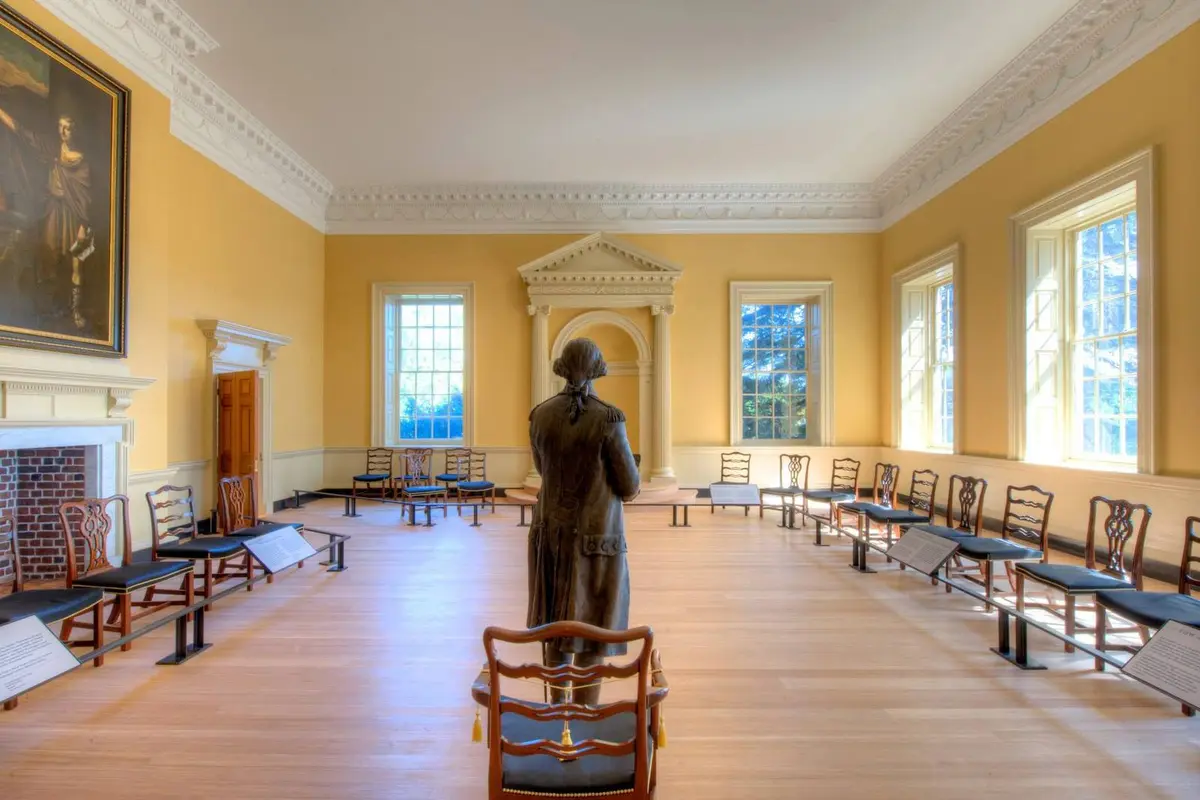
The restored Old Senate Chamber of the Maryland State House, with a bronze of Washington standing about where he resigned.. Bestbudbrian / Wikimedia Commons. His hand shook
He begins to read. James McHenry, watching from his seat, sees the general’s hand shake. When Washington recommends the officers of his staff to Congress, he has to hold the paper with both hands. When he commends his country to Almighty God, his voice falters and sinks. He pauses, recovers, and finishes. Then he draws his commission from his coat and gives it to Mifflin.
Washington’s last words as commanderI here offer my Commission, and take my leave of all the employments of public life.
Too affecting for utterance
Mifflin reads Congress’s answer, written by Jefferson: “The United states in Congress assembled receive with emotions too affecting for utterance this solemn resignation.” McHenry writes that the spectators all wept, and hardly a member of Congress did not drop tears. When the crowd has gone, Washington steps back in, bids every member farewell, and rides off from the door, intent on eating his Christmas dinner at home.
Home
He rides out that afternoon, stops for the night on the road, and the next day crosses the Potomac into Virginia. He reaches Mount Vernon before dark on Christmas Eve. Martha is waiting. For the first time in eight and a half years he holds no command. He is a farmer again, by his own choice.
The men in the room

Virginia planter named commander in chief in June 1775. He took no salary, held the army together for eight and a half years, and won at Yorktown. He refused a crown, stopped a mutiny at Newburgh, and gave his power back.

Philadelphia merchant who joined Washington’s staff as an aide-de-camp in July 1775 and became quartermaster general that August. Elected President of Congress in November 1783, he received the commission. He later signed the Constitution and governed Pennsylvania.

Author of the Declaration of Independence and wartime governor of Virginia, back in Congress in 1783. He chaired the committee that planned the ceremony and wrote the reply Mifflin read. Madison later saw in it “the shining traces of his pen.”
By the numbers
In pictures


Watch, listen, see
Films, photographs and first-hand accounts from across the web. Each opens in a new tab.

How the victorious general handed his commission back to Congress at Annapolis and went home.
American Battlefield Trust
The officers’ revolt that Washington stopped in one meeting, nine months before he resigned.
American Battlefield Trust
A historian tells how a pair of spectacles ended the Newburgh crisis in March 1783.
American Revolution Institute
The four great Revolution paintings in the Capitol Rotunda, including Washington resigning his commission.
Architect of the Capitol
John Trumbull’s 12-by-18-foot painting of the resignation, and the figures in it.
Architect of the Capitol
Washington’s own handwritten copy of the speech, now in the Maryland State House, with the words he struck out.
Maryland State Archives
Washington’s full 1782 rebuke of an officer who proposed that America take a king.
Teaching American HistoryFerdinand Pettrich’s seven-foot plaster of Washington resigning his commission, made about 1841.
Smithsonian American Art MuseumRead it
Address to Congress on Resigning His Commission341 words · Full text
Mr. President:
The great events on which my resignation depended having at length taken place; I have now the honor of offering my sincere Congratulations to Congress and of presenting myself before them to surrender into their hands the trust committed to me, and to claim the indulgence of retiring from the Service of my Country.
Happy in the confirmation of our Independence and Sovereignty, and pleased with the opportunity afforded the United States of becoming a respectable Nation, I resign with satisfaction the Appointment I accepted with diffidence. A diffidence in my abilities to accomplish so arduous a task, which however was superseded by a confidence in the rectitude of our Cause, the support of the Supreme Power of the Union, and the patronage of Heaven.
The Successful termination of the War has verified the most sanguine expectations, and my gratitude for the interposition of Providence, and the assistance I have received from my Country-men, encreases with every review of the momentous Contest.
While I repeat my obligations to the Army in general, I should do injustice to my own feelings not to acknowledge in this place the peculiar Services and distinguished merits of the Gentlemen who have been attached to my person during the War. It was impossible the choice of confidential Officers to compose my family should have been more fortunate. Permit me Sir, to recommend in particular those, who have continued in Service to the present moment, as worthy of the favorable notice and patronage of Congress.
I consider it an indispensable duty to close this last solemn act of my Official life, by commending the Interests of our dearest Country to the protection of Almighty God, and those who have the superintendence of them, to his holy keeping.
Having now finished the work assigned me, I retire from the great theatre of Action; and bidding an Affectionate farewell to this August body under whose orders I have so long acted, I here offer my Commission, and take my leave of all the employments of public life.
George Washington, Old Senate Chamber, Maryland State House, Annapolis, 23 December 1783 (Founders Online text, original spelling) · Source
“Having defended the standard of liberty in this new world, having taught a lesson useful to those who inflict and to those who feel oppression you retire from the great theatre of action with the blessings of your fellow citizens.”
Congress’s reply to Washington, written by Thomas Jefferson and read by President Thomas Mifflin, Annapolis, 23 December 1783
After
A month later Washington asked for his commission back, to keep among his papers. It might serve his grandchildren “some fifty or a hundd. years hence for a theme to ruminate upon,” he wrote. It stayed with the records of Congress instead, and today it is in the Library of Congress.
He did not stay retired. In 1787 he came back to preside over the Constitutional Convention, and he served two terms as the first President. In 1797 he walked away from power a second time and went home to Mount Vernon again.
John Trumbull, once his aide, painted the scene for the Capitol, finishing in 1824. The canvas hangs in the Rotunda. In 2007 Maryland brought Washington’s own copy of the speech home to Annapolis, and the Old Senate Chamber has been restored to look as it did that day.
Primary sources
- Editorial Note: George Washington’s Resignation as Commander-in-Chief, with the eyewitness letters of James McHenry and James Tilton. The Papers of Thomas Jefferson, vol. 6 (Founders Online, National Archives).
- Journals of the Continental Congress, 1774–1789, vol. 25: 20–23 December 1783. Library of Congress.
- Attendees at George Washington’s Resignation of his Commission, Old Senate Chamber, Maryland State House, December 23, 1783. Maryland State Archives, 2009.
Keep exploring
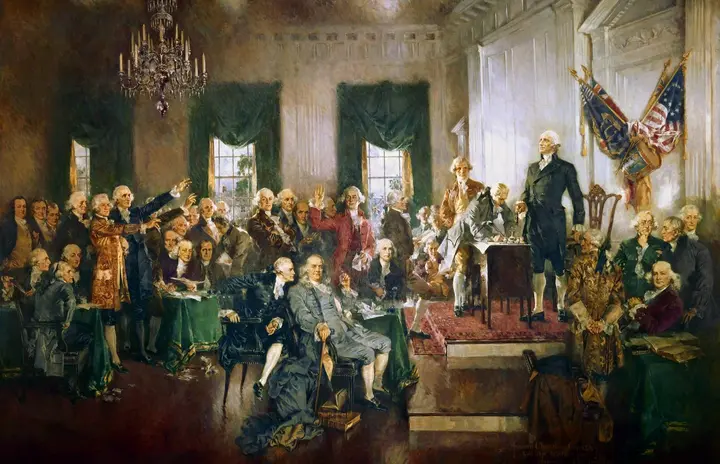
- The ConstitutionThirty-nine delegates signed the plan for a government of the people. It is the oldest written national constitution still in force.39signers
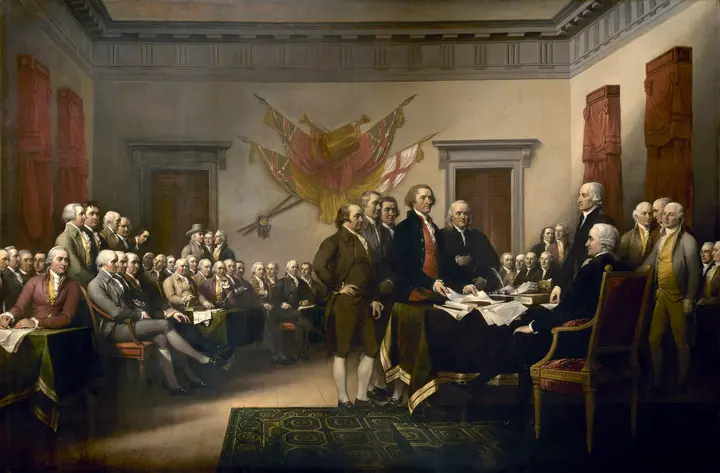
- The DeclarationFifty-six men signed their names to treason against the Crown and pledged their lives, fortunes and sacred honor.56signers
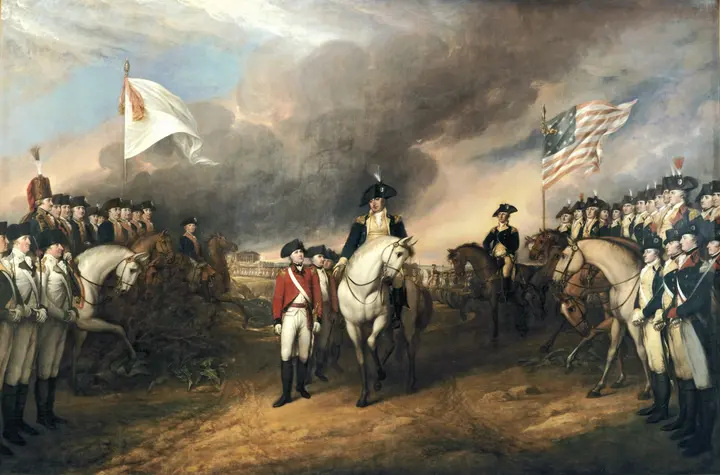
- YorktownCornwallis’s army marched out between the allied lines and laid down its arms. A new nation had beaten the British Empire.~8,000surrendered
- Fort McHenryThe Royal Navy shelled the fort through a day and a night. At dawn the flag was still there, and Francis Scott Key wrote it down.25hours of bombardment


Free, with no ads. Support the museum →