Baltimore, Maryland · 14 September 1814 · Armistead’s garrison
Our Flag Was Still There
For 25 hours the Royal Navy threw shells at the star-shaped fort guarding Baltimore. At dawn the garrison raised a flag 42 feet long, and a lawyer watching from a ship wrote the words the nation still sings.

The moment · About 09:00 · 14 September 1814
The British guns have gone quiet. On a truce ship down the river, Francis Scott Key strains through a spyglass. Inside the fort, the soaked storm flag comes down. The fifes and drums play Yankee Doodle, and the great garrison flag, 30 feet by 42, climbs the pole.
O say can you see, by the dawn’s early lightFrancis Scott Key
Three weeks after British troops burned the Capitol and the White House, the same army and fleet came for Baltimore, the third-largest city in the nation. The way into its harbor ran past Fort McHenry. Major George Armistead had about 1,000 men, guns that could not reach the bomb ships, and a flag he had ordered big enough for the British to see.
The fleet in the river
Late on Saturday the 10th, British warships appear at the mouth of the Patapsco. Baltimore is ready. For three weeks Maj. Gen. Samuel Smith has had the city digging in shifts, Black and white, free and enslaved. A mile and a half of earthworks now crowns Hampstead Hill, held by 15,000 to 20,000 men and about 60 cannon. On the 11th Brig. Gen. John Stricker marches the 3rd Brigade of Maryland militia out to meet the enemy.
The general falls
At about 03:00 the British start landing nearly 4,700 soldiers, sailors and marines at North Point. Maj. Gen. Robert Ross, the man who burned Washington, rides ahead with the advance and runs into American riflemen. As he turns in his saddle to call up more troops, a ball goes through his arm and into his chest. He dies on the way back to the fleet. Two teenage militiamen, Daniel Wells and Henry McComas, are believed to have fired the shots.
The Marylanders stand
Col. Arthur Brooke, now in command, attacks Stricker’s line with Congreve rockets. Veterans of the 5th Maryland tell the new men the rockets are harmless toys, and the line holds. For almost an hour the militia trade volleys with the troops who beat Napoleon. The British lose 46 killed and 295 wounded. Stricker falls back in order toward the city. In the rain that night, the British army sits on the battlefield and waits for the navy.
The bombs bursting in air
Five bomb ships and the rocket ship Erebus anchor about two miles out and open fire. Each mortar throws a 200-pound shell packed with powder, timed to burst over the fort. Armistead’s guns fire back, but every shot falls short. The men have no bombproofs. They stand at their posts in the open and take it, hour after hour, as the rain comes on.
Armistead’s report to the Secretary of WarNot a man shrunk from the conflict.
The ships come closer
A shell dismounts a 24-pounder, killing Lt. Levi Clagett and Sgt. John Clemm of the Baltimore volunteers. Another hits the powder magazine, holes the roof and glances off. Armistead has the barrels carried out. Seeing the commotion, Admiral Cochrane brings three bomb ships in closer. That is what Armistead has waited for. Every gun in the fort opens up. Within half an hour the ships pull back out of range, and the garrison gives three cheers.
Muffled oars
Under heavy rain, British barges row past the fort to land troops behind it. At Battery Babcock, Sailing Master John Webster hears muffled oars over the storm and opens fire with his six guns. Fort Covington joins in, then Fort McHenry. Aiming by the flash of rockets, they keep up the fire for nearly two hours and drive the boats back. At 03:00 Brooke orders his army back to the ships. Baltimore will not be taken.
By the dawn’s early light
The bombardment ends in the early morning, about 25 hours after it began. At 09:00 Armistead has the rain-soaked storm flag lowered. The fifes and drums play Yankee Doodle, and the 30-by-42-foot garrison flag goes up as the British ships weigh anchor. Two miles off, aboard the American truce ship, Francis Scott Key, John Skinner and Dr. William Beanes see it through a spyglass. Key pulls a letter from his coat and starts to write.
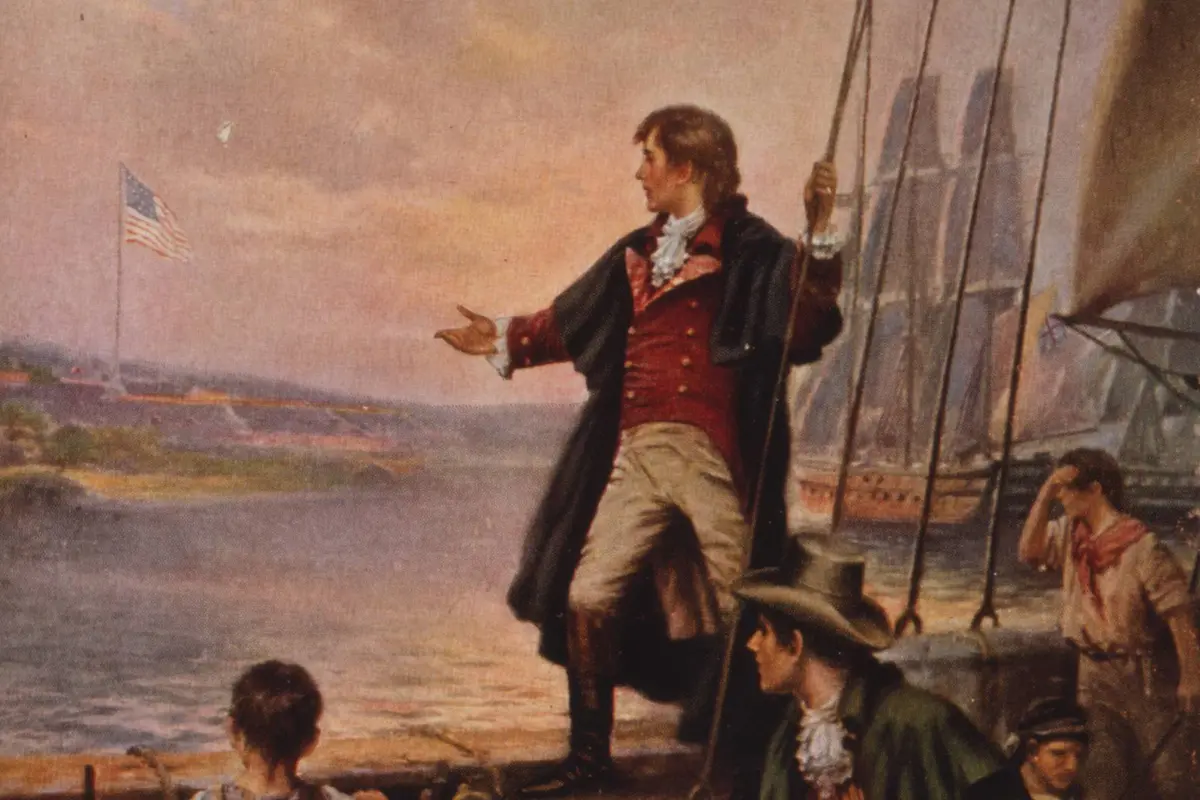
By Dawn’s Early Light: Francis Scott Key sees the flag still flying over Fort McHenry (Edward Percy Moran, 1913).. Edward Percy Moran / Library of Congress. Francis Scott Key, “Defence of Fort M’Henry”O say does that star-spangled banner yet wave, O’er the land of the free and the home of the brave?
The song goes out
The truce ship docks at Fells Point on the evening of the 16th. In the Indian Queen Tavern, Key finishes four verses, set to a popular tune, “To Anacreon in Heaven.” His brother-in-law Joseph Nicholson, who fought in the fort, takes them to a printer. Handbills titled “Defence of Fort M’Henry” go out to the fort’s defenders. On 20 September a Baltimore paper prints the poem, and within weeks it runs in newspapers up and down the coast.
The defenders

Virginian, one of five brothers who served in the war. In 1813 he helped take Fort George and carried the captured British flags to President Madison. Given Fort McHenry that June, he ordered the giant flag and held the fort through 25 hours of fire.

Revolutionary War officer who held Fort Mifflin on the Delaware against British bombardment in 1777. A sitting U.S. senator, he took command of Baltimore’s defense, put the whole city to work on its earthworks and had the line manned when the British came.

Georgetown lawyer who served as a volunteer aide at Bladensburg. Sent with John Skinner to win the release of Dr. William Beanes, he was held with the British fleet through the attack. At dawn he saw the flag still flying and began to write.

Philadelphia-born widow who learned flagmaking from her mother and sold ships’ colors in Baltimore. With her daughter, two nieces and apprentice Grace Wisher, she sewed the 30-by-42-foot flag in about seven weeks, often working until midnight.
By the numbers
In pictures


Watch, listen, see
Films, photographs and first-hand accounts from across the web. Each opens in a new tab.

The Fort McHenry visitor center film: the 1814 bombardment and how Key came to write the anthem.
National Park Service
A quick, clear account of the attack on Baltimore and the poem it inspired.
American Battlefield Trust · YouTube
Fort McHenry historian Vince Vaise gives a tour of the fort and tells the story of the bombardment.
C-SPAN American History TV
Museum visitors unfold a full-size 30-by-42-foot replica and sing the national anthem together.
National Museum of American History · YouTube
Zoom in on the original Star-Spangled Banner and open the stories stitched into it.
Smithsonian NMAHThe fort commander’s own report to the Secretary of War, written ten days after the attack.
American Battlefield Trust
All four verses, with Key’s manuscript, the first printed broadside and the first sheet music.
Smithsonian NMAH
The National Park Service’s full classroom lesson on Key, the bombardment and the fort that held.
National Park Service“Then, in that hour of deliverance and joyful triumph, my heart spoke, ‘does not such a country and such defenders of their country deserve a song?’ was its question.”
Francis Scott Key, recalling the morning of 14 September 1814
After
Baltimore was saved. The defeat there, and the American naval victory at Plattsburgh the same week, stunned London. Asked to take command in America, the Duke of Wellington told the government it had won nothing that entitled it to demand American territory. On 24 December 1814 the Treaty of Ghent ended the war with the borders where they began.
Armistead, worn out by the siege, fell ill the day after the battle. He was promoted brevet lieutenant colonel, and the citizens of Baltimore gave him a silver punch bowl shaped like a British bombshell. He died at the fort in 1818, aged 38. His family kept the flag for 90 years, and his grandson Eben Appleton gave it to the Smithsonian in 1912. It hangs today in the National Museum of American History.
Key’s song spread across the country within weeks. The Navy ordered it played at morning colors in 1889, and on 3 March 1931 President Hoover signed the law making “The Star-Spangled Banner” the national anthem. Fort McHenry is the only place in the National Park System called a National Monument and Historic Shrine.
Primary sources
- Lt. Col. George Armistead to Secretary of War James Monroe, Fort McHenry, 24 September 1814. Printed in Niles’ Weekly Register, 1 October 1814.
- Bombardment of Fort McHenry, Parts 1 and 2. Fort McHenry National Monument and Historic Shrine, National Park Service.
- The Star-Spangled Banner: Making the Flag. National Museum of American History, Smithsonian Institution.