New York · 4 August 1735 · A printer, a lawyer and a jury
The Cause of Liberty
A German-born printer sat in a New York jail for more than eight months for printing the truth about his governor. A Philadelphia lawyer told twelve citizens it was their right to say so.

The moment · 4 August 1735 · City Hall, Wall Street
The judge says the jury may decide only whether Zenger printed the papers. Andrew Hamilton does not wait. He turns from the bench to the twelve men in the box and tells them the case is bigger than one printer. It reaches every free man in America.
It is the best cause. It is the cause of liberty.Andrew Hamilton
In 1733 a few New Yorkers started a newspaper to say what they thought of their royal governor. The governor jailed the printer. English law held that a printed insult to an official was a crime whether or not it was true. The printer’s lawyers were thrown out of court, and a famous lawyer came up from Philadelphia. He made the case to the jury, and the jury decided.
A governor arrives
William Cosby lands in New York in 1732 as the new royal governor. He demands half of the salary that Rip Van Dam, the senior councilor, earned while serving as acting governor, and sues him in a court Cosby sets up himself. Chief Justice Lewis Morris rules against the governor. In 1733 Cosby removes him and names James DeLancey in his place. Morris’s friends decide they need a newspaper.
The New-York Weekly Journal
John Peter Zenger prints the first issue. He came to New York from the Palatinate in Germany as a boy of 12 or 13, and he learned the trade under William Bradford, the city’s first printer. The Journal comes out on Mondays and is backed by Morris, Van Dam and the lawyer James Alexander. It is the first paper in New York to oppose the governor, and it prints what the Gazette will not.
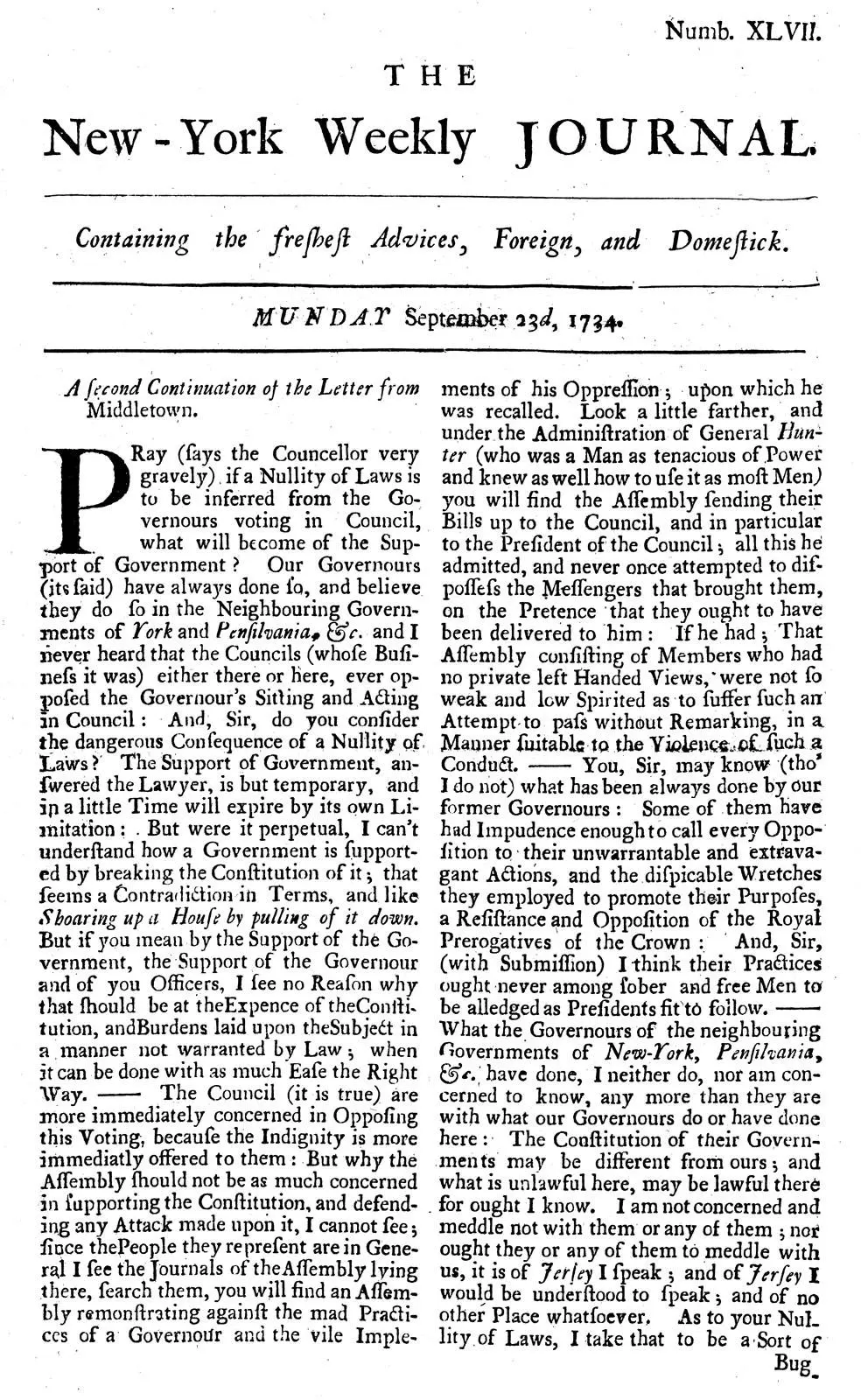
A page of Zenger's New-York Weekly Journal, 23 September 1734, the kind of issue that put him in jail.. Photograph by XelaWho / John Peter Zenger, printer. Arrested for libel
On the governor’s orders the sheriff arrests Zenger and takes him to the jail at City Hall on Wall Street. Bail is set at £400 with two more sureties of £200 each, far more than a printer can pay, and he stays in his cell. His wife Anna and his helpers keep the press running. Zenger gives them his instructions through a hole in the door, and the Journal keeps coming out.
No indictment
The grand jury will not indict him. The governor’s attorney general, Richard Bradley, files the charge of seditious libel himself, without a grand jury. Zenger waits in jail through the winter and into the spring. The Journal misses one issue and then keeps coming out.
The lawyers are thrown out
James Alexander and William Smith argue that DeLancey holds his seat on a governor’s order and has no right to it. DeLancey disbars both men on the spot. He assigns John Chambers to defend Zenger. Alexander and his friends send for the best lawyer in the colonies, Andrew Hamilton of Philadelphia, and Hamilton comes.
Hamilton rises
The trial opens in the courtroom on the second floor of City Hall. Hamilton shocks the room by admitting that Zenger printed the papers. His case is that the words are true, and that a true statement is no libel. DeLancey rules that truth is no defense. Hamilton turns from the bench and speaks to the jurors, who he says have the right to judge both the facts and the law.
Not guilty
The judge charges the jury to find only whether Zenger printed the papers. The jury leaves and returns in a short time. The clerk asks if Zenger is guilty, and foreman Thomas Hunt answers: “Not guilty.” The crowd in the courtroom answers with three cheers. Zenger is freed the next day.
Zenger, A Brief Narrative (1736)there were three huzzas in the hall
The same building
In 1789 the old City Hall on Wall Street is rebuilt as Federal Hall, the first capitol of the United States. There the first Congress writes the Bill of Rights. Its First Amendment says Congress shall make no law abridging the freedom of speech or of the press. The States ratify it in 1791, 56 years after the verdict.
The principals

German-born printer who learned his trade under William Bradford. He printed the Journal from 1733, sat in jail for over eight months, and walked free. New York named him its public printer in 1737. He died on 28 July 1746.

Scots-born lawyer, former attorney general of Pennsylvania and sitting speaker of its Assembly. He came to New York for Zenger and won the case in a day. Later he oversaw the building of the Pennsylvania State House, now Independence Hall.

Scots-born New York lawyer who helped found and write the Journal. He was disbarred for challenging the judge, and he is credited with the account of the trial published under Zenger’s name. His son became Revolutionary War general Lord Stirling.

Army officer and former governor of Minorca who took charge of New York in 1732. He had the Journal’s printer arrested and lost the case. He died on 10 March 1736, seven months after the verdict.
By the numbers
In pictures


Watch, listen, see
Films, photographs and first-hand accounts from across the web. Each opens in a new tab.

The National Park Service tells the Zenger story at the site where he was jailed and tried.
National Park Service
Andrew Hamilton’s argument in the Zenger trial, in the Constitution Center’s historic document library.
National Constitution Center
Trial record, chronology and key documents of the 1735 trial, from the University of Missouri-Kansas City.
Famous Trials, UMKC LawThe New York court system’s own history of the case, from the disbarments to the verdict.
Historical Society of the New York Courts
The trial in its Lower Manhattan setting, among the printers and presses of Printing House Row.
Lower Manhattan Historical AssociationThe Constitution Center marks the day of the verdict and its place in First Amendment history.
National Constitution Center
The National Archives presents the Bill of Rights and the First Amendment, with a full transcript.
National Archives
A New York City history account of Cosby, Zenger and the trial that gave the colonies a free press.
The Bowery Boys: New York City History“It is not the cause of one poor printer, nor of New York alone, which you are now trying. No! It may in its consequence affect every free man that lives under a British government on the main of America. It is the best cause. It is the cause of liberty.”
Andrew Hamilton to the jury, 4 August 1735, from A Brief Narrative of the Case and Tryal of John Peter Zenger (1736)
After
Zenger went back to his press. In 1736 he printed A Brief Narrative of the Case and Tryal of John Peter Zenger, an account of the trial that was reprinted in the colonies and in England. In 1737 New York named him its public printer. He died on 28 July 1746. His widow Anna kept the shop going.
New York’s Common Council honored Andrew Hamilton with the freedom of the city, presented in a gold box. He went home to Philadelphia and died in 1741. His Zenger speech was printed again and again.
Hamilton’s words became the creed of the American press. The jury had decided that a printer could tell the truth about those in power. In 1791 the First Amendment protected the freedom of the press. Today the courtroom’s site at 26 Wall Street is Federal Hall National Memorial.
Keep exploring
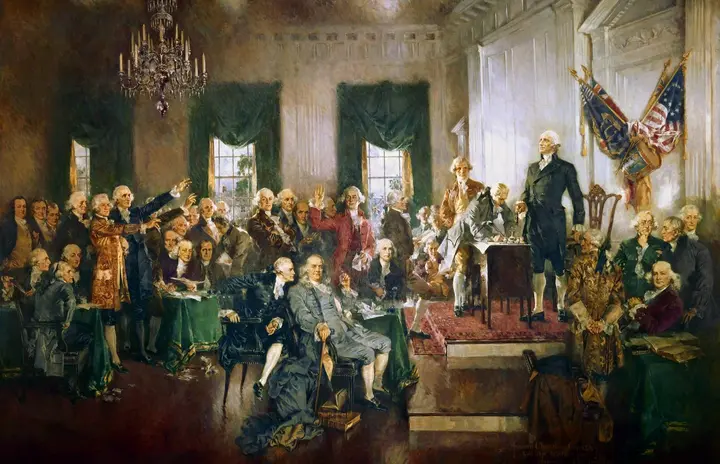
- The ConstitutionThirty-nine delegates signed the plan for a government of the people. It is the oldest written national constitution still in force.39signers
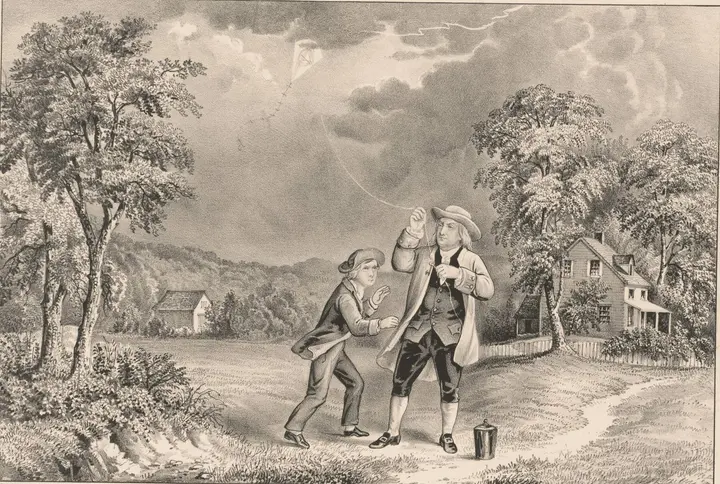
- Franklin and the Lightning RodFranklin proposed the test, a kite repeated it in a Philadelphia storm, and a few feet of iron rod gave every house a way to survive lightning.6–8 ftof iron rod to save a house
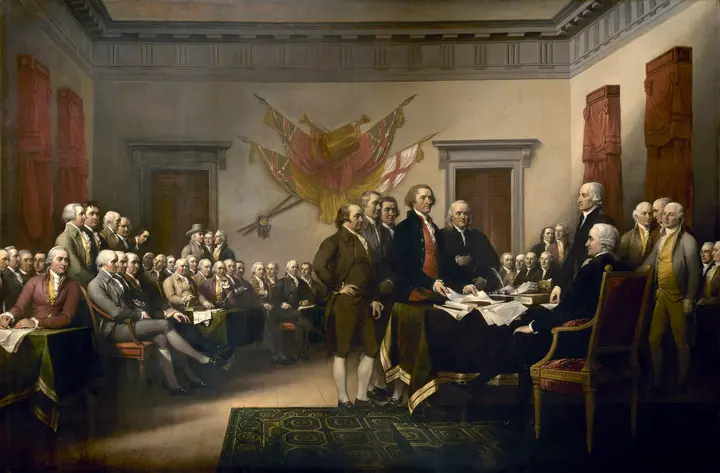
- The DeclarationFifty-six men signed their names to treason against the Crown and pledged their lives, fortunes and sacred honor.56signers
- A New Birth of FreedomLincoln spoke for about two minutes at Gettysburg and defined what the nation was for.272words


Free, with no ads. Support the museum →