USS Hornet to Tokyo · 18 April 1942 · Doolittle’s Raiders
Thirty Seconds Over Tokyo
Four months after Pearl Harbor, sixteen Army bombers flew off a Navy carrier in a gale and bombed Japan.

The moment · About 08:20 · 18 April 1942
Hornet turns into a 40-knot wind and runs at 22 knots. Green water breaks over the bow. Doolittle’s bomber sits first in line with 467 feet of wet, pitching deck ahead. Engines roar to full power. The brakes come off, and the B-25 lifts into the gale.
Launch planes. To Colonel Doolittle and gallant command, good luck and God bless you.Vice Adm. William F. Halsey to Hornet
After Pearl Harbor, President Roosevelt pressed his chiefs for a way to strike Japan itself. A Navy submariner, Capt. Francis Low, found it: fly Army bombers off a Navy carrier. Lt. Col. Jimmy Doolittle took the job and called for volunteers. A B-25 could take off from a carrier but could never land back on one. Every crew would fly one way.
Sixteen bombers on deck
Cranes hoist sixteen B-25B Mitchells onto USS Hornet at Naval Air Station Alameda. They are too big for the hangar elevators, so they will ride the whole way lashed to the flight deck. The crews are volunteers from the 17th Bombardment Group. At Eglin Field, Navy Lt. Henry Miller taught them to get a loaded bomber airborne in a few hundred feet. None of them has ever flown off a carrier.
Cheers from every section
At 10:18 Hornet stands out to sea in broad daylight, the bombers in plain view, as if she were only ferrying planes. That afternoon the crew hears the mission over the loudspeaker. Capt. Marc Mitscher reports cheers from every section of the ship. On 13 April, north of Hawaii, Hornet joins Vice Adm. William Halsey and the carrier Enterprise, whose fighters and scouts will guard both ships.
Return to sender
In a ceremony on Hornet’s flight deck, Mitscher hands Doolittle Japanese medals once awarded to American Navy men, from the days of the Great White Fleet’s 1908 visit to Japan. Some of those men are now defense workers, and they have asked that the medals go back to Japan on a bomb. Doolittle wires them to a 500-pound bomb as his crews look on.
Spotted
Dawn comes up raw and gray over a heavy sea. Lookouts sight the picket boat No. 23 Nitto Maru, 15,000 yards off. The task force’s radio intercept team confirms she has reported them. The plan called for a launch that evening, far closer in. They are still 650 miles out. The cruiser Nashville opens fire and sinks the boat. Halsey makes the call: launch now.
Launch planes
Hornet turns into a wind of more than 40 knots and works up to 22 knots. Seas break over the bow and soak the deck. Doolittle goes first, with 467 feet of deck ahead, lifts off, and circles back over the ship to line up his course for Tokyo. Fifteen more follow, one every few minutes. The last bomber is airborne at 09:19, 59 minutes after the first.
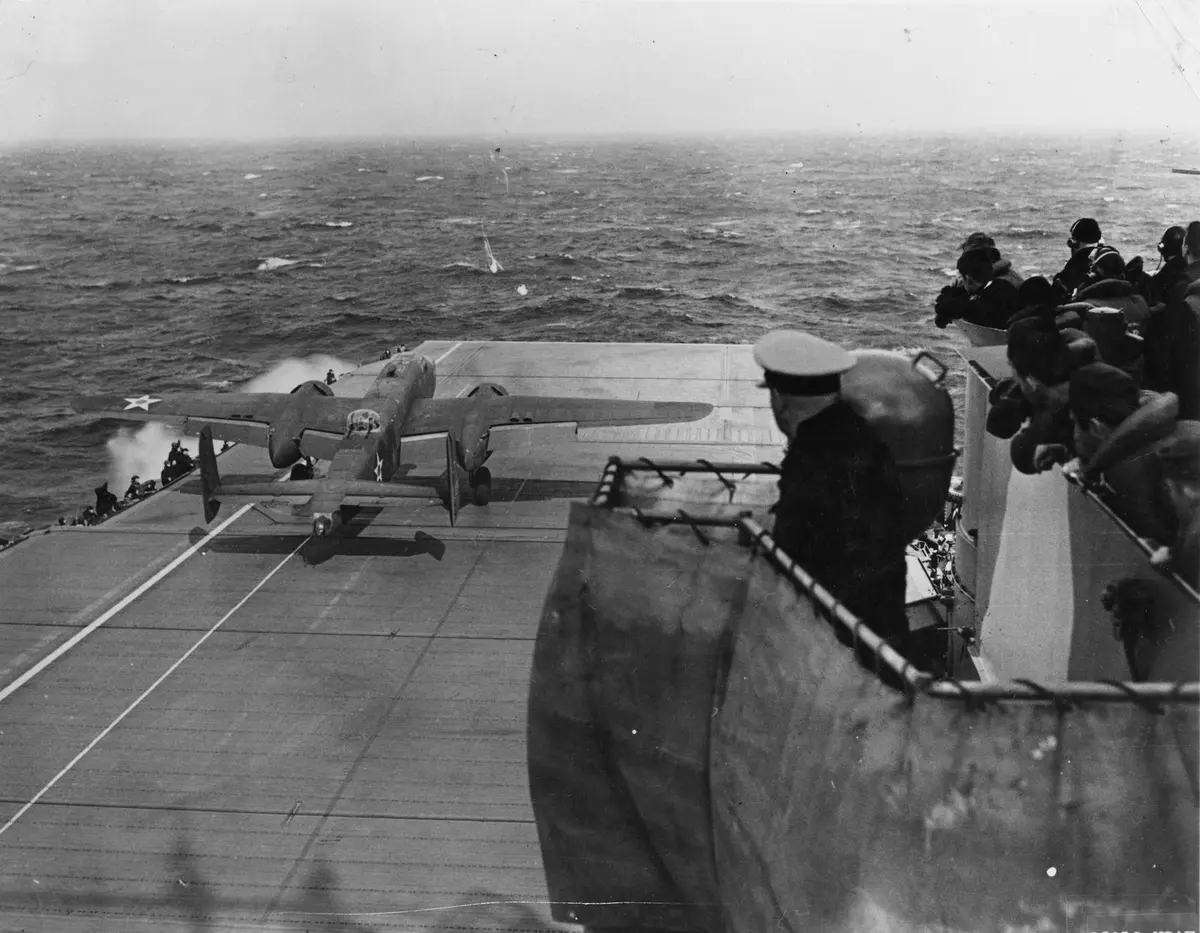
A B-25 starts its takeoff run down Hornet’s wet flight deck on 18 April 1942 while officers watch from the bridge wing.. U.S. Army Air Forces / U.S. Air Force. Over Tokyo
The bombers come in low across the coast. Doolittle reaches Tokyo from the north, pulls up to 1,200 feet and drops four incendiary clusters on an industrial district. Lt. Travis Hoover hits a powder works from 900 feet, so low the debris flies higher than his plane. Thirteen bombers strike the Tokyo area, spread across a 50-mile front so the Japanese will think there are more of them.
Yokosuka to Kobe
At the Yokosuka navy yard, Lt. Edgar McElroy’s crew sees a crane blown apart and a ship on the slips burst into flames. A bomb damages the tender Taigei, being rebuilt as the light carrier Ryuho, and delays her completion. The last flight of three swings south of Tokyo and splits up, one bomber each for Nagoya, Osaka and Kobe. Not one B-25 is shot down over Japan.
One way
The early launch has cost them their margin. Weather closes in over the China coast and no airfield is ready to guide them in. One by one the fuel tanks run dry. Doolittle’s crew bails out at 8,000 feet in the rain after 13 hours and about 2,250 miles in the air. Fifteen crews bail out, crash-land or ditch. Capt. Edward York’s crew lands near Vladivostok and is interned by the Soviets.
Tokyo successfully bombed
Chinese soldiers and villagers find the Americans and lead them to safety. Ted Lawson’s Ruptured Duck has crashed in the surf. Sgt. David Thatcher, the only man fit to carry on, wades back into the sea for the medical kit and talks Chinese fishermen into carrying his injured crewmates around Japanese outposts. Doolittle’s crew finds its wrecked bomber, and he wires Washington.
Doolittle to Gen. Hap ArnoldTokyo successfully bombed. Due bad weather on China Coast believe all airplanes wrecked. Five crews found safe in China so far.

The men who made it happen

Enlisted in 1917, won the Schneider, Bendix and Thompson trophies, and flew the first blind flight in 1929. Planned the raid, trained the crews and flew the first bomber off Hornet. Earned the Medal of Honor and a jump straight to brigadier general.

Naval Academy, class of 1904. Took half the Navy’s Pacific carrier force to within 650 miles of Japan. When a picket boat spotted him, he launched at once, ten hours early. Later commanded the Third Fleet and became a five-star fleet admiral.

Naval Aviator No. 33, winged in 1916. Took the brand-new Hornet to sea in daylight with sixteen Army bombers lashed to her deck, turned her into a gale and launched every one. Later led the Fast Carrier Task Force across the Pacific.

Worked at Douglas Aircraft, then earned his Army wings in 1940. Flew the seventh bomber off Hornet and hit Tokyo’s industrial district. Crashed in the surf off China and lost his left leg. His 1943 book, Thirty Seconds Over Tokyo, told the nation the story.
By the numbers
In pictures


Watch, listen, see
Films, photographs and first-hand accounts from across the web. Each opens in a new tab.

National Archives film of Task Force 16 at sea, Halsey on the bridge, and the B-25s leaving Hornet.
Naval History and Heritage Command
Wartime footage of the Raiders, their bombers and USS Hornet on the way to Japan.
National Museum of the U.S. Air Force
Dick Cole, Doolittle’s co-pilot and the last surviving Raider, in an Air Force tribute.
Air Force Television
The Ruptured Duck’s gunner, who saved his injured crew in China, recounts the raid.
Library of Congress Veterans History Project
NHHC director Sam Cox on how a Navy idea put Army bombers over Tokyo.
Naval History and Heritage Command
Navy photographs of the bombers on deck, the launch and the crews in China.
Naval History and Heritage Command
Doolittle’s 1942 report to General Arnold, with every takeoff time and each crew’s story.
HyperWarThe medal President Roosevelt pinned on Doolittle in May 1942, donated by Doolittle himself.
Smithsonian National Air and Space Museum“With the apparent certainty of being forced to land in enemy territory or to perish at sea, Gen. Doolittle personally led a squadron of Army bombers, manned by volunteer crews, in a highly destructive raid on the Japanese mainland.”
Medal of Honor citation, presented by President Franklin D. Roosevelt, 19 May 1942
After
Tokyo radio announced the raid that afternoon. Asked where the bombers had come from, President Roosevelt said Shangri-La. On 19 May he presented Doolittle the Medal of Honor at the White House, and every Raider received the Distinguished Flying Cross. Shaken that bombs had fallen on Tokyo, Admiral Yamamoto pushed through his plan to attack Midway. Seven weeks later, Hornet was there.
Three Raiders died bailing out or ditching. Eight were captured; three were executed and one died in prison, and the other four came home in 1945. Most of the rest walked out of China with Chinese help and went back to war. Doolittle went on to command the Eighth Air Force against Germany.
In 1959 the city of Tucson gave the Raiders 80 silver goblets, one engraved with each man’s name. On 9 November 2013 the last survivors drank their final toast at the National Museum of the U.S. Air Force. Dick Cole, Doolittle’s co-pilot, died in 2019 at 103, the last of the 80.
Primary sources
- Report of Action, April 18, 1942. Capt. Marc A. Mitscher, Commanding Officer, USS Hornet (CV-8), 28 April 1942.
- General Doolittle’s Report on Japanese Raid, April 18, 1942. Headquarters, Army Air Forces, 9 July 1942.
- Hornet VII (CV-8). Dictionary of American Naval Fighting Ships, Naval History and Heritage Command.