New Orleans to Normandy · 6 June 1944 · Higgins Industries
The Man Who Won the War for Us
A Nebraska-born boatbuilder took a swamp boat from the Louisiana bayous, put a steel ramp on the front, and built more than 20,000 boats. They carried American armies onto the beaches of the world.

The moment · 06:30 · 6 June 1944 · Utah Beach
Twenty Higgins boats run in abreast through smoke and spray, thirty men in each. A few hundred yards out, the company commanders fire smoke to lift the naval guns. Almost exactly at H-Hour the ramps drop. Six hundred men step into waist-deep water and wade for France.
Goddam, we’re on French soil.Men of the 8th Infantry, reaching dry sand at Utah Beach
To beat Germany and Japan, America had to put whole armies onto beaches the enemy held, far from any port. The Navy spent years trying to design a boat that could do it. A New Orleans boatbuilder already had one, built for the bayous. Andrew Higgins sold it to the Marines, added a ramp, and turned out boats by the thousand.
A boat for the bayous
Andrew Higgins, a lumberman from Nebraska, builds boats for the trappers and oil drillers who work the shallow bayous of Louisiana. His Eureka tucks its propeller into a tunnel in the hull, safe from logs and sandbars. A flat “spoonbill” bow lets it run straight up onto a bank and back off again under its own power. Within a decade it is fast in shallow water and turns almost in its own length.
Thirty days
The Marines need a boat that can land troops on an open beach, and the Navy’s designs keep falling short. Comdr. Ralph McDowell of the Navy’s Bureau of Construction and Repair invites Higgins to come talk. Higgins and his naval architect catch the first train to Washington and spend a week in McDowell’s office turning the Eureka into a landing boat. Higgins offers to build one for less than cost. He delivers it to Norfolk in 30 days.
The best boat yet
At Fleet Landing Exercise 5 in February 1939, the Eureka runs against the Navy’s own boats and the fishing boats tested before it. The Marines who ride it are sold. A year later, at Flex 6, they call it the best landing boat yet designed. In September 1940 the Navy makes the 36-foot Eureka its standard: twice the load of the 30-footer it replaces, at the same speed.
Commanding officer, 1st Battalion, 5th Marines, Flex 5The Higgins boat gave the best performance under all conditions.
Ramp down
The Eureka has one flaw. Men have to climb out over its high sides, in the open. In 1937 Lt. Victor Krulak had photographed Japanese boats with ramps in the bow off Shanghai. In April 1941 Marine Maj. Ernest Linsert shows Higgins a picture of one. Higgins builds a ramp-bow Eureka at his own expense. On Lake Pontchartrain it beaches, drops its ramp and lands a truck and men. Formal tests in June pass it with flying colors.
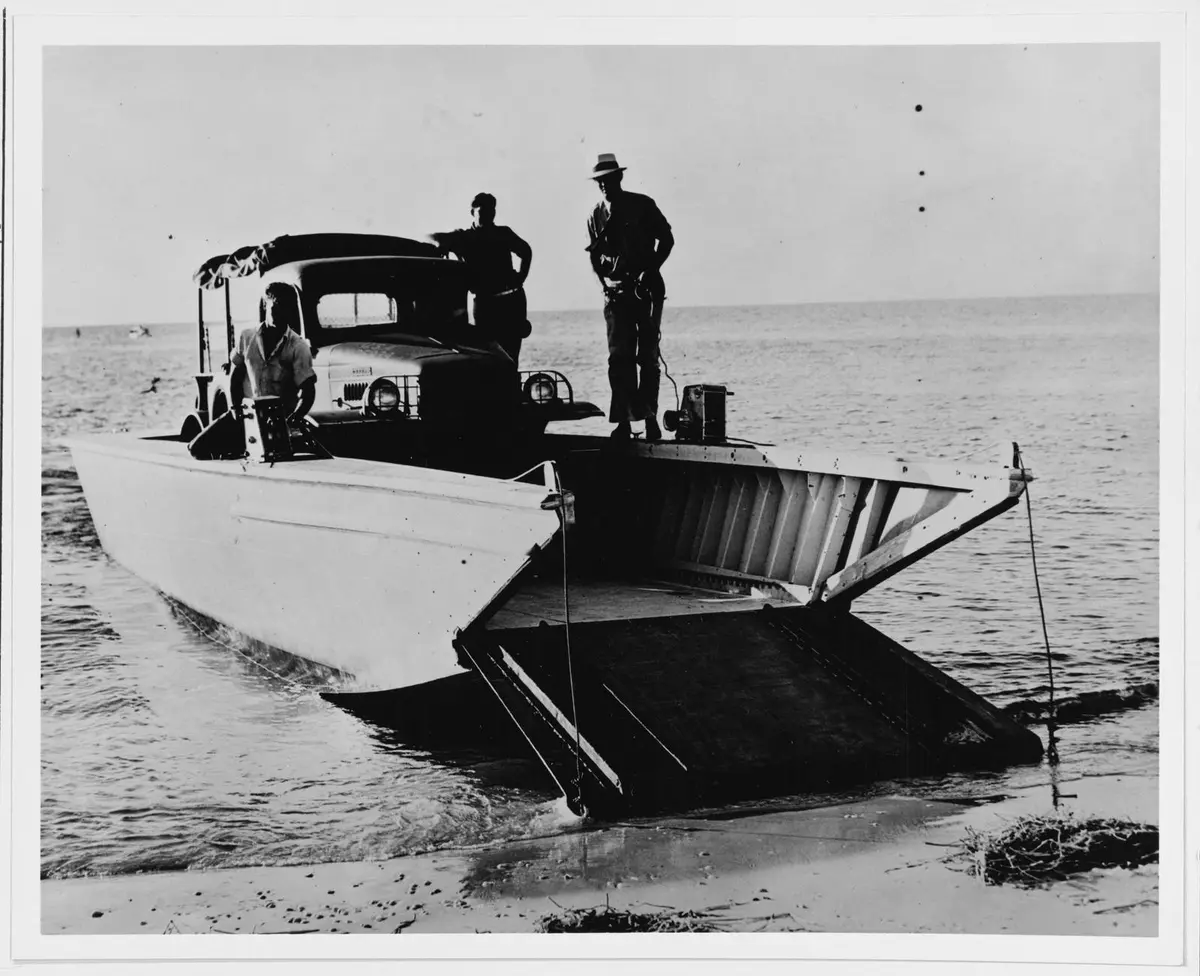
Higgins’s 36-foot ramp-bow boat lands a military truck during trials in May 1941. The design became the LCVP.. Naval History and Heritage Command (NH 73812). Sixty-one hours
On 30 May 1941 the Navy orders Higgins by telephone to turn one of his boats into a tank lighter. His crews design and build it in 61 hours. In the spring of 1942, off Norfolk, a 50-foot Higgins lighter and the Navy’s own design each carry a 30-ton tank into rough water. The Navy boat ships water and turns back. The Higgins boat runs on and lands its tank. The Navy tells every yard to build the Higgins type.
Seven plants
In 1938 Higgins had one boatyard and fewer than 75 workers. By 1943 he has seven plants and more than 20,000. Men and women, Black and white, young and old work side by side, paid the same wage for the same job, the first integrated workforce in New Orleans. Finished boats roll out on railroad flatcars. In April 1943 the LCVP goes into production, with a full-width steel ramp and its two machine guns moved aft.
Ashore
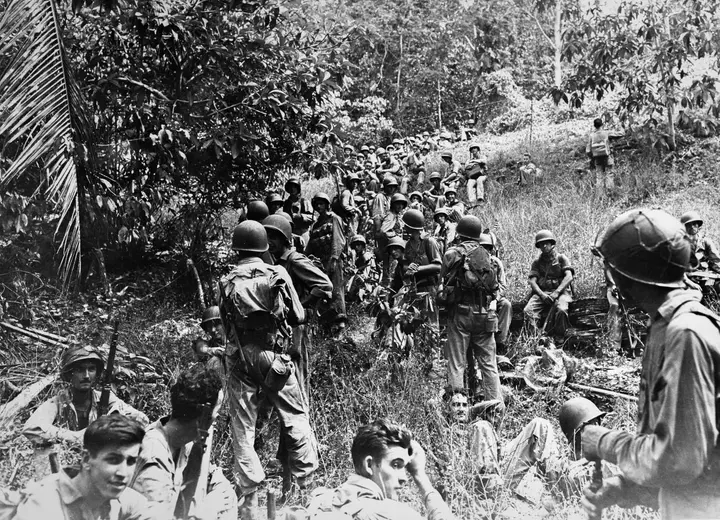
On 7 August 1942 the 1st Marine Division lands at Guadalcanal and Tulagi from Higgins boats, America’s first amphibious offensive of the war. In November the Army goes ashore in North Africa. In July 1943 LCVPs from the transport Joseph T. Dickman run trucks through the surf at Gela, Sicily. From here to the end of the war, Higgins boats are in every major American landing, in Europe and the Pacific.
H-Hour
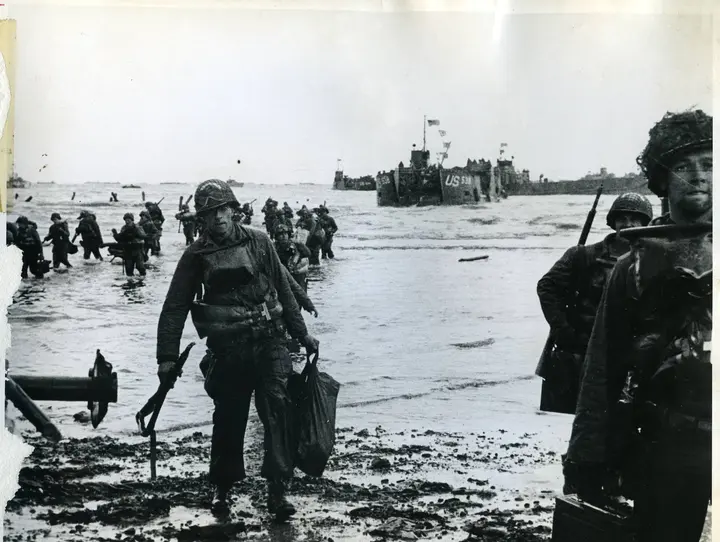
The first wave at Utah is 20 LCVPs abreast, each carrying a 30-man assault team of the 8th Infantry. When they are 300 to 400 yards out, the company commanders fire smoke to lift the naval guns. Almost exactly at H-Hour the ramps go down, and 600 men wade the last hundred yards to the beach. Across the invasion beaches that day, more than 1,000 Higgins boats land troops and vehicles.
To the last beach
On 19 February 1945 Higgins boats circle off Iwo Jima, waiting to carry the Marines in. In March, Navy crews ferry Army troops across the Rhine in them, into the heart of Germany. In April they unload men and supplies on Okinawa. Back home, Higgins had marked his 10,000th boat in July 1944 with a mock landing on the Lake Pontchartrain seawall. By the war’s end, the count passes 20,000.
The men behind the boat

Born in Columbus, Nebraska. Expelled from high school for brawling, he first moved troops on water in the Nebraska National Guard. A lumberman turned boatbuilder, he spent years selling the Navy on his Eureka, then built more than 20,000 boats for the war.

Naval Academy class of 1934. At Shanghai in 1937 he photographed Japanese ramp-bow landing boats and sent the pictures to Washington, where they were filed away. He later took the ramp idea to Higgins. Won the Navy Cross leading the Choiseul raid in 1943.

Marine since 1905, nicknamed “Howlin’ Mad.” From 1941 he trained the 1st Marine Division and the Army’s 1st and 9th Infantry Divisions in amphibious landings and put the Higgins boats through their paces. Later led the assault troops at Saipan and Iwo Jima.
By the numbers
In pictures


Watch, listen, see
Films, photographs and first-hand accounts from across the web. Each opens in a new tab.

The Army Museum’s chief curator presents its LCVP, one of a handful linked to the Normandy landings.
National Museum of the United States Army
A deep look at the boat’s design, its path from Eureka to LCVP, and the men who rode it in.
National Museum of Military Vehicles
The most famous photograph of D-Day, taken from inside a Coast Guard–manned Higgins boat at Omaha Beach.
National Archives
George Kearney, who started at Higgins in 1937 at 30 cents an hour, on building landing craft and PT boats.
The National WWII Museum
The story of Higgins’s hull and ramp patents, the ramp filed the day after Pearl Harbor.
U.S. Patent and Trademark Office
The official account of how the Eureka, the ramp and the tank lighter won over the Marines.
U.S. Marine Corps Historical Branch
Navy photographs of the 1941 ramp trials, the Eureka fleet, PT boats and the President’s plant visit.
Naval History and Heritage Command
John Vachon’s photograph of ramp boats being fitted out at the Higgins yards in New Orleans.
Library of Congress“Andrew Higgins is the man who won the war for us.”
Dwight D. Eisenhower, as recalled by historian Stephen Ambrose from a 1964 interview
After
Higgins died in New Orleans on 1 August 1952. In 1987 the Navy put to sea a fleet oiler named USNS Andrew J. Higgins, and his hometown of Columbus, Nebraska, keeps a national memorial to him.
Eisenhower’s words to Stephen Ambrose stayed with the historian. Ambrose set out to build a museum to D-Day in the city where the boats were built. The National D-Day Museum opened in New Orleans on 6 June 2000, and in 2003 Congress named it America’s National WWII Museum. It stands on Andrew Higgins Drive, and a Higgins boat built from the original plans by volunteers, some of whom had built them during the war, stands in its Louisiana Memorial Pavilion.
The giant plant Higgins built at Michoud for the war still stands. In the 1960s it built the first stages of the Saturn V rockets that flew Americans to the Moon. Today it builds the core stages of NASA’s Space Launch System.
Primary sources
Keep exploring
- D-DayThe largest amphibious invasion in history put Americans on Utah and Omaha and broke Hitler’s Atlantic Wall in a day.73,000Americans ashore and airborne
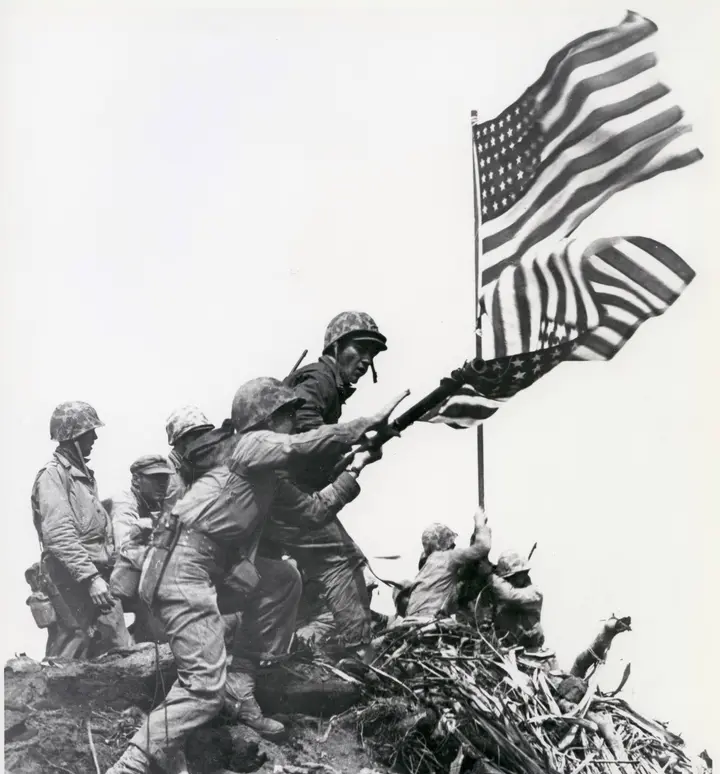
- Iwo JimaThirty-six days on eight square miles of volcanic rock. More Medals of Honor than any other battle of the war.27Medals of Honor
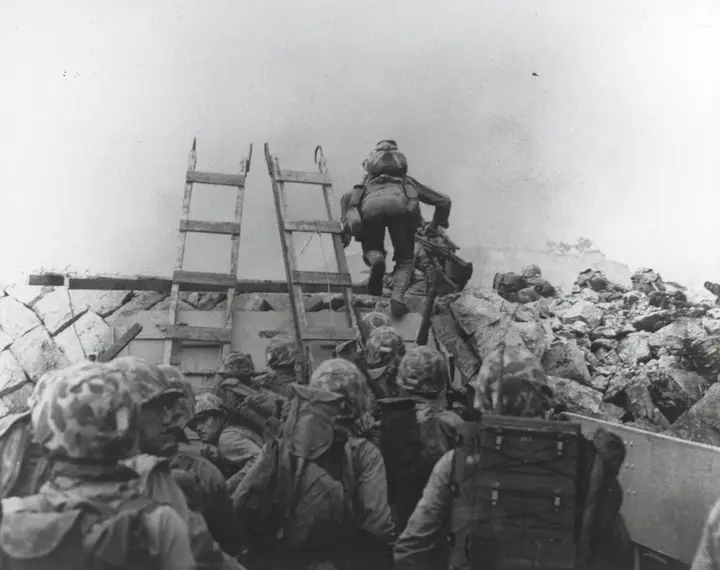
- InchonMacArthur landed behind enemy lines on a 31-foot tide, and Marines climbed the seawall on ladders to turn the Korean War.12days from the seawall to Seoul
- GuadalcanalThe Marines took the island’s airfield, named it Henderson Field and held it against everything Japan threw at them.6months


Free, with no ads. Support the museum →