Jezero Crater, Mars · 19 April 2021 · NASA Jet Propulsion Laboratory
Our Wright Brothers Moment
A four-pound American helicopter flew itself in air one percent as thick as Earth’s, and made the first powered flight on another planet.

The moment · 06:46 EDT · 19 April 2021
At JPL the team waits in silence. Three hours ago, on Mars, Ingenuity flew or failed on its own, and nobody on Earth knows which. The data arrives. A line on the altimeter plot climbs to ten feet, holds, and comes back down.
Altimeter data confirms that Ingenuity has performed its first flight, the first flight of a powered aircraft on another planet.Håvard Grip, Ingenuity chief pilot
No aircraft had ever flown on another planet. Mars has gravity a third of Earth’s, but its air is about one percent as dense, so the rotors have to spin roughly 2,500 times a minute to lift anything at all. Radio takes minutes each way, so the helicopter has to fly itself. NASA’s Jet Propulsion Laboratory built one that weighed four pounds.
Liftoff
An Atlas V rocket climbs off Space Launch Complex 41 at Cape Canaveral carrying Perseverance, a car-sized rover built to hunt for signs of ancient life on Mars. Bolted under its belly, behind a shield, rides a passenger no one has tried before: a twin-rotor helicopter named Ingenuity. Ahead lies a cruise of 203 days and 293 million miles.
Seven minutes of terror
Perseverance hits the top of the Martian atmosphere at about 12,100 mph, its heat shield glowing at 2,370 degrees. A 70.5-foot parachute opens at about 940 mph. The spacecraft’s own autopilot picks a safe spot, and a rocket-powered sky crane lowers the rover on 25 feet of nylon cord to the floor of Jezero Crater. Radio needs 11 minutes to reach Earth, so it is over before anyone knows.
Swati Mohan, guidance and controls operations lead, JPLTouchdown confirmed! Perseverance is safely on the surface of Mars, ready to begin seeking the signs of past life.
Alone on Mars
Perseverance lowers Ingenuity from its belly onto a flat patch of ground and backs away. For the first time the helicopter is on its own, living off a small solar panel and six lithium-ion batteries. Nights in Jezero Crater fall as low as minus 130 degrees Fahrenheit. Its heaters, insulation and battery carry it through the first one, and the team moves on to checkout.
A stalled spin test
During a high-speed spin of the rotors, a watchdog timer cuts the test short. The flight computer cannot switch from preflight to flight mode, and without that switch the blades cannot reach flying speed. The first flight is postponed. Project manager MiMi Aung’s team finds a fix they can send from Earth: change the timing of the command sequence. In tests it works about 85 percent of the time. They go.
Liftoff on Mars
It is just past noon at Jezero Crater, the hour the team picked for the best energy and flying conditions. Nobody can steer it from Earth. Ingenuity flies itself. Its rotors spin at 2,537 rpm, and it climbs to ten feet, holds a steady hover for 30 seconds, and settles back down. Total time in the air: 39.1 seconds. Perseverance films it all from Van Zyl Overlook, 211 feet away.
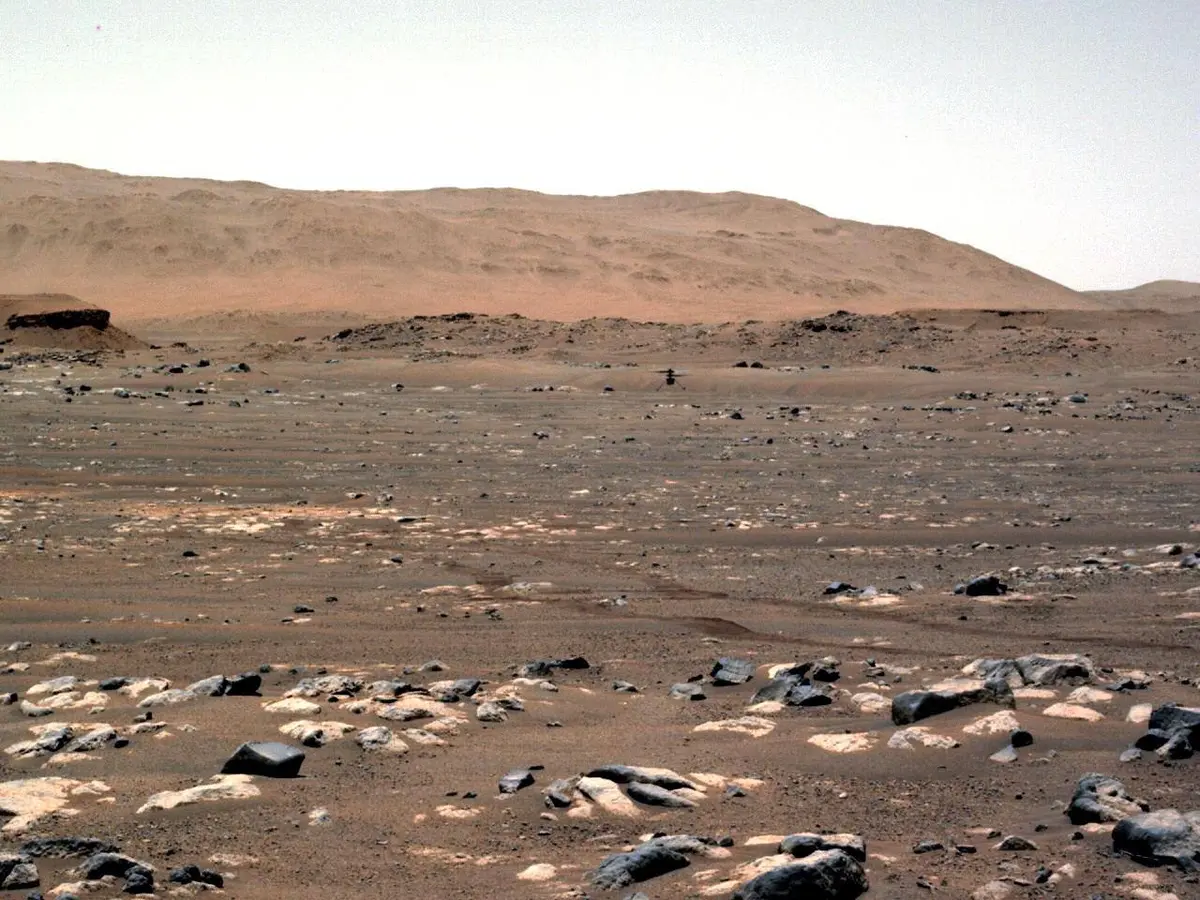
Ingenuity hovers over Wright Brothers Field on the first powered, controlled flight on another planet, seen by Perseverance's Navcam from 210 feet away, 19 April 2021. NASA / JPL-Caltech. The data comes home
In the Space Flight Operations Facility at JPL, the team in orange shirts watches the downlink arrive by way of Perseverance. Chief pilot Håvard Grip reads the altimeter plot out to the room, and the room erupts in cheers and raised fists. Then comes a black-and-white picture Ingenuity took of its own shadow on the Martian ground, from ten feet up.
Håvard Grip, to the control roomAltimeter data confirms that Ingenuity has performed its first flight, the first flight of a powered aircraft on another planet.
Wright Brothers Field
Ingenuity carries a postage-stamp-sized piece of muslin from the lower-left wing of the 1903 Wright Flyer, wrapped around a cable under its solar panel. NASA science chief Thomas Zurbuchen names the patch of Jezero Crater Wright Brothers Field. The United Nations aviation agency, ICAO, assigns Ingenuity the designator IGY and the call sign INGENUITY. It took 117 years to go from Kitty Hawk to Mars.
One way to a new airfield
Flights two, three and four go higher, faster and farther. On flight five Ingenuity leaves Wright Brothers Field for good. It flies 423 feet south, climbs to a record 33 feet, photographs its new neighborhood and lands there after 108 seconds aloft. The five-flight test is complete, and NASA keeps flying it as a scout for Perseverance.
The last flight
Nearly three years later, Ingenuity makes a short vertical hop to check its systems. It climbs to 40 feet and hovers. Over smooth, featureless sand its navigation camera has too little to track, and it lands hard on a sand ripple. All four rotor blades snap. The helicopter built for five flights in 30 days has flown 72 times, for 128.8 minutes and 10.5 miles.

The flight team

Born in Illinois to Burmese parents, she returned to America at 16 to study and earned two electrical engineering degrees at the University of Illinois. A Deep Space Network veteran, she led Ingenuity from early development through its first flights.

Grew up in south India following Apollo on the radio, then earned his doctorate at Rensselaer and spent 35 years in robotics at JPL. He conceived a Mars helicopter in the 1990s and kept the idea alive until NASA said yes.

Norwegian engineer with a doctorate in engineering cybernetics. Joined the project in 2013 as aerodynamics and flight control lead and wrote the models and control algorithms Ingenuity flies by. As chief pilot, he flew the first flight.

MIT-trained engineer who ran engineering at the Drone Racing League before joining JPL in 2017. Worked the helicopter’s test flights on Earth, then led the Ingenuity team on Mars from spring 2021 through flight 72.
By the numbers
In pictures


Watch, listen, see
Films, photographs and first-hand accounts from across the web. Each opens in a new tab.

NASA’s live broadcast from JPL as the Ingenuity team receives the data from the first flight on Mars.
NASA
Perseverance’s Mastcam-Z footage of the first flight on another planet, from liftoff to touchdown.
NASA Jet Propulsion Laboratory
Real footage of the parachute, sky crane and touchdown in Jezero Crater, with Mission Control’s call-outs.
NASA
JPL looks back on 72 flights by the first aircraft to fly on another world.
NASA Jet Propulsion LaboratoryChief engineer Bob Balaram and team lead Teddy Tzanetos tell how they built and flew Ingenuity.
NASA JPL, On a Mission podcast
Spin and inspect NASA’s 3D model of the Mars helicopter, free to download.
NASA ScienceThe picture Ingenuity took of its own shadow while hovering on the first flight on Mars.
NASA Jet Propulsion Laboratory
The prototype that first flew in a Mars-like chamber at JPL in 2016 joins the national collection.
Smithsonian National Air and Space Museum“We have been thinking for so long about having our Wright brothers moment on Mars, and here it is.”
MiMi Aung, Ingenuity project manager, NASA Jet Propulsion Laboratory, 19 April 2021
After
In June 2022 the Ingenuity team received the 2021 Robert J. Collier Trophy, given each year for the greatest achievement in aeronautics or astronautics in America. Orville Wright won it in 1913. Chuck Yeager won it for breaking the sound barrier. The crews of Apollo 8, 11 and 15 won it for the Moon.
Ingenuity still stands at its last airfield in Jezero Crater. A final software update turned it into a stationary testbed, and it still sends weather and avionics data to Perseverance about once a week. JPL is designing a Mars helicopter about 20 times heavier on what it learned. The prototype that first flew in a Mars-like chamber at JPL in May 2016 now belongs to the Smithsonian.
The swatch of Flyer fabric ties Ingenuity to the museum’s Kitty Hawk exhibit. On 17 December 1903 Orville Wright flew 120 feet in 12 seconds. Then 117 years later, a piece of that same airplane flew on Mars.
Primary sources