A million miles from Earth · 25 December 2021 · NASA Goddard, Northrop Grumman, Ball Aerospace
To the Edge of Time Itself
NASA folded the largest telescope ever launched into the nose of a rocket. A million miles out, with no way to fix a mistake, it unfolded itself and looked back more than 13 billion years.

The moment · 13:17 EST · 8 January 2022
In Baltimore, the control room watches the telemetry as the last wing of Webb’s golden mirror swings into place. Two weeks of unfolding come down to this. Any one of 344 single-point failures could have ended the mission. The latch closes. Every major deployment is done.
We have a deployed telescope on orbit.Thomas Zurbuchen, NASA associate administrator for science
The first galaxies are so far away that their light has stretched into the infrared on its 13-billion-year trip. To catch it, NASA needed a mirror too big for any rocket and a telescope colder than minus 380 degrees. So Goddard, Northrop Grumman and Ball Aerospace built one that folds. It had to unfold itself a million miles from home, where no one could reach it.
Eighteen golden hexagons
Construction begins in 2004. Ball Aerospace in Boulder, Colorado, leads the optics. Each of the 18 mirror segments is beryllium, light and stiff in deep cold, and 4.3 feet across. Tinsley Laboratories in Richmond, California, polishes them to tolerances as tight as 20 nanometers, and NASA’s Marshall center in Huntsville tests them at about minus 400 degrees. A coat of gold 100 nanometers thick goes on last. The whole mirror carries about 50 grams of it.
Frozen through a hurricane
The telescope and its instruments go into Chamber A at NASA’s Johnson Space Center, the vacuum chamber built for Apollo. The 40-ton door seals on 10 July, and the team chills Webb to the cold of deep space. On 25 August Hurricane Harvey comes ashore and drops as much as 50 inches of rain on Houston. The crew works overnight shifts through the storm, and the test never stops. After about 100 days, Webb passes.
Christmas morning liftoff
An Ariane 5 provided by the European Space Agency lifts off from Europe’s Spaceport in Kourou, French Guiana, with Webb folded into its nose. Twenty-seven minutes later, at about 870 miles up, the rocket lets it go. Thirty minutes after liftoff the solar array is out and making power. The launch is so precise that Webb saves fuel, enough for well over ten years of science.
Rob Navias, NASA launch commentatorLiftoff, from a tropical rainforest to the edge of time itself, James Webb begins a voyage back to the birth of the universe.
A sunshield the size of a tennis court
Webb’s sunshield is five layers of plastic film, each about as thin as a human hair. Unfolding it takes 139 of Webb’s 178 release mechanisms, 70 hinge assemblies, eight motors, about 400 pulleys and 90 cables totaling a quarter mile. Over eight days, controllers in Baltimore unfold it and pull each layer taut. At 11:59 a.m. EST on 4 January the fifth layer is tensioned. Over 200 kilowatts of sunlight is cut to a fraction of a watt.
The tripod
Three struts, each almost 25 feet long, swing the 2.4-foot secondary mirror out in front of the main mirror and latch. It has to lock in place to within about a millimeter and a half, in the cold, on the first try. It does. Optics manager Lee Feinberg calls it the world’s most sophisticated tripod. Project manager Bill Ochs tells the team: “We’re about 600,000 miles from Earth, and we actually have a telescope.”
The last wing
The mirror launched with its two outer wings, three segments each, folded back. The port wing swings out on 7 January. The starboard wing starts at 8:53 a.m. and locks at 1:17 p.m. Webb is fully deployed. Mission systems engineer Mike Menzel had counted 344 single-point failures at launch, about 80 percent of them in the deployments. “178 of 178,” the operations manager tells the room. “Congratulations.”
Thomas Zurbuchen, to the Webb teamWe have a deployed telescope on orbit.
Home at L2, then in focus
At 2 p.m. EST on 24 January, Webb fires its thrusters for 297 seconds, adding just 3.6 mph, and settles into orbit around L2, a million miles out. “Webb, welcome home!” says NASA Administrator Bill Nelson. Then the slow work. The team drives 126 actuators on the backs of the 18 segments until they act as one mirror. On 11 March the fine phasing is done, and every optical check meets or beats expectations.
The President reveals the first image
At the White House, with Vice President Harris and NASA Administrator Bill Nelson, President Biden says Webb has deployed “a mirror 21 feet wide, a sunshield the size of a tennis court.” Then Webb’s First Deep Field fills the screen. Nelson explains it is a patch of sky the size of a grain of sand held at arm’s length, full of galaxies whose light left them more than 13 billion years ago.
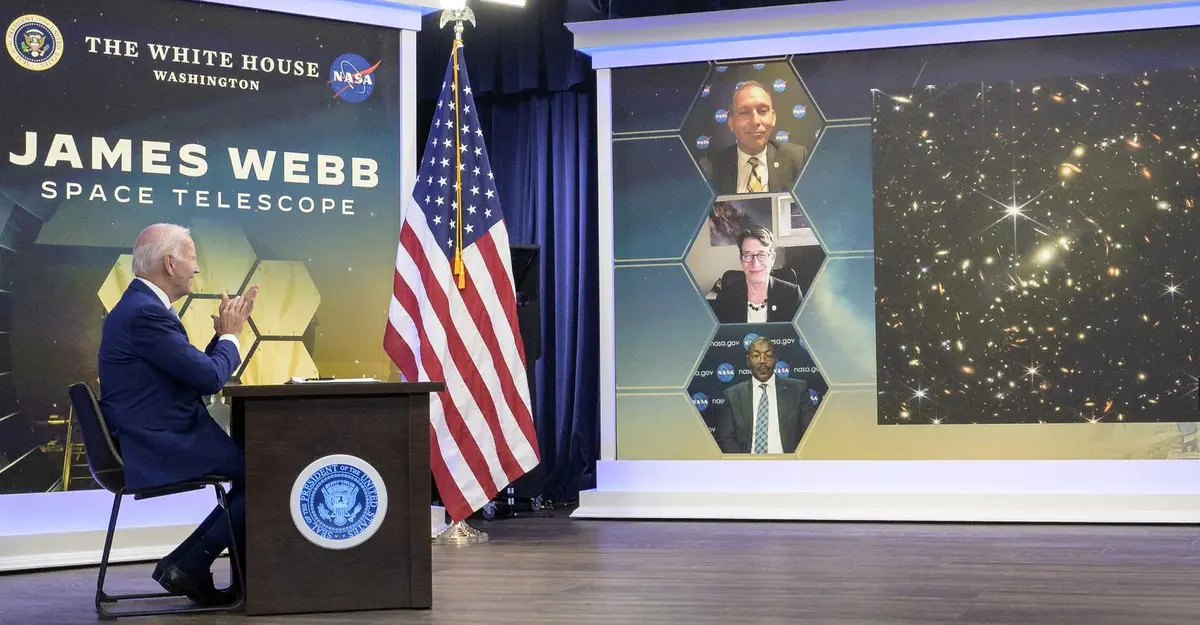
President Joe Biden applauds as Webb’s First Deep Field fills the screen at the White House, 11 July 2022. On screen are NASA’s Thomas Zurbuchen, STScI’s Nancy Levenson and Webb program director Greg Robinson.. NASA / Bill Ingalls. A new view of the cosmos
At NASA’s Goddard Space Flight Center the rest arrive. The Cosmic Cliffs of the Carina Nebula, where stars are being born. Stephan’s Quintet, a tight knot of galaxies in Pegasus. The Southern Ring Nebula around a dying star. And the clear signature of water in the air of WASP-96 b, a planet around another star. That evening the images light the screens of Times Square. “Absolutely thrilling!” says John Mather. “The equipment is working perfectly.”
Hear it
The builders

Physicist who won the 2006 Nobel Prize for measuring the Big Bang’s afterglow with NASA’s COBE satellite. Led Webb’s science team from 1995, twenty-six years before launch, and held the telescope to the job of finding the first galaxies.

Electrical engineer who wrote Hubble safing software in 1979 and ran Hubble operations. Took over Webb in December 2010, rebuilt its plan and schedule, put off retirement to see it through, and led the team through every deployment.

MIT physicist and former RCA antenna engineer who began working on Webb’s design in 1998. As lead systems engineer from 2004, he owned its requirements, design and testing, and tallied the 344 single points of failure it had to survive.

Lehigh-trained electrical engineer who ran satellite payload work on the Milstar and AEHF military programs. Led Northrop Grumman’s Webb team from 2009 until the observatory reached L2, building the spacecraft and sunshield and joining the whole observatory together.
By the numbers
In pictures


Watch, listen, see
Films, photographs and first-hand accounts from across the web. Each opens in a new tab.

NASA’s engineers walk through the 50 deployments and 178 release mechanisms that all had to work.
NASA Webb Telescope
NASA’s live broadcast of Webb’s launch from French Guiana on 25 December 2021.
NASA
NASA’s live reveal at Goddard of Webb’s first full-color images and data, 12 July 2022.
NASA
NASA’s tracker of the trip to L2, each deployment step and the long cooldown.
NASAProject manager Bill Ochs on the re-plan, the single-point failures and the last mirror wing.
NPR
Transcript of the 11 July 2022 White House briefing where President Biden revealed Webb’s first image.
The American Presidency Project
The first five releases: the deep field, Carina, Stephan’s Quintet, the Southern Ring and WASP-96 b.
NASA
NASA’s illustrated guide to how Webb folded into an Ariane 5 and unfolded itself in space.
NASA“These images are going to remind the world that America can do big things. And they’ll remind the American people, especially our children, that there’s nothing beyond our capacity.”
President Joe Biden, the White House, 11 July 2022
After
Webb is NASA’s mission, built with two partners. The European Space Agency launched it and supplied the NIRSpec instrument and half of MIRI. The Canadian Space Agency supplied the Fine Guidance Sensor that keeps it pointed. Thousands of people from 29 states and 14 countries built it. In 2023 the James Webb Space Telescope Team received the 2022 Robert J. Collier Trophy, America’s top prize in aeronautics and astronautics.
Since July 2022 Webb has found the most distant galaxies ever seen, the current record at about 280 million years after the Big Bang. It has read the chemistry of the air on planets around other stars. Astronomers around the world compete for time on it.
It still works from L2, a million miles out, where no crew can reach it. It never needed to be. Every deployment succeeded.
Primary sources
- NASA’s Webb Telescope Reaches Major Milestone as Mirror Unfolds. NASA, 8 January 2022.
- Sunshield Successfully Deploys on NASA’s Next Flagship Telescope. NASA, 4 January 2022.
- Remarks During a Briefing by NASA Officials To Preview the First Images From the James Webb Space Telescope, President Joseph R. Biden Jr., 11 July 2022.
Keep exploring
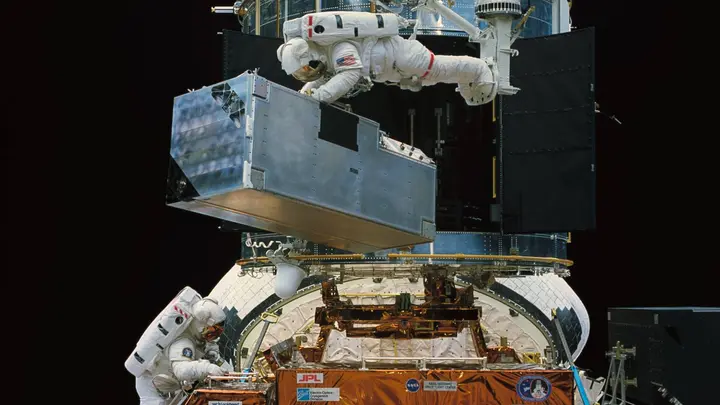
- Fixing HubbleThe telescope went up flawed. Astronauts caught it in orbit, gave it new eyes, and it showed us the universe.5spacewalks
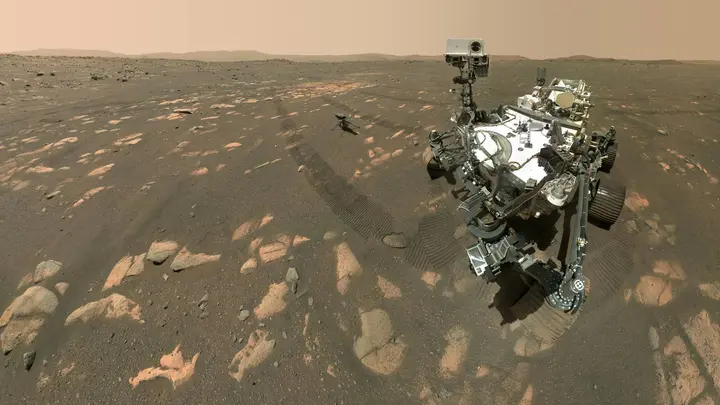
- First Flight on MarsA four-pound helicopter flew in air one percent as thick as Earth’s, 117 years after Kitty Hawk.39seconds in the air
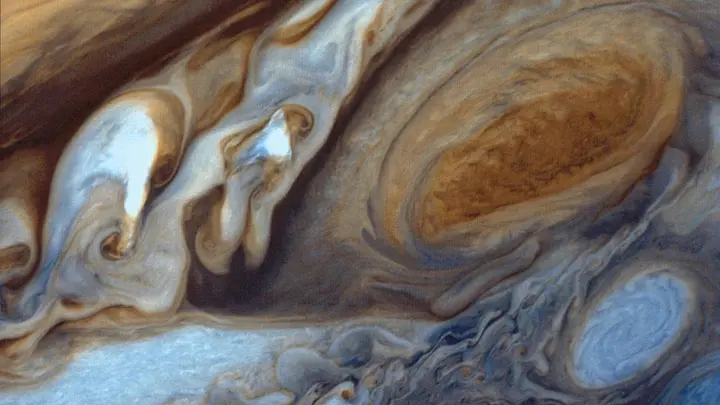
- VoyagerBetween them, two probes toured Jupiter, Saturn, Uranus and Neptune, then became the first human-made objects in interstellar space.16Bmiles and counting
- ColumbiaTwo astronauts flew a brand-new winged spacecraft into orbit on its first flight and landed it like an airplane.1streusable spaceship


Free, with no ads. Support the museum →