Starbase, Texas · 13 October 2024 · SpaceX Starship Flight 5
The Tower Has Caught the Rocket
Three rockets failed before the first one reached orbit. Sixteen years later, SpaceX caught a 233-foot booster in the arms of its launch tower.

The moment · About 07:32 CDT · 13 October 2024
Seven minutes after liftoff, Booster 12 falls back toward Texas. Its engines relight. It slows to a near hover beside the tower and slides sideways into place. The steel arms close around it. The engines shut down. The 233-foot booster hangs in the tower, caught on the first try.
Folks, this is a day for the engineering history books.Kate Tice, SpaceX engineering manager, on the launch webcast
For more than half a century, the first stage of an orbital rocket was almost always thrown away after one flight. Elon Musk founded SpaceX in 2002 to build rockets that come back and fly again. It took three failed launches, one last rocket and thirteen years to land the first booster. Nine years after that, the launch tower caught one.
Fourth time’s the charm
Three Falcon 1 rockets have failed. The first caught fire and fell 41 seconds after liftoff in 2006. The second spun out short of orbit in 2007. The third collided with its own upper stage in August 2008. Musk had budgeted for three attempts. He orders one more, and his team builds it from spare parts in about six weeks. From Omelek Island in the Pacific, it climbs, and 9 minutes 31 seconds later it is in orbit.
A contract for the station
Twelve weeks after Falcon 1 reaches orbit, NASA awards SpaceX 12 cargo flights to the International Space Station, worth about $1.6 billion. Gwynne Shotwell, who joined in 2002 to win customers, helped negotiate the deal and becomes president of the company that month. The cargo will ride inside a Dragon capsule on Falcon 9, a new rocket with nine Merlin engines.
The Falcon has landed
Falcon 9 lifts off from Cape Canaveral with 11 ORBCOMM satellites. After separation, the first stage flips over and relights its engines to fly back to the coast. It falls through the night, slows, unfolds four legs and touches down upright on Landing Zone 1, about six miles from the pad, about ten minutes after liftoff. No orbital booster has ever done this.
SpaceX launch webcastThe Falcon has landed.
Landing at sea
When a mission leaves a booster too little fuel to fly back to land, SpaceX parks a robotic drone ship far out in the ocean. Four landing attempts on the ship have ended in tipped-over boosters and fireballs. On the fifth try, after sending a Dragon cargo ship to the space station, the booster settles onto the deck of Of Course I Still Love You and stays standing.
Flown again
The booster that landed at sea in April, B1021, is inspected, refitted and stood up on Launch Complex 39A, the pad that launched Apollo 11. It sends the SES-10 communications satellite toward orbit, then lands on the drone ship a second time. No orbital-class booster has ever flown twice before. Reflown boosters soon become the normal way SpaceX flies.
Americans launch from America
Since the last Space Shuttle flight in 2011, NASA has bought seats on Russian Soyuz rockets to get its astronauts to orbit. Now NASA’s Bob Behnken and Doug Hurley strap into Crew Dragon on top of a Falcon 9 at Launch Complex 39A. Hurley borrows Alan Shepard’s words from 1961: “Let’s light this candle.” Nineteen hours later they dock at the space station. The booster lands on the drone ship.
Liftoff at Starbase
On the Texas Gulf coast near the Mexican border, all 33 Raptor engines light and the 397-foot Starship rises off its pad. It is the fifth test flight of the most powerful rocket ever built. The upper stage, Ship 30, separates and heads for space. Super Heavy Booster 12 flips around and fires its engines to fly back toward the tower it launched from.
Caught
SpaceX will try the catch only if thousands of checks on the booster and the tower pass and the flight director sends a manual command. They pass. The command goes. Booster 12 relights its engines, slows to a near hover beside the tower and slides sideways into place. The two steel arms SpaceX calls chopsticks close around it. The engines shut down. It hangs in the tower, caught on the first try.
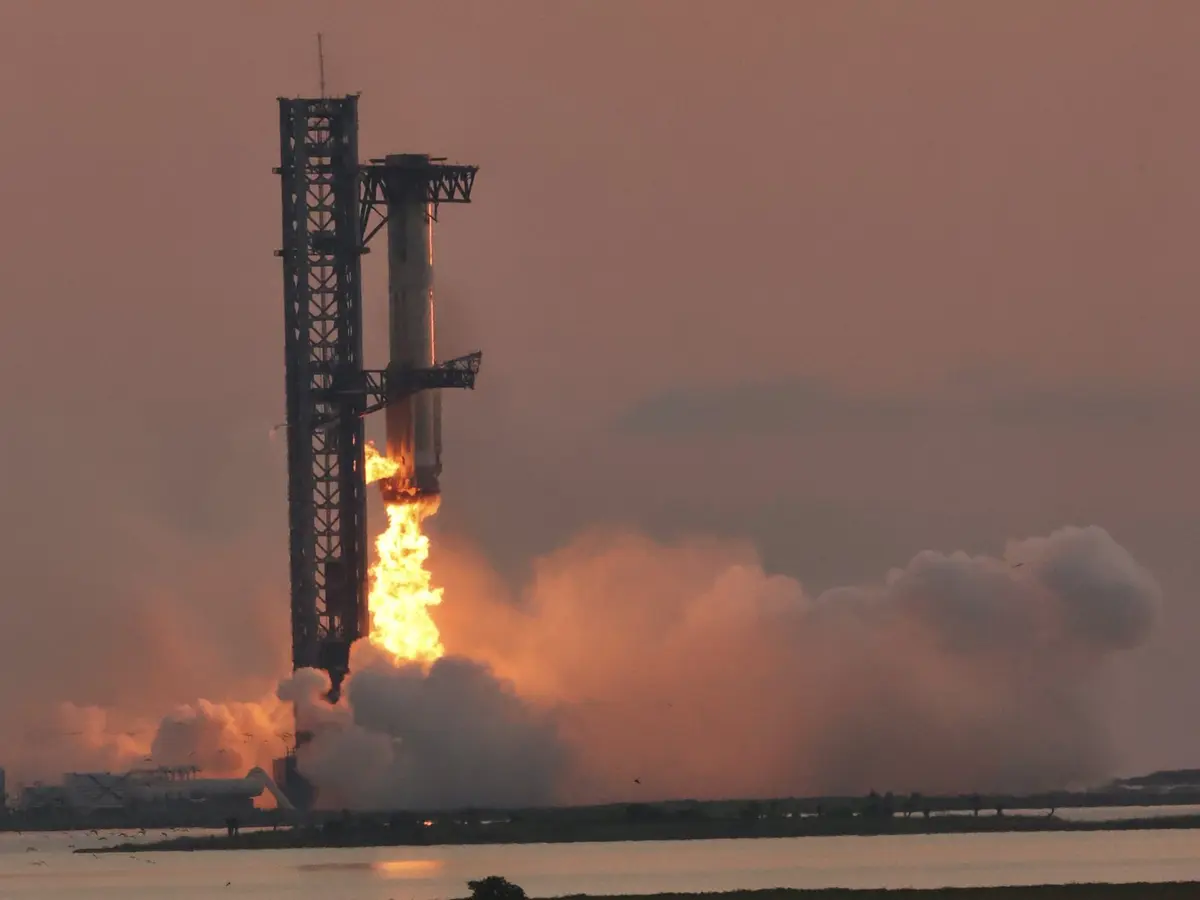
The tower’s arms close around Super Heavy Booster 12 as it returns to Starbase, 13 October 2024.. Steve Jurvetson. Kate Tice, on the SpaceX webcastFolks, this is a day for the engineering history books.
Splashdown on target
Ship 30 flies halfway around the world, survives the heat of reentry and steers itself down to a controlled splashdown in the Indian Ocean, about an hour after liftoff. It lands close beside a buoy SpaceX placed there to film it. Both stages have done what they were built to do. The same day, NASA Administrator Bill Nelson congratulates SpaceX on the catch.

The builders

Became an American citizen in 2002, the year he founded SpaceX with money from the sale of PayPal. Chief executive and chief engineer. Had about $100 million of his own in the company when he ordered a fourth Falcon 1 after three failures.

Northwestern mechanical engineer who spent ten years at The Aerospace Corporation. Joined SpaceX in 2002 to win its customers. Helped close NASA’s 2008 cargo contract and has run the company day to day as president ever since.

A logger’s son from St. Maries, Idaho, who built rocket engines in his garage. Became SpaceX employee No. 1 in 2002 and led the team that built the Merlin, the engine that took Falcon 1 to orbit and powers every Falcon 9.

Earned his doctorate in guidance and control at MIT, then worked at NASA’s Jet Propulsion Laboratory. Joined SpaceX in 2011 and took charge of entry, descent and landing for Falcon 9. His team built the guidance that steers each booster home.
By the numbers
In pictures


Watch, listen, see
Films, photographs and first-hand accounts from across the web. Each opens in a new tab.

SpaceX’s own cut of Flight 5, from liftoff at Starbase to the tower catching Booster 12.
SpaceX
SpaceX’s own reel of the crashes and fireballs it took to learn how to land an orbital booster.
SpaceX
The full December 2015 webcast: liftoff, eleven satellites to orbit and the first booster ever to land.
SpaceX
Footage of Falcon 1’s fourth flight from Omelek Island, the launch that put SpaceX in orbit.
SpaceX
Falcon 9 and Crew Dragon lift off with Behnken and Hurley, the first astronauts launched from Florida since 2011.
NASA Kennedy Space CenterSpaceX’s president on winning NASA’s trust, the cargo contract and building Falcon 9 and Dragon. Recorded in 2013.
NASA JSC Oral History Project
NASA’s history of the program that hired American companies to fly cargo to the space station.
NASA
Lars Blackmore, who led Falcon 9 landing at SpaceX, explains the guidance that brings boosters home.
National Academy of Engineering“Big step towards making life multiplanetary was made today.”
Elon Musk, 13 October 2024
After
The first booster ever to land never flew again. SpaceX test-fired it, then stood it upright outside company headquarters in Hawthorne, California, where it has been on display since August 2016.
The tower caught a second Super Heavy, Booster 14, in January 2025. In May that same booster flew again, the first Super Heavy to fly twice. On the Falcon side, reuse became routine: by August 2026 a single Falcon 9 booster, B1067, had flown 37 times.
Crew Dragon now carries NASA astronauts to the space station from Florida on a regular schedule, on boosters that have flown before.
Primary sources
- Starship Flight 5 mission summary. SpaceX, 13 October 2024.
- Gwynne Shotwell oral history. NASA Johnson Space Center Oral History Project, 15 January 2013.
- Commercial Orbital Transportation Services: A New Era in Spaceflight. NASA SP-2014-617, 2014.