Philadelphia, Pennsylvania · June 1752 · Benjamin Franklin
Lightning from the Sky
Benjamin Franklin proposed the test that showed lightning is electricity, flew a kite in a Philadelphia storm to repeat it, and then gave every house a rod to survive it.

The moment · June 1752 · A field near Philadelphia
Dark clouds build. Franklin has a silk kite in the air, a sharp wire a foot above its top, and a key tied where the silk ribbon meets the twine. He stays under cover to keep the ribbon dry. Rain wets the string. Then the key answers his knuckle.
you will find it stream out plentifully from the Key on the Approach of your Knuckle.Benjamin Franklin, Pennsylvania Gazette, 19 October 1752
In the 1740s electricity was the great mystery of the age. It made sparks in drawing rooms and nobody could say what it was. Lightning looked the same, but no one had proved it. Franklin, a Philadelphia printer, wrote down a test. Two years later it worked in France and in Pennsylvania, and he had a rod to put on every roof.
A mystery in a glass tube
Electricity is the age’s great puzzle. Around 1745 Peter Collinson, a London merchant and Fellow of the Royal Society, sends the Library Company of Philadelphia a glass tube and directions for using it. Franklin takes it up. In 1748, at 42, he retires from printing to give his days to science. With his friends Ebenezer Kinnersley, Thomas Hopkinson and Philip Syng, he builds the experiments that make him famous.
The sentry box
Franklin writes Collinson a test. Put a man in a sentry box on a tall steeple, standing on an insulated stand. From the stand, run a pointed iron rod 20 or 30 feet into the sky. If a storm cloud is electric, the rod will draw sparks to his knuckle. Nobody has tried it. Franklin has put the question where anyone with an iron rod can answer it.
A book from Philadelphia
Collinson gathers Franklin’s letters, and the London printer Edward Cave publishes them as Experiments and Observations on Electricity, made at Philadelphia in America. The book is a hit. In time it is translated into French, German, Italian and Latin. At the urging of the naturalist Buffon, the French naturalist Thomas-François Dalibard prepares the French edition in 1752.
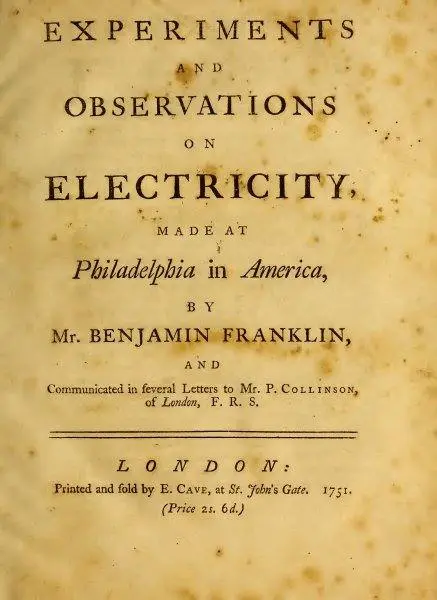
Title page of Experiments and Observations on Electricity, made at Philadelphia in America, London, 1751. E. Cave, printer. The sentry box at Marly
In his garden near Paris, Dalibard has built Franklin’s test: a pointed iron rod about 40 feet tall, set on wine bottles for insulation, with a sentry box beside it. A storm rolls in. His helper Coiffier, a former dragoon, holds a brass wire to the rod. A spark jumps and smells of sulfur. The local priest, Raulet, repeats it several times.
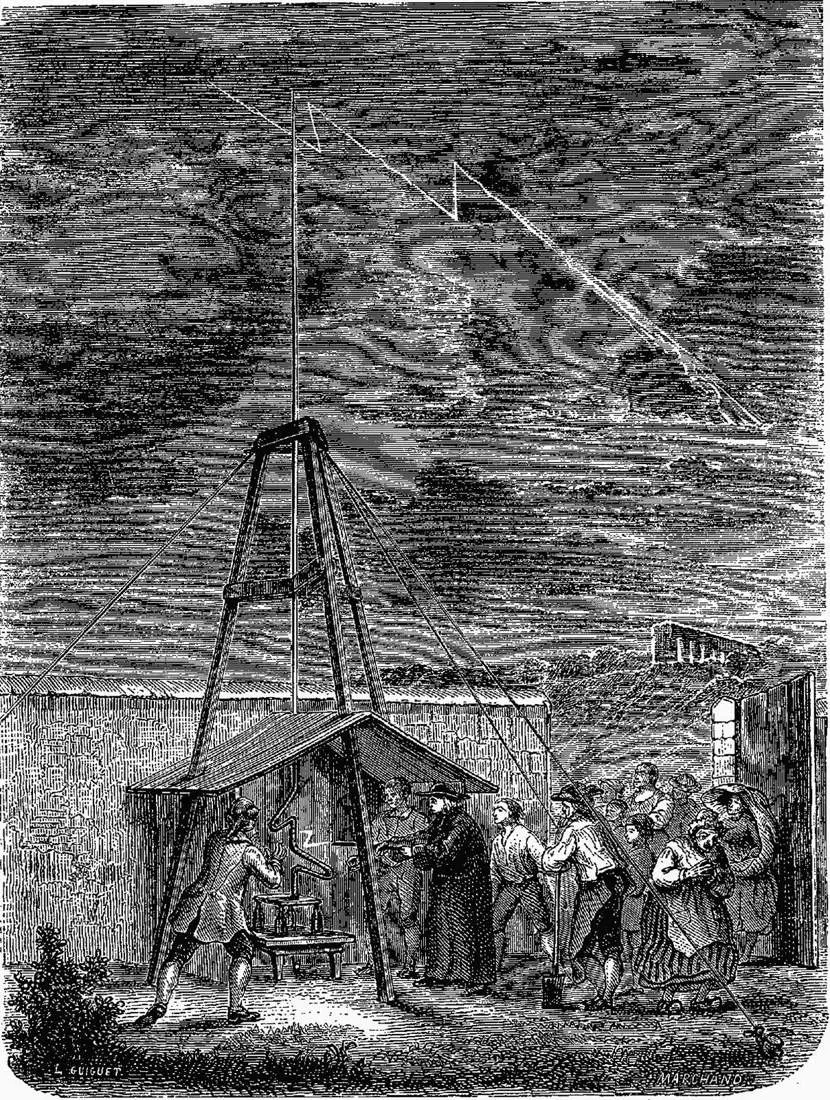
Dalibard’s iron rod and sentry box at Marly-la-Ville, 10 May 1752, with the crowd watching: wood engraving from Louis Figuier, 1867. Louis Figuier, Les merveilles de la science (engraving by L. Guiguet). Paris confirms it
Dalibard reports the Marly result to the Académie des Sciences three days later. On 18 May his collaborator Delor repeats the test in Paris. Both men say they have only followed the path Franklin traced. Word crosses the Channel and the Atlantic. Franklin’s idea, written down in Philadelphia in 1750, has now drawn fire from a French sky.
The kite
Franklin has no steeple, so he builds a kite of silk and cedar with a sharp wire at the top. Joseph Priestley wrote in 1767 that Franklin took his son and went out to a field at the first approaching storm. The kite draws a charge from the clouds, the twine bristles, and the key gives sparks. The silk ribbon stays dry. Franklin sets down the method that October.
Franklin, Pennsylvania GazetteAs soon as any of the thunder clouds come over the kite, the pointed wire will draw the electric fire from them, and the kite, with all the twine, will be electrified, and the loose filaments of the twine will stand out every way, and be attracted by an approaching finger.
The letter
Franklin writes to Collinson in London and the Pennsylvania Gazette prints the same account on 19 October. It gives the method, step by step, so that anyone can repeat it. It does not say who flew the kite on which day. Priestley supplies that fifteen years later. The method is enough. Experimenters on both sides of the Atlantic can now do what Franklin did.
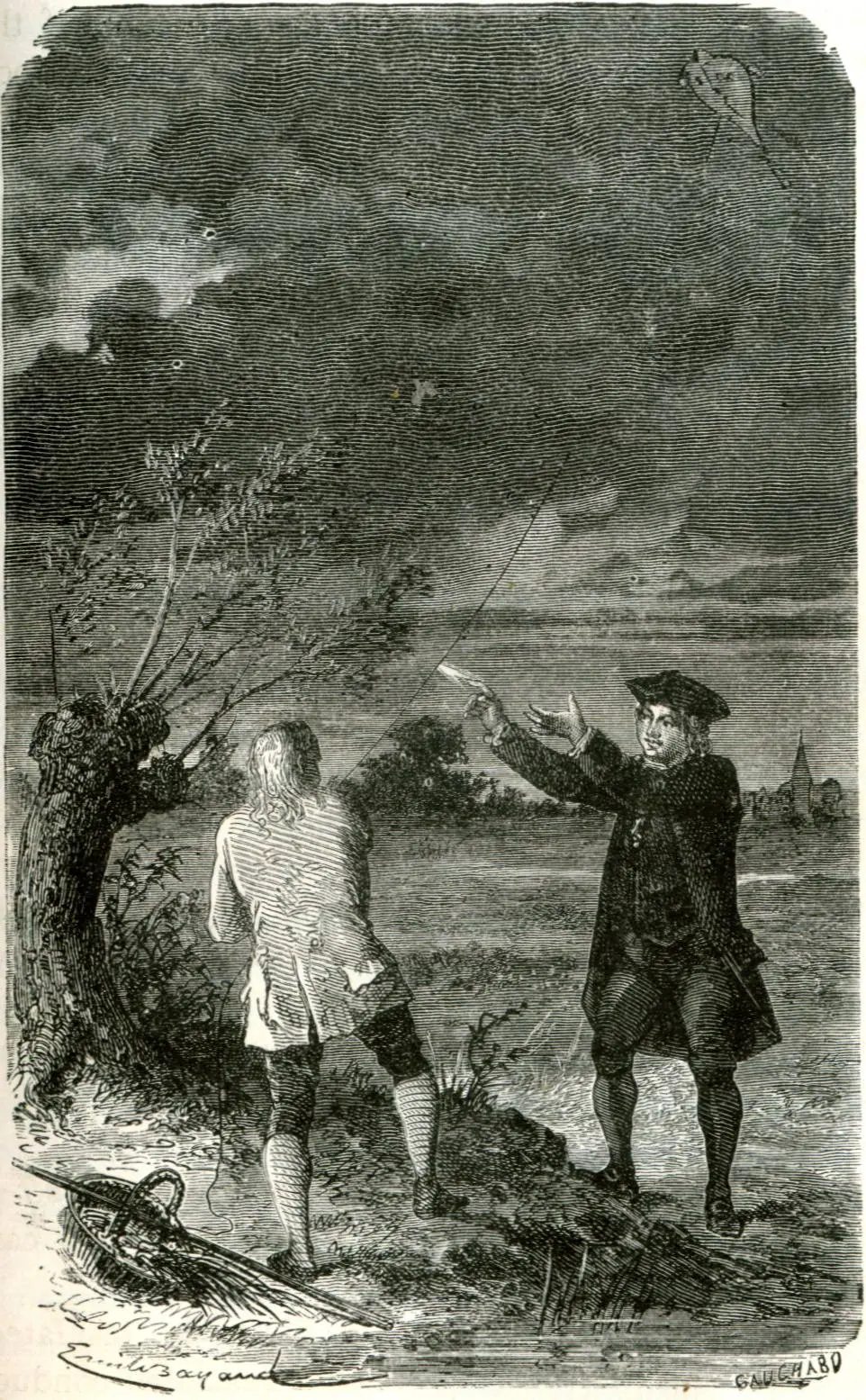
Franklin’s kite in a storm: engraving from Natural Philosophy for Common and High Schools, 1881. Le Roy C. Cooley. A rod for every roof
Franklin fits a pointed iron rod to his own house. Then he writes the plan for everyone else in Poor Richard Improved for 1753, the almanac he publishes every year. A rod of nailer’s iron, six or eight feet above the roof, with a sharpened brass tip, runs down three or four feet into moist ground. The lightning follows the metal into the earth.
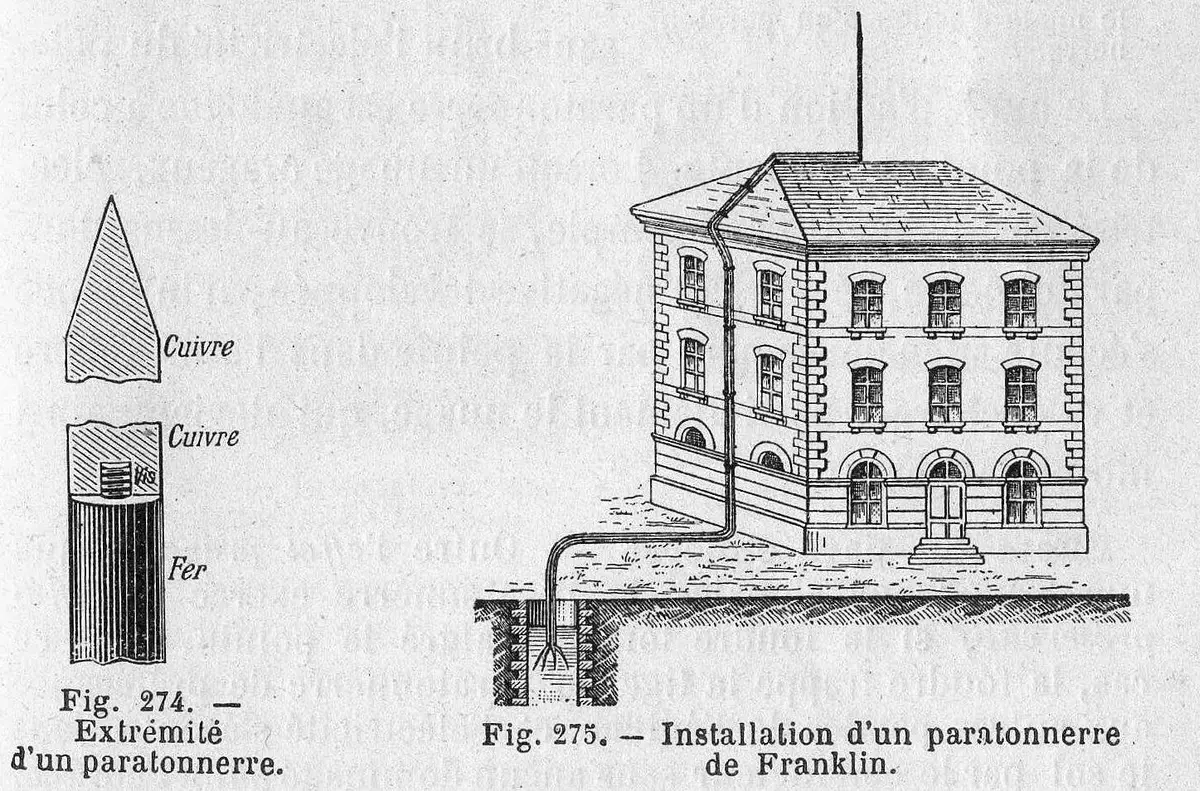
A Franklin lightning rod: the pointed copper tip, and the rod run down beside a house into the earth. Gillard (illustration after Louis Figuier). Poor Richard Improved, 1753A House thus furnished will not be damaged by Lightning, it being attracted by the Points, and passing thro the Metal into the Ground without hurting any Thing.
The Copley Medal
The Royal Society awards Franklin its Copley Medal for his curious experiments and observations on electricity. Harvard and Yale give him honorary degrees the same year. In 1756 the Royal Society elects him a Fellow. A Philadelphia printer has become a name in every European laboratory.

The experimenters

Born in Boston in 1706, he retired from printing at 42 to study electricity. He proposed the sentry-box test, flew the kite in June 1752 and wrote the 1753 rod instructions. The Royal Society gave him its Copley Medal that year.

A Paris botanist who put Franklin’s book into French in 1752. On 10 May he had Franklin’s sentry-box test run at Marly-la-Ville. Three days later he told the Académie des Sciences that lightning is electric.

A cloth merchant and plant collector who sent Philadelphia its first electrical tube. He carried Franklin’s letters to London’s learned world, helped get them printed in 1751, and passed on the kite letter that December.

Priestley’s account of the kite says Franklin took his son along to raise it. William later read law in London and was appointed governor of New Jersey in 1762.
By the numbers
In pictures


Watch, listen, see
Films, photographs and first-hand accounts from across the web. Each opens in a new tab.

The Philadelphia museum explains how the kite, key and Leyden jar worked, and what Franklin proved.
The Franklin InstituteA PBS documentary clip on Franklin’s observations and experiments on electricity.
PBSThe Pennsylvania Gazette of 19 October 1752, in the Papers of Benjamin Franklin.
Founders Online
The almanac that told colonists how to put a rod on a house.
Founders Online
The letter on the electrical kite as it reached the Royal Society in London.
Royal Society
The digitized book of Franklin’s letters that made his name in Europe.
Smithsonian Libraries
The society Franklin founded shows his first edition and Leyden jars in an online exhibit.
American Philosophical Society
Independence National Historical Park on Franklin’s electricity work and his lightning rod.
National Park ServiceRead it
How to secure Houses, &c. from Lightning216 words · Full text
It has pleased God in his Goodness to Mankind, at length to discover to them the Means of securing their Habitations and other Buildings from Mischief by Thunder and Lightning. The Method is this: Provide a small Iron Rod (it may be made of the Rod-iron used by the Nailers) but of such a Length, that one End being three or four Feet in the moist Ground, the other may be six or eight Feet above the highest Part of the Building. To the upper End of the Rod fasten about a Foot of Brass Wire, the Size of a common Knitting-needle, sharpened to a fine Point; the Rod may be secured to the House by a few small Staples. If the House or Barn be long, there may be a Rod and Point at each End, and a middling Wire along the Ridge from one to the other. A House thus furnished will not be damaged by Lightning, it being attracted by the Points, and passing thro the Metal into the Ground without hurting any Thing.
Vessels also, having a sharp pointed Rod fix’d on the Top of their Masts, with a Wire from the Foot of the Rod reaching down, round one of the Shrouds, to the Water, will not be hurt by Lightning.
Poor Richard Improved, 1753, the almanac Franklin printed in Philadelphia in the autumn of 1752 · Source
“It has pleased God in his Goodness to Mankind, at length to discover to them the Means of securing their Habitations and other Buildings from Mischief by Thunder and Lightning.”
Benjamin Franklin, Poor Richard Improved, 1753
After
The word went to London fast. Collinson read the kite letter to the Royal Society on 21 December 1752, and its Philosophical Transactions printed it. On 30 November 1753 the Society gave Franklin the Copley Medal for his experiments on electricity. Harvard and Yale gave him honorary degrees that year. The Royal Society made him a Fellow in 1756.
Rods went up on houses, barns, churches and ships. Franklin had one on his own house on High Street, now Market Street, in Philadelphia. He never patented the rod. He published the instructions free in an almanac that sold across the colonies.
His fame went with it. Kant called him the Prometheus of modern times. In 1778 the French statesman Turgot gave him a line that was printed under his portraits: “He seized the lightning from the sky and the scepter from tyrants.” Franklin was the best-known American scientist in Europe, and he had done it from Philadelphia.
Primary sources
- Benjamin Franklin, account of the electrical kite, Pennsylvania Gazette, 19 October 1752. The Papers of Benjamin Franklin, vol. 4, Founders Online, National Archives.
- Benjamin Franklin, “How to secure Houses, &c. from Lightning,” Poor Richard Improved, 1753. The Papers of Benjamin Franklin, vol. 4, Founders Online, National Archives.
- Joseph Priestley, The History and Present State of Electricity (London, 1767), account of Franklin’s kite.
Keep exploring
- Smallpox InoculationDr. Zabdiel Boylston inoculated Boston against smallpox in 1721, and his careful count of every patient showed the method saved lives.1 in 40died after inoculation, vs. 1 in 7 naturally
- The DeclarationFifty-six men signed their names to treason against the Crown and pledged their lives, fortunes and sacred honor.56signers
- The Zenger TrialA New York jury acquitted printer John Peter Zenger of seditious libel in 1735, and the case became the seed of a free American press.8 monthsin jail, then a jury said no
- Edison Lights New YorkEdison made a bulb that lasted, then built the power station, wires and meters to light a city with it.400lamps lit the first night


Free, with no ads. Support the museum →